Vietnamese tea culture is easy to encounter and easy to misunderstand. A small glass of green tea may appear at a family table, after a meal, during a business conversation, or beside a long chat with friends. It is not always a formal ceremony, yet it can still carry the warmth of an invitation and the quiet rhythm of hospitality. For visitors, the best approach is not to perform a perfect ritual. It is to notice what the host is doing, accept the moment with appreciation, and let the household lead.
This guide explains how Vietnamese tea customs work in everyday life, what to do when tea is offered, how formal and informal settings differ, and how to take part without turning a personal welcome into a staged photo opportunity. It also connects tea to Vietnam’s wider traditions of craft, family, festivals, and place.
Why tea matters in Vietnamese daily life
Tea is both ordinary and meaningful in Vietnam. The official Vietnam Tourism account of the historic 1927 Tea Factory in Bao Loc describes tea as part of everyday life, business meetings, weddings, meals, and conversations between friends. That range is important: Vietnamese tea culture is not limited to a single ceremony or a luxury tasting room. It lives in repeated, familiar acts of offering, pouring, pausing, and talking.
The same source presents tea as connected to Vietnam’s history and economy as well as its social life. The story of tea therefore has two sides. One is intimate: a host brings out a pot because guests have arrived. The other is regional: plantations, processing, utensils, labor, and trade have shaped communities over generations. A thoughtful traveler can hold both ideas at once.
Tea also creates a useful pace for cultural travel. A cup gives people a reason to sit rather than rush through a checklist. That slower attention pairs naturally with the site’s guide to planning a cultural trip that leaves room to listen. When tea is offered, the invitation may be less about the drink itself than about making time for a relationship.
What happens when a host offers you tea
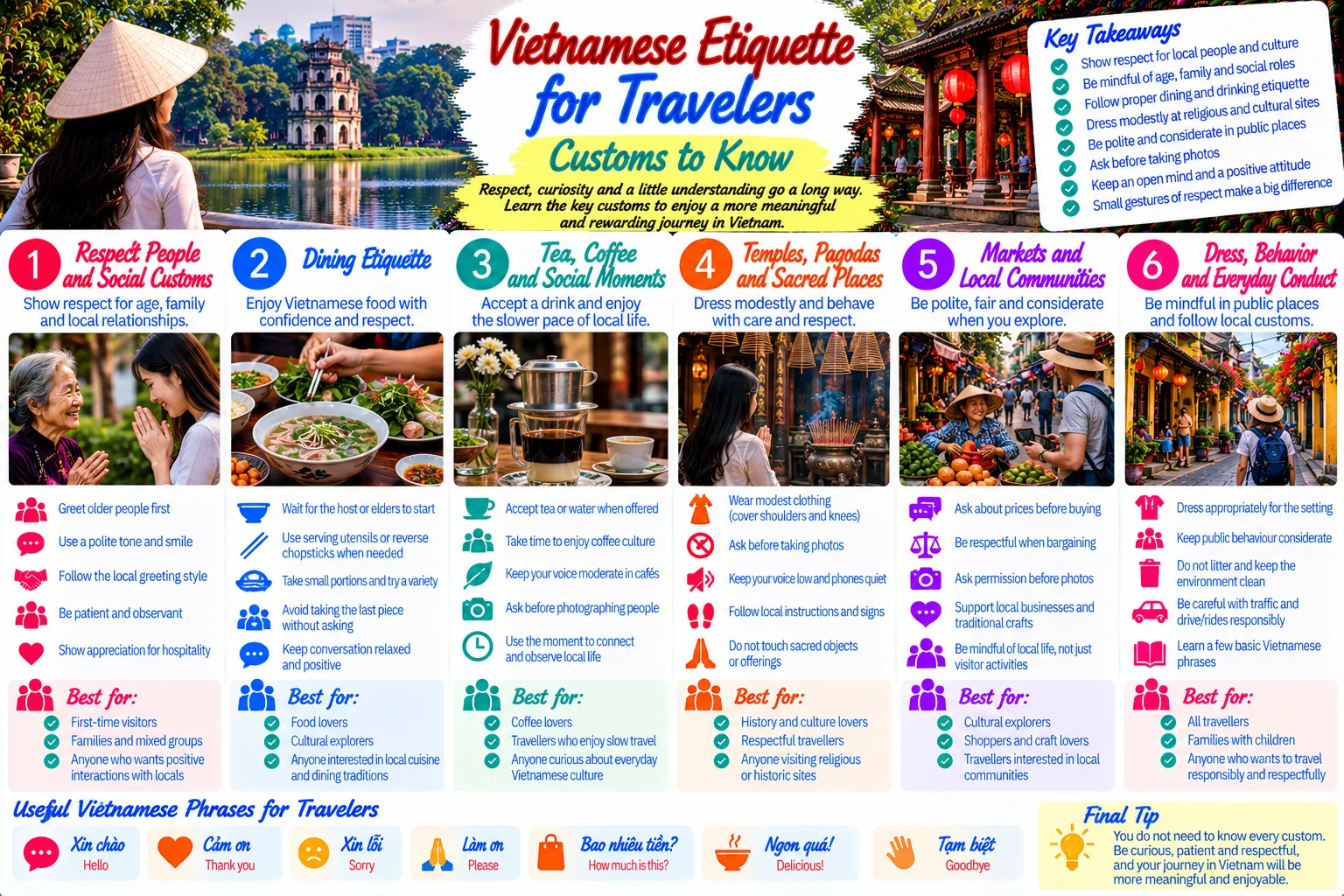
In most informal situations, the correct response is simple: acknowledge the offer, accept if you would like some, and drink at a comfortable pace. You do not need to know the name of the tea or identify every utensil. A smile, a thank-you, and attention to the host are more valuable than technical knowledge.
A practical sequence for visitors
- Pause and make eye contact when the tea is offered.
- Say thank you, or use a warm gesture if language is limited.
- Watch whether others wait before drinking and follow the group’s pace.
- Hold a small cup carefully and take a first sip rather than emptying it quickly.
- Let the conversation continue; silence is not necessarily awkward.
Do not assume that a full cup means you must drink everything immediately. Tea may be poured several times, and the host may be more interested in keeping the conversation comfortable than in measuring your consumption. If you do not want more, a polite verbal response or a small hand gesture is usually enough. If you have dietary, medical, or caffeine concerns, explain them plainly instead of accepting and then feeling uncomfortable.
In a family home, the person pouring may be a host, an elder, or simply the person nearest the teapot. Avoid treating that person as a performer. Thank them directly and allow the gathering to remain a gathering.
Tea etiquette in homes, cafés, and guest settings
The setting changes the meaning of the invitation. In a home, tea is often part of welcoming visitors into an existing routine. In a café, it may be a beverage order with its own menu and preparation style. At a workshop, heritage property, or homestay, the tea may be a bridge between a visitor and a local story.
In a Vietnamese home
Follow the household’s lead about where to sit, when to begin, and whether shoes should be removed. These details vary by home, so observation is better than assuming one national rule. If older relatives are present, allow them to settle first and avoid interrupting their conversation. A home visit is not a museum tour: ask before photographing people, family objects, or the tea setup.
At a café or tea house
Ask what is included before ordering if the menu is unfamiliar. Some places emphasize a single pot shared by a group; others serve individual drinks. Taste, strength, temperature, and sweetness can vary. Do not judge a tea by comparing it with a drink from another region. If you want to learn, ask where the tea comes from, how it is prepared, and whether the staff recommend drinking it plain.
At a homestay or cultural activity
Listen to the explanation, but do not turn every local person into an unpaid guide. A good question is specific and open: “Is this tea usually served at home?” or “When would your family drink this?” Avoid asking one person to speak for all of Vietnam. Customs differ by region, generation, family, and community.
For more ideas about choosing experiences that respect local knowledge, see how to choose a cultural workshop that gives back. The same principle applies to tea: value the relationship and the labor behind the experience, not only the finished cup.
How formal Vietnamese tea ceremonies differ
Travelers sometimes search for “Vietnamese tea ceremony etiquette” as if there were one universal script. There is not. Formal tea gatherings can draw on family practice, regional habits, religious settings, wedding customs, artistic presentation, or contemporary hospitality businesses. A ceremony arranged for visitors may be carefully choreographed, while an intimate family gathering may be formal in feeling but relaxed in technique.
In a more formal setting, wait for the host or tea server to indicate where to sit and when to taste. Keep your movements unhurried. Do not reach across the tray, rearrange cups, or handle a pot without permission. If the host demonstrates a way to hold or receive a cup, copy the movement as closely as you can without exaggerating it.
Formal does not mean silent. Questions are welcome when the host has made space for them. Ask about the tea’s origin, the vessel, or the reason for a particular step. Avoid demanding a performance of “authenticity.” Traditions change, and many contemporary tea experiences deliberately combine older practices with modern design.
Tea, elders, family, and the language of respect
Tea can mark relationships within a family. Who pours first, who is invited to sit, and who leads a conversation may reflect age and familiarity. Visitors do not need to decode every relationship, but they should avoid behaving as if everyone at the table has the same role.
Use respectful forms of address when they are offered, and ask your host how to address older relatives. If you are unsure, a courteous greeting and attentive posture are safer than using a first name casually. Do not make jokes about age, family hierarchy, or a person’s accent while everyone is drinking.
When tea is served at a celebration, the gathering may have an emotional or ceremonial purpose beyond refreshment. Weddings, New Year visits, and family reunions can involve greetings and offerings that are meaningful to the people present. If you are invited to join, wait for instructions and keep photographs discreet. The guide to experiencing a Vietnamese festival as a visitor offers a useful wider lesson: participation begins with observing the rhythm of the event.
Tea utensils, craft, and the stories behind a cup
A tea experience can reveal Vietnam’s craft traditions as much as its drinking habits. A pot may be plain, inherited, locally made, or chosen for its shape and handling. Cups can be part of a family set. Trays, baskets, ceramics, textiles, and carved furniture may all carry regional or personal associations.
Handle unfamiliar objects gently and ask before touching anything displayed as a collection. The country’s craft traditions are diverse, and a village workshop is not interchangeable with a souvenir stall. Vietnam Tourism’s overview of traditional silk villages describes places where visitors can watch processes passed through generations, from raising silkworms to weaving and dyeing. That attention to process is a helpful model for tea travel too: ask how leaves are grown, picked, processed, stored, and prepared.
You can continue that curiosity through the site’s Traditional Craft Villages category, where material culture and living skills take center stage. Tea is not isolated from these traditions. The cup, the tray, the woven cloth, and the place where people sit can all be part of the experience.
How to taste Vietnamese tea respectfully
You do not need specialist vocabulary to taste tea well. Start with the overall impression: is it light or strong, fresh or roasted, sweet, grassy, floral, bitter, or smoky? Notice how the flavor changes as the tea cools. Then ask a question based on what you actually experienced.
- Take a small sip before adding sugar or other ingredients.
- Notice whether the tea is intended for repeated short infusions or one larger serving.
- Describe your preference honestly without calling an unfamiliar flavor “bad.”
- Ask whether the tea is associated with a particular region, season, or occasion.
- Buy only what you can carry and use; a small purchase can be more thoughtful than a rushed haul.
Vietnam has many tea-growing areas and styles, so avoid treating one cup as representative of the whole country. A tea from a northern mountain community, a highland plantation, and an urban tea house may be prepared differently. If a seller makes a claim about origin or production, listen, ask for details, and avoid repeating a sweeping claim unless you can verify it.
Common mistakes visitors can avoid
The most common mistake is turning etiquette into a test. People sometimes worry about holding the cup incorrectly, using the wrong hand, or missing an invisible sequence. In everyday settings, warmth and awareness matter more than perfection. Watch, follow, and ask.
Another mistake is photographing the tea before acknowledging the people who offered it. Take the social moment first. Ask permission before photographing a host, elder, artisan, or private home. Do not place a phone between people during a conversation simply to capture a pour.
A third mistake is assuming every “tea ceremony” marketed to travelers represents a single ancient national tradition. Experiences vary in purpose and design. Some are family-based, some educational, some commercial, and some connected with performance or ceremony. Treat the host’s explanation as the starting point, not as proof that all Vietnamese people do the same thing.
Finally, do not compare local customs competitively. Tea culture is not a contest between countries or regions. Comparisons can be useful when they open a conversation, but they become disrespectful when they turn a host’s practice into a novelty.
Planning a tea-centered cultural experience
A tea-focused visit works best when it has a clear human connection. Look for a place where someone can explain the tea’s context, not only sell a tasting. A plantation, historic factory, family-run tea house, craft village, cooking school, or cultural center may each offer a different perspective. Confirm current opening details and booking requirements directly with the venue before traveling; schedules and access can change.
Build time around the experience rather than squeezing it between unrelated stops. Leave room for conversation, and learn a few Vietnamese words for thanks and greetings. If you are visiting with children, explain that the tea table is a social space and that asking before touching is part of being a considerate guest.
For a broader itinerary, browse the site’s Cultural Travel Experiences category and pair tea with a museum, heritage site, festival, or workshop. You can also explore everyday Vietnamese customs visitors can meet with care before your trip. The goal is not to collect rituals. It is to understand how ordinary gestures create belonging.
Conclusion: let the cup slow you down
Vietnamese tea culture rewards patience. A host may be offering a drink, but they may also be offering time, conversation, and a place in the room. Accept the cup with gratitude, observe before acting, ask thoughtful questions, and remember that customs change across households and regions.
The most respectful visitor is not the one who performs every gesture flawlessly. It is the one who notices the people, the labor, and the setting behind the tea—and leaves the encounter with more curiosity than certainty.
JOIN THE CONVERSATION
Comments (0)
No comments yet. Be the first to share a thought.