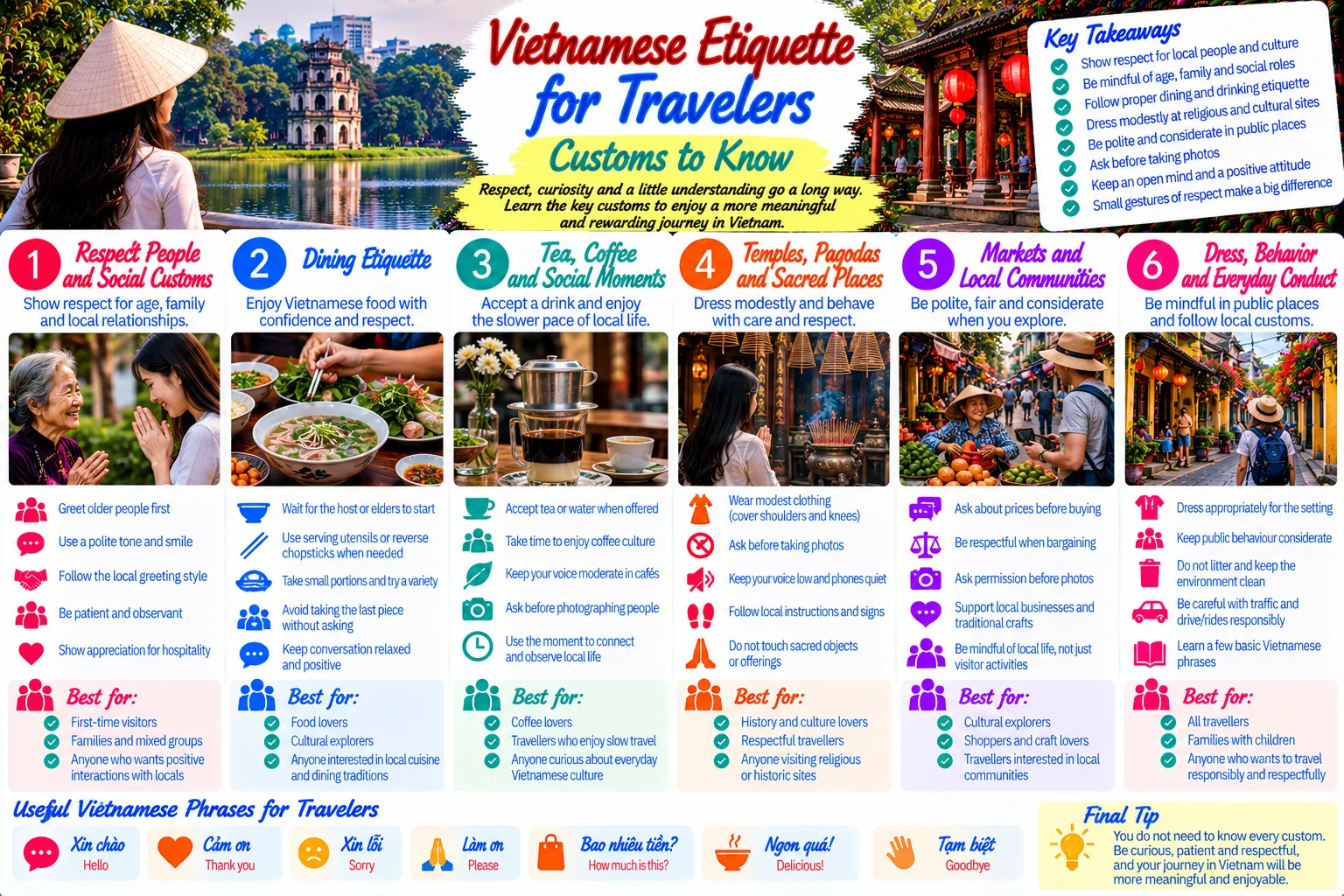
Vietnamese customs are easiest to understand when they appear in ordinary moments: a host making room at the table, an older relative being greeted first, shoes paused at a doorway, or a visitor waiting before taking a photograph. For travelers, the goal is not to perform a perfect version of Vietnamese etiquette. It is to notice relationships, ask when unsure, and let the people around you set the pace. This guide focuses on visiting a Vietnamese home, sharing food, meeting elders, and participating respectfully in everyday life.
Begin with the relationship, not a checklist
Vietnamese etiquette is not one rigid national rulebook. Customs vary between families, regions, generations, religions, and urban or rural settings. A practice that feels formal in one household may be relaxed in another. That is why the most useful approach to Vietnamese culture for tourists is attentive flexibility.
If you are invited somewhere, clarify the context without making the host feel tested. Ask whether it is a casual visit, a family meal, a celebration, or a religious occasion. Ask what time would be convenient, whether you should bring anything, and whether there is anything you should know before entering. These small questions communicate respect more clearly than memorizing a long list of taboos.
Vietnam’s official tourism guidance presents cultural travel as something learned through immersion rather than simply observed from outside. That idea matters in a home or neighborhood: you are a guest in someone’s lived space, not an audience at a staged performance. If you are planning a wider cultural itinerary, pair this slower approach with planning a cultural trip that leaves room to listen.
What to do when visiting a Vietnamese home
Arrive prepared to follow the household
Wear clean, comfortable clothing that allows you to adjust to the setting. A private home may be informal, but a family with a home altar, a conservative household, or a meal connected to a ceremony may appreciate more modest dress. Avoid assuming that tourist-casual clothing is suitable everywhere. When in doubt, choose covered shoulders and a longer hem, especially if the visit may include a temple, pagoda, ancestral space, or formal family gathering.
At the entrance, pause and watch. Some homes ask visitors to remove shoes; others do not. Do not step over objects, move footwear, or enter a room ahead of the host without checking. If you see a raised threshold, altar, offering table, or carefully arranged family display, treat it as meaningful rather than decorative.
A warm greeting can be simple. Smile, make eye contact when appropriate, and use the host’s preferred form of address. Vietnamese pronouns and kinship terms can reflect age and relationship, so it is perfectly reasonable to ask what you should call someone. A host will usually appreciate the question more than an uncertain attempt at a title.
Bring a thoughtful, low-pressure gift
When visiting a Vietnamese home, a modest gift is often a considerate gesture, particularly if the invitation is for a meal or a special occasion. Choose something easy to share: fruit, sweets, tea, flowers, or a small specialty from your home. The point is not price. A useful gift gives the host freedom to serve it later rather than creating an obligation to use it immediately.
Do not turn gift giving into a cultural test. You do not need to guess a perfect symbolic object, and you should not make confident claims about what a color, number, or item “always” means across Vietnam. If the host says you did not need to bring anything, accept the welcome graciously instead of arguing about the gift. If you are unsure about flowers, alcohol, or food, ask a local friend or your host beforehand.
Understand the Vietnamese meal as a shared activity
Meals are among the clearest ways visitors encounter Vietnamese family customs. Food may arrive in shared dishes placed in the center of the table, with rice, soup, vegetables, and other dishes forming a common meal. The social rhythm matters as much as what is served: people may encourage one another to eat, offer dishes across the table, and pay attention to older guests or visitors.
How to participate respectfully
- Wait for the host to indicate where to sit and when to begin.
- Take a modest portion first, especially when you are trying an unfamiliar dish.
- Use serving utensils when they are provided, and watch how the household shares food.
- Accept an offer warmly, but explain dietary restrictions clearly and early.
- Compliment what you genuinely enjoy without insisting that every dish suits you.
In many homes, refusing everything can make a host worry that you are uncomfortable, while accepting more than you can eat can create waste. A friendly middle path works best: try what you can, say what you need, and leave room for the meal to continue. If you are vegetarian, vegan, allergic, diabetic, or avoiding a particular ingredient, do not rely on a vague gesture. Use a translation card or a clear Vietnamese phrase prepared in advance.
Table manners are also about awareness. Do not reach across someone when you can wait or ask for a dish to be passed. Keep conversation open and let the host explain unfamiliar food. A meal can become a conversation about family history, local ingredients, migration, religion, or regional taste. Listen rather than turning the table into a comparison with food from home.
Give elders and family spaces the respect they deserve
Respect for age and family relationships is a central theme visitors may notice in Vietnam, but it should not be reduced to a stereotype. In practice, this means paying attention to who is being welcomed, who is speaking, and how the household organizes a gathering. A younger person may invite an older relative to begin, choose a seat, or speak first. You do not need to imitate every gesture; you do need to avoid treating elders as background scenery.
When introduced to an older family member, offer a calm greeting and let the family guide the level of formality. If a host gives you a kinship term, use it carefully. Ask for repetition if pronunciation is difficult. A sincere attempt and a willingness to learn are usually better received than an exaggerated performance.
Home altars and ancestral spaces require particular care. They may be located in a visible room, but visibility does not make them public. Do not touch offerings, move objects, lean on an altar, or photograph it without permission. If a family is observing a ritual, wait for an invitation before approaching. The respectful question is simple: “May I take a photo?” If the answer is no, accept it without asking for a reason.
For more context on sacred settings beyond the home, read visiting temples and sacred places respectfully. The same principle applies: observe first, follow local direction, and do not confuse access with entitlement.
Photography, conversation, and personal space
Ask before making a moment permanent
Photographs can be a generous way to remember a visit, but they can also change the atmosphere. Ask before photographing people, especially children, older relatives, meals in progress, religious objects, workspaces, or private rooms. A host may happily invite photographs once they understand what you want. If someone turns away, covers their face, or says no, lower the camera and continue the visit normally.
Do not assume that a public street, market stall, or village courtyard is automatically permission to photograph every person there. A wide scene may be less intrusive than a close portrait. Showing a person the image afterward can be a considerate way to build trust, but it does not replace asking.
Let conversation develop naturally
Visitors are often asked about their age, family, work, marriage, or travel plans. These questions can feel personal in English-speaking cultures, yet may function as friendly conversation or a way to establish social context. You can answer briefly, redirect, or say that a subject is private. There is no need to disclose more than you want.
Return the curiosity. Ask about a dish, a neighborhood tradition, a family recipe, a craft, or how a celebration is prepared. Avoid treating one person as a spokesperson for all Vietnamese people. Vietnam contains major regional and ethnic diversity, and a household’s customs belong to that household before they become material for a traveler’s story. The site’s guide to ethnic diversity in Northern Vietnam is a useful reminder to keep cultural claims specific.
How to behave at festivals, ceremonies, and community events
Everyday Vietnamese customs become more visible during holidays, ancestor-related observances, weddings, funerals, and neighborhood festivals. These events can be welcoming, but they are not automatically entertainment for outsiders. Find out whether you are attending as an invited guest, a customer, a participant, or an observer.
Dress more conservatively than you might for a sightseeing day. Keep your voice low near prayer or ritual, follow instructions about where to stand, and avoid blocking processions or ceremonial actions. Do not handle offerings, costumes, instruments, or religious objects unless someone explicitly invites you to do so. If food is being distributed as part of a ritual, ask before taking it.
At a festival, it is fine to enjoy music, food, and public activity, but remember that the event may carry family, spiritual, or community meaning. The official Vietnam Tourism site describes Hoi An’s historic core as a living place where people preserve habits and customs, not a museum frozen for visitors. That distinction is useful everywhere: make room for ordinary life to continue. For planning around larger celebrations, see Vietnamese festivals and the guide to experiencing a Vietnamese festival as a visitor.
Common mistakes and better alternatives
- Mistake: Treating every custom as universal. Better: Ask what this family or community prefers.
- Mistake: Entering a room or touching an object without waiting. Better: Pause at thresholds and follow the host.
- Mistake: Photographing rituals or relatives automatically. Better: Request permission before raising your phone.
- Mistake: Saying yes to food you cannot safely eat. Better: Explain allergies or dietary needs before the meal.
- Mistake: Turning a family conversation into an interrogation. Better: Share a little about yourself and listen.
- Mistake: Assuming a tourist-facing experience is a complete picture of local life. Better: Seek context through people, museums, workshops, and community voices.
If you make a mistake, a brief apology is usually enough. Do not create a second awkward moment by delivering a long explanation about how different the custom is in your country. Say sorry, correct your action, and continue respectfully. People tend to remember whether you responded with humility.
A practical checklist for a respectful visit
Before you go, confirm the time, setting, dress expectations, transport plan, and any food restrictions. Bring a small gift only if it feels appropriate. Charge your phone, but keep it out of the center of the gathering. Learn a few greetings and the words you need to explain dietary limits. During the visit, watch first, ask before touching or photographing, and accept that the host may change the plan.
Afterward, thank your host in the way that feels natural for the relationship. A message with a specific compliment about the meal, conversation, or welcome is more meaningful than a generic review. If you share photographs, send only the images people are comfortable with. Cultural travel becomes more responsible when gratitude continues after the appointment ends.
Conclusion: be a considerate guest
The heart of Vietnamese etiquette for visitors is not flawless performance. It is the habit of entering another person’s world carefully. Greet people with attention, let households set the rhythm, treat food as shared hospitality, protect private and sacred spaces, and ask before turning a person or ritual into a photograph. Those choices make everyday encounters warmer and help you experience Vietnamese traditions as living relationships rather than a list of rules.
JOIN THE CONVERSATION
Comments (0)
No comments yet. Be the first to share a thought.