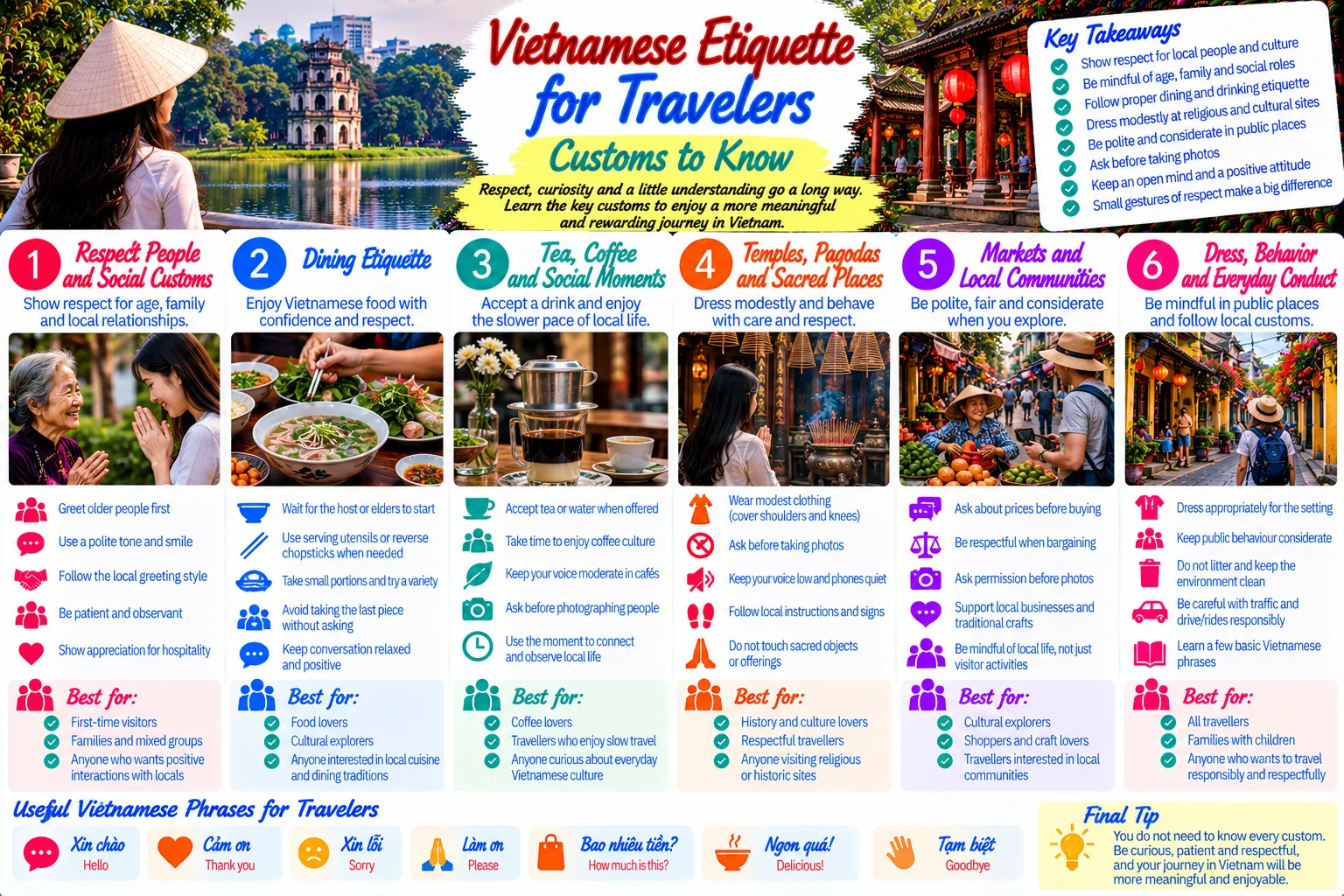
Vietnamese customs are easiest to understand when you see them as expressions of relationship: respect for elders, care for guests, loyalty to family, and attention to the shared setting. Visitors do not need to perform every tradition perfectly. A calm greeting, patient observation, modest clothing in sacred places, and willingness to follow a host’s lead will carry you a long way. This guide explains practical Vietnamese etiquette for tourists while leaving room for the country’s regional, family, religious, and ethnic diversity.
Start with the principles behind Vietnamese etiquette
Vietnam is not culturally uniform. A family in Hanoi, a household in the Mekong Delta, a Cham community, and a highland village may have different languages, foods, rituals, and expectations. Even within one family, customs change with age, faith, education, and urban life. Treat the advice below as a useful starting point, not a script that overrides local guidance.
Three habits help in almost every situation:
- Observe before acting. Notice whether people remove shoes, wait for an elder, bow their head slightly, or begin eating.
- Ask without making the moment awkward. “Should I remove my shoes?” or “Where should I sit?” is considerate, not ignorant.
- Let the host set the pace. Hospitality can be generous and spontaneous. Accept what you comfortably can, decline gently when necessary, and show appreciation.
For a wider approach to meaningful encounters, pair this article with Planning a Cultural Trip That Leaves Room to Listen. Listening is not an abstract virtue here; it is a practical travel skill.
Greetings, age, and forms of address
Why age matters in conversation
Vietnamese speech often reflects the relationship between people. Family terms such as anh, chị, cô, chú, bác, and em can be used beyond the immediate family to signal relative age and respect. A visitor who speaks only English can still show awareness by greeting people warmly and avoiding an overly familiar tone with older adults.
When introduced to someone, smile, make comfortable eye contact, and offer a small nod or a light handshake if the other person initiates one. Do not assume that a hug is welcome, particularly in formal, religious, or first-meeting situations. In a group, greet the oldest or most senior person first when the context makes that clear, then acknowledge everyone else.
Using names naturally
Vietnamese names are usually written with the family name first in Vietnamese contexts, although international settings may reverse the order. If you are unsure how to address someone, listen to how others do it or ask politely. Repeating a person’s name accurately matters more than displaying a memorized list of Vietnamese titles.
Learn a few simple phrases: “Xin chào” is a general hello, “cảm ơn” means thank you, and “xin lỗi” can express apology or get someone’s attention. Pronunciation takes practice, so a sincere attempt is more valuable than forcing a perfect tone.
Eating together: the customs visitors notice first
Shared dishes and table behavior
Many Vietnamese meals are communal. Rice, soup, vegetables, herbs, and main dishes may be placed in the center for everyone to share. Use serving utensils when provided. If there are no separate serving tools, watch how the table handles shared food and follow that pattern. Take moderate portions first so others can also enjoy the dish, and try a little before deciding whether you want more.
Chopsticks are practical tools, but they also carry social meaning. Avoid sticking them upright in a bowl of rice, since that can resemble incense used in remembrance rituals. Do not wave them while talking, point with them at people, or rummage through a shared plate. Rest them on a chopstick holder or beside your bowl when you pause.
Accepting and declining food
A host may encourage you to eat more as a sign of care. You can accept another serving if you want it, but you do not need to eat beyond your comfort. Smile, thank the host, and use a gentle explanation such as “I’m full, but it was delicious.” Dietary restrictions should be explained early and clearly. Vegetarian, vegan, halal, allergy, and medical needs are easier to accommodate when a host or restaurant has time to prepare.
At a restaurant, the person who invited the group may expect to pay, though arrangements vary. Avoid turning the bill into a public tug-of-war. Discuss payment quietly, offer once, and follow the group’s decision unless you have agreed on a different arrangement in advance.
Food is also a doorway into regional identity. You can continue exploring that connection through the site’s Cultural Travel Experiences category and the article Choosing a Cultural Workshop That Gives Back.
Visiting a Vietnamese home
What to ask at the door
If you are invited into a home, pause at the entrance and ask whether shoes should come off. Some households expect it; others do not. Dress neatly, especially if the visit is connected to a family celebration or formal introduction. Avoid sitting immediately in the most prominent chair. Wait to be shown where to sit, since seating can reflect age, status, or the host’s wish to honor you.
A small gift is thoughtful but not compulsory. Fruit, tea, flowers, sweets, or a modest specialty from your home can work well. Give it with both hands or with a respectful gesture, and do not worry if the recipient initially refuses out of politeness. Offer once more if appropriate, then let the exchange move on.
Family altars and private spaces
Many Vietnamese homes have an ancestor altar or another dedicated spiritual space. Treat it as private and significant. Do not touch offerings, rearrange objects, lean against the altar, or take close-up photographs without permission. If the family is preparing incense or a remembrance ceremony, observe quietly and ask questions later, unless your host invites you to participate.
Some homes contain both Buddhist and folk practices, while others reflect Christianity, Cao Dai, Islam, local beliefs, or no formal religion. Avoid assuming that one household represents all Vietnamese traditions. A respectful question about what a practice means to this family is usually better than a broad statement about “Vietnamese belief.”
Temples, pagodas, and sacred places
Vietnamese temple etiquette begins with reading the atmosphere. Wear clothing that covers shoulders and knees when visiting a sacred place, and carry a light layer if your itinerary includes several sites. Remove a hat indoors if local practice suggests it, lower your voice, and silence your phone. Walk around worshippers rather than interrupting a prayer, ceremony, or offering.
Ask before photographing people, ritual objects, monks, nuns, or ceremonies. A building may be open to tourists while particular rooms, altars, or processions remain private. Do not climb on monuments, touch statues for luck, or treat incense, offerings, and donation boxes as props. If you make a donation, use the designated box or follow staff instructions rather than placing money wherever you choose.
Dress and behavior matter at historical and spiritual sites, but interpretation matters too. The site’s Temples & Spiritual Culture category offers context for approaching sacred places as living environments rather than photo stops. You can also read Visiting Temples and Sacred Places Respectfully before planning a visit.
Photography, privacy, and public behavior
Ask before making a person the subject
Street photography can be rewarding, but a busy public space is not blanket permission to photograph every individual. Ask before close portraits, especially of older people, children, vendors at work, mourners, worshippers, and anyone in a vulnerable situation. Learn a simple request such as “Tôi chụp ảnh được không?” or use gestures and a friendly expression if language is limited.
If someone declines, lower the camera and move on without debate. Do not offer money as if access to a person’s dignity were a transaction. In markets and villages, ask before photographing a stall, workshop, home, or ceremonial clothing. A few seconds of consent can turn a potentially intrusive image into a respectful exchange.
Keep public spaces comfortable
Vietnamese cities can be lively and crowded, but that does not make shouting, blocking doorways, or pushing through queues acceptable. Keep your voice moderate in museums, transport areas, and residential lanes. Follow local signs about photography, smoking, footwear, and restricted areas. When attending a performance or festival, remain aware of the people who came to participate rather than merely watch.
For more ideas about reading performances and cultural symbols, visit Traditional Arts & Performances and the guide Listening for the Story in Vietnamese Traditional Arts.
Tet, festivals, and visiting during family celebrations
Tet, the Vietnamese Lunar New Year, brings family reunions, ancestor remembrance, home visits, food, decorations, and hopes for a fortunate year. A visitor may see red envelopes, flowers, calligraphy, special foods, and people traveling to their home communities. The meaning of a custom can differ by family, so ask before joining in.
During Tet, avoid treating homes, altars, and ceremonies as an open-house attraction. If invited, arrive with good wishes, wear clean and presentable clothing, and follow the host’s lead about where to sit and what to do. Red envelopes are traditionally associated with giving luck, but visitors should not hand them out casually to strangers or children unless a local friend explains the context.
Festivals can also involve processions, sacred objects, crowds, and temporary rules. Stand behind barriers, do not step into a ritual route for a photograph, and respect requests from organizers. Check current transport and venue information before traveling because holiday schedules and access arrangements can change. The site’s Vietnamese Festivals category can help you understand the difference between observing a celebration and entering its ritual space.
Small mistakes, graceful recovery, and better questions
Visitors sometimes worry that one mistake will ruin an interaction. Usually, a sincere apology and a willingness to adjust are enough. If you use the wrong form of address, mispronounce a name, sit in the wrong place, or forget to remove your shoes, say “xin lỗi,” smile, and follow the correction. Defensiveness creates more discomfort than the original error.
Good questions are specific:
- “Is this area open to visitors?”
- “May I take a photograph?”
- “Would you like me to remove my shoes?”
- “Is there a respectful way to join this activity?”
- “What does this ceremony mean to your family or community?”
Avoid questions that reduce culture to a stereotype, such as asking someone to explain what “all Vietnamese people” believe. Vietnam’s diversity is not a footnote; it is part of the experience. The Ethnic Minority Cultures category is a useful reminder to seek community-specific context rather than applying one urban Kinh norm everywhere.
A practical checklist for your next interaction
- Greet warmly and use a calm, respectful tone.
- Observe seating, footwear, serving, and photography norms before copying them.
- Use shared serving utensils and handle chopsticks carefully.
- Ask before entering private areas, photographing people, or joining rituals.
- Dress modestly for homes, temples, pagodas, and ceremonies.
- Accept hospitality gratefully, but explain dietary or health needs early.
- Keep hands off altars, offerings, statues, and ceremonial objects.
- When corrected, apologize briefly and adapt without making the host reassure you.
- Remember that regional, religious, ethnic, and family differences are normal.
Conclusion: travel with attention, not anxiety
Vietnamese customs are not a test visitors must pass. They are invitations to notice how people care for elders, welcome guests, share food, remember family, and protect meaningful spaces. If you arrive curious, ask before assuming, and allow local people to guide the encounter, you can participate with confidence while preserving the dignity of the people and places you visit. The most respectful traveler is not the one who never makes a mistake, but the one who pays attention and changes course when a better way is shown.
JOIN THE CONVERSATION
Comments (0)
No comments yet. Be the first to share a thought.