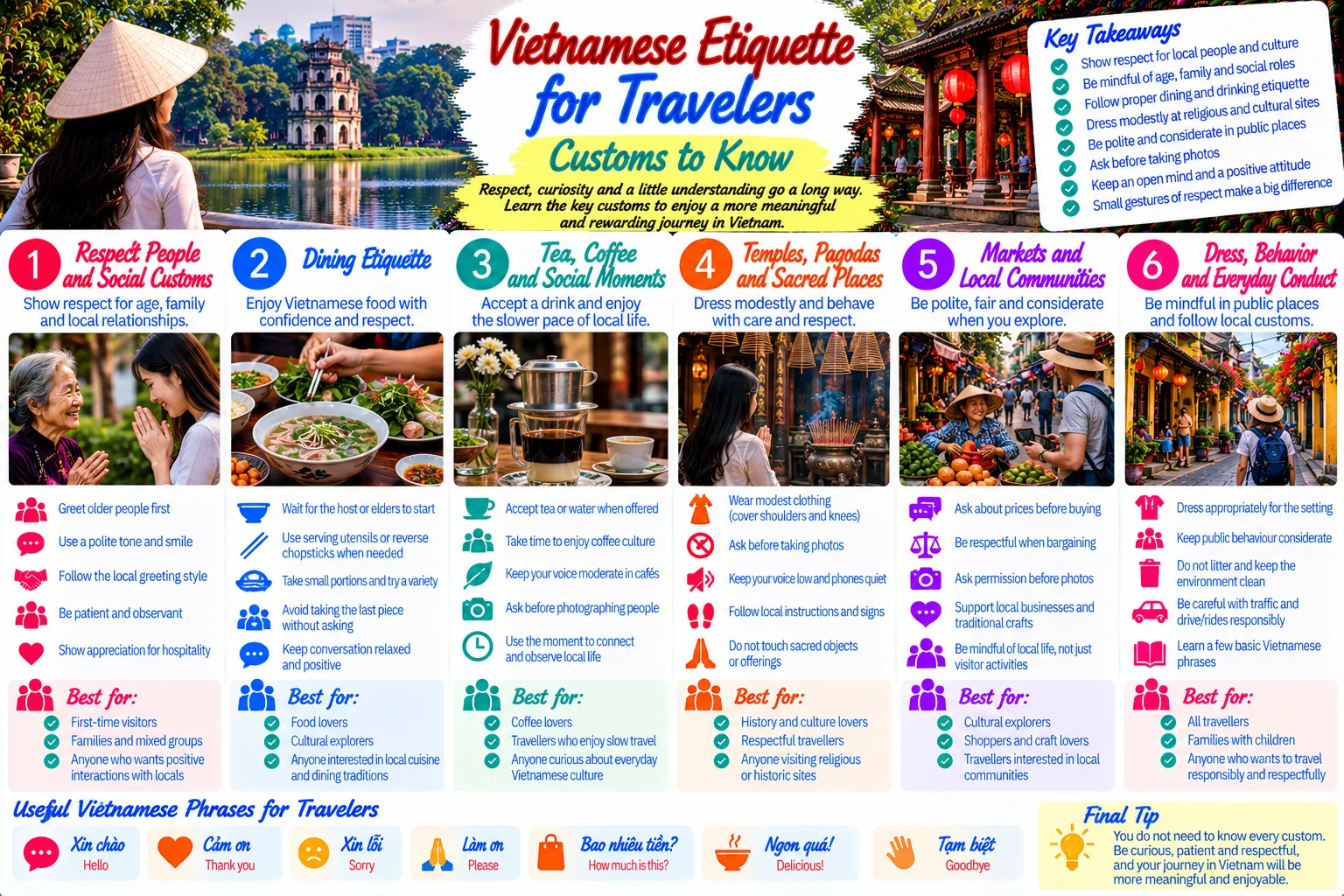
Vietnamese customs are easiest to understand when you notice how ordinary moments are shared: a greeting that acknowledges age, a meal arranged for everyone, a cup of tea offered before conversation, or a craftsperson welcoming a visitor into a working village. Travelers do not need to perform every custom perfectly. They do need curiosity, patience, and the willingness to watch before joining in. This practical guide to Vietnamese etiquette focuses on the situations visitors meet most often, from homes and restaurants to temples, markets, family occasions, and community-based cultural experiences.
Start with respect for age, family, and relationship
Vietnamese social life often pays close attention to age and family relationship. The words used for “you” and “I” can change according to who is speaking, so a visitor may hear kinship terms used outside a literal family relationship. You do not need to master the entire system before arriving. A simple, warm greeting, a smile, and attention to the other person’s lead are more useful than forcing an unfamiliar phrase.
How to greet people well
Greet older people first when you are entering a group or being introduced.
Use a calm voice and avoid treating a formal introduction like a photo opportunity.
If someone offers a hand, return the handshake naturally; if they prefer a nod or verbal greeting, follow that cue.
When you are unsure how to address someone, ask politely or let your local host introduce the appropriate form.
Vietnamese hospitality may look generous and informal at the same time. A host can encourage you to eat more, offer fruit or tea, or insist that you take another serving. Treat this as an invitation to connect, not as a test you must pass by overfilling your plate. If you are full, a smile and a clear “thank you” are usually kinder than silently refusing everything. If you have dietary needs, explain them early and specifically rather than waiting until food is served.
Learn the rhythm of a Vietnamese meal
For many visitors, dining etiquette is the most visible part of Vietnamese culture. In a shared meal, dishes may be placed in the middle for everyone to taste rather than portioned separately. Rice, soup, vegetables, meat, fish, herbs, and dipping sauces can appear together, creating a meal built around balance and conversation. Vietnam Tourism describes Hanoi cuisine as a meeting point of traditional Vietnamese cooking, Chinese influences, and French heritage, while its street-food culture connects ingredients and flavors with the city’s everyday rhythms. That is why a meal is not merely fuel: it is a way to observe how people gather.
Small habits that make shared dining easier
Wait briefly until elders or hosts begin, especially at a family meal.
Use serving utensils when they are provided; otherwise, turn your chopsticks around to take food cleanly.
Take modest portions first so everyone can share, then return for more.
Place chopsticks beside your bowl or on a rest when you pause. Avoid leaving them standing upright in rice.
Ask before taking the last piece of a dish if the table is small or the meal is intimate.
Keep conversation relaxed, and do not criticize an unfamiliar dish before understanding how it is meant to be eaten.
There is no single “correct” Vietnamese meal. A bowl of pho eaten in the morning, bun cha with herbs and dipping sauce, banh mi bought from a street stall, and a home meal all have different rhythms. Vietnam Tourism’s official cuisine guide notes that pho reflects Hanoi’s daily life, while bun cha brings together grilled pork, noodles, sauce, and raw herbs. Approach each dish as a local practice rather than a performance for visitors. Watch how nearby diners combine ingredients, then copy the method gradually.
Tea, coffee, and the value of slowing down
Offering a drink can be a way to welcome someone, create time for conversation, or mark a pause in the day. In a home, workshop, or small business, accept tea or water graciously when you can. If you do not want more, place the cup down and explain with a smile instead of repeatedly waving it away. Coffee has its own social dimension. Vietnam Tourism describes phin-filtered coffee, condensed milk, and egg coffee as parts of Hanoi’s distinctive coffee culture, and presents small cafés as places to observe local life at a slower pace.
That slower pace is useful cultural etiquette in itself. Do not rush through every café or treat a quiet street-side seat as a backdrop only. Keep your voice moderate, ask before photographing people, and leave room for the staff and regular customers who use the space daily. A thoughtful coffee stop can teach you more than a checklist of famous drinks if you pay attention to who gathers there and how the place is used.
Dress and behavior at homes, temples, and sacred places
Vietnamese traditions vary by region, religion, family, and setting, so avoid presenting one rule as universal. The safest approach is to dress more modestly when visiting a home, temple, pagoda, shrine, memorial, or religious ceremony than you might at a beach or nightlife venue. Cover shoulders and knees when the setting calls for it, keep your voice low, and watch whether visitors remove shoes before entering an interior space.
Before you take part
Ask whether photography is welcome, especially around altars, monks, worshippers, funerals, or family ceremonies.
Do not touch sacred objects, offerings, statues, or household displays simply because they are within reach.
Follow signs and local instructions about where to stand, sit, or walk.
Keep phones quiet and step outside if you need to take a call.
If you are unsure whether an action is devotional or merely decorative, observe first and ask a guide.
A visitor’s role is usually to witness respectfully, not to imitate a ritual for a dramatic photograph. You can learn more by asking what an object or gesture means than by copying it without context. For further planning, the site’s guide to visiting temples and sacred places respectfully offers a useful companion to this broader overview of Vietnamese customs.
Photographs, markets, and everyday privacy
Vietnam is visually rich, but a person is not a prop. Ask before taking a close portrait, particularly when photographing older people, children, workers, vendors, or religious participants. A friendly gesture toward your camera followed by a clear question is better than photographing first and apologizing later. If someone declines, accept the answer without bargaining.
At markets, look before touching merchandise and ask before handling fragile goods. A vendor may welcome conversation, but not every smile is permission to film a long interaction. If you make a purchase, complete the exchange clearly and avoid blocking a stall while negotiating. In a household or workshop, ask whether you may enter a back room, touch tools, or photograph the production process. The official Vietnam Tourism account of Vietnamese silk villages emphasizes that visitors can watch artisans work and appreciate the stages of production; that does not remove the need to follow the individual workshop’s own boundaries.
These habits matter especially in community-based travel. If you are visiting a village, learn whether a guide or host has arranged the visit, where guests may walk, and whether gifts or donations should go through a community channel. The site’s Traditional Craft Villages category can help you place individual craft encounters in a wider cultural context.
Family occasions, gifts, and invitations
Invitations into Vietnamese homes or family gatherings are meaningful, but they can also be more formal than a casual restaurant meal. Bring a small, useful gift if your host suggests it, such as fruit, flowers, or a locally appropriate item; ask a guide or trusted local contact if you are uncertain about the occasion. Avoid assuming that every red envelope, flower arrangement, or food offering has the same meaning across regions and events.
When entering a home, pause at the threshold and follow the host’s direction about shoes, seating, and where to place a gift. Let the oldest or most senior guest guide the order of conversation and serving. If a toast is offered, you can participate in a way that suits your health and beliefs; declining alcohol does not require a long explanation. A simple “thank you, I do not drink” is enough.
Festivals and family ceremonies may involve practices that are not designed for tourist participation. The most respectful response is to ask what visitors may do, what should remain private, and whether there is a suitable viewing area. The site’s guide to experiencing a Vietnamese festival as a visitor can help you think through that difference between attending and taking over.
Use language as a bridge, not a test
A few Vietnamese words can open a conversation, but pronunciation mistakes are normal. Learn a greeting, “thank you,” “please,” and a polite way to say that you do not understand. Use them with humility. Do not turn a local person’s correction into entertainment for the group, and do not assume that speaking loudly will solve a language gap. Pointing, translation tools, writing down an address, or asking a bilingual guide can be more effective.
When discussing customs, ask open questions: “How is this usually done in your family?” or “Is this appropriate here?” This leaves room for regional and generational differences. Vietnamese culture is not a museum exhibit with one frozen script. Urban cafés, family homes, craft villages, festivals, and workplaces all have their own expectations. The Vietnamese Festivals category and the site’s article on everyday Vietnamese customs visitors can meet with care provide places to explore those differences without reducing them to a list of stereotypes.
A practical checklist for culturally considerate travel
Observe first, then join when the host or setting makes the invitation clear.
Greet older people and hosts before moving straight to photographs or questions.
Share food thoughtfully: take small portions, use serving tools, and keep chopsticks respectful.
Dress modestly in homes, temples, memorial spaces, and ceremonies.
Ask before photographing people, sacred objects, workshops, or private gatherings.
Accept hospitality warmly while stating dietary, health, or alcohol limits clearly.
Expect regional and family differences; ask instead of declaring one rule universal.
Choose community visits where hosts explain boundaries and the benefits of tourism are visible.
Conclusion: let attention do the work
The most useful Vietnamese etiquette for travelers is not a complicated performance. It is attention: to age, space, food, privacy, ritual, and the person who is welcoming you. If you pause before taking a photograph, watch before using a shared dish, and ask before entering a cultural space, you are already traveling with care. Let local people set the pace, accept correction lightly, and remember that respectful curiosity is more valuable than pretending to know every custom.
JOIN THE CONVERSATION
Comments (0)
No comments yet. Be the first to share a thought.