Vietnamese tea culture is easy to encounter and easy to misunderstand. A small glass of hot tea may appear at a family home, a business meeting, after a meal, during a wedding, or beside a long conversation with friends. It can look casual, yet the act of offering and receiving tea often creates a moment of welcome. For travelers, the most useful approach is not to search for one rigid national ceremony, but to notice how tea works in the relationship and setting around you.
This guide explains how to take part with confidence: what an offered cup can mean, how to receive it, how to behave around a household tea table, and how to explore Vietnamese tea traditions without turning an everyday custom into a performance. For a wider foundation, pair this guide with Everyday Vietnamese Customs Visitors Can Meet with Care.
What Vietnamese tea culture means in daily life
Tea in Vietnam is both ordinary and meaningful. The official Vietnam Tourism feature on the historic 1927 tea factory in Lam Dong describes tea as part of everyday life as well as the country’s history and economy. It also notes that tea commonly appears at the beginning of business meetings, during weddings, after meals, and in conversations between friends. That range matters: a cup is not automatically a formal ceremony, a religious offering, or a commercial tasting. Its meaning comes from who offers it, where you are, and what is happening around it.
Tea can be a gentle way to begin a conversation before the practical purpose of a visit. It can give guests something to share while an older relative asks where they come from. It can mark a pause after food, or simply keep a group talking. In many situations, the hospitality lies less in the rarity of the tea than in the attention of preparing and offering it.
That is why travelers should avoid judging a cup by price, presentation, or vocabulary alone. A chipped glass in a busy home may carry as much warmth as an elaborate pot in a specialist tea room. Vietnamese tea culture is not limited to connoisseurship; its strength is its accessibility and connection to ordinary social life.
Tea is not one fixed Vietnamese ceremony
Visitors sometimes arrive expecting a single set of steps called the Vietnamese tea ceremony. In reality, tea habits vary by household, region, age, occasion, and personal taste. A family may use a teapot and small cups. A roadside stop may offer strong tea in a glass. A formal gathering may give more attention to seating, serving order, or the quality of the leaves. A modern cafe may reinterpret Vietnamese tea through design and tasting flights.
These differences are not evidence that one version is more authentic than another. They show how a living custom adapts. The most respectful traveler asks what kind of experience is being offered instead of imposing a script.
Three settings you may encounter
- A family or host’s home: Tea may be a welcome, an invitation to sit, or a natural part of conversation. The atmosphere is usually more important than technical tasting language.
- A social or professional meeting: Tea can open a discussion and create a calmer rhythm before business or introductions begin. Watch the host’s pace rather than rushing to finish.
- A cultural venue or tea experience: A guide may explain processing, utensils, aroma, or regional styles. This is the best setting for detailed questions, photography, and tasting notes.
If you are interested in structured learning, a carefully chosen cultural workshop that gives back can offer more context than a quick photo stop. The key is to choose an experience that treats tea as a living practice and credits the people who maintain it.
How to accept an offered cup respectfully
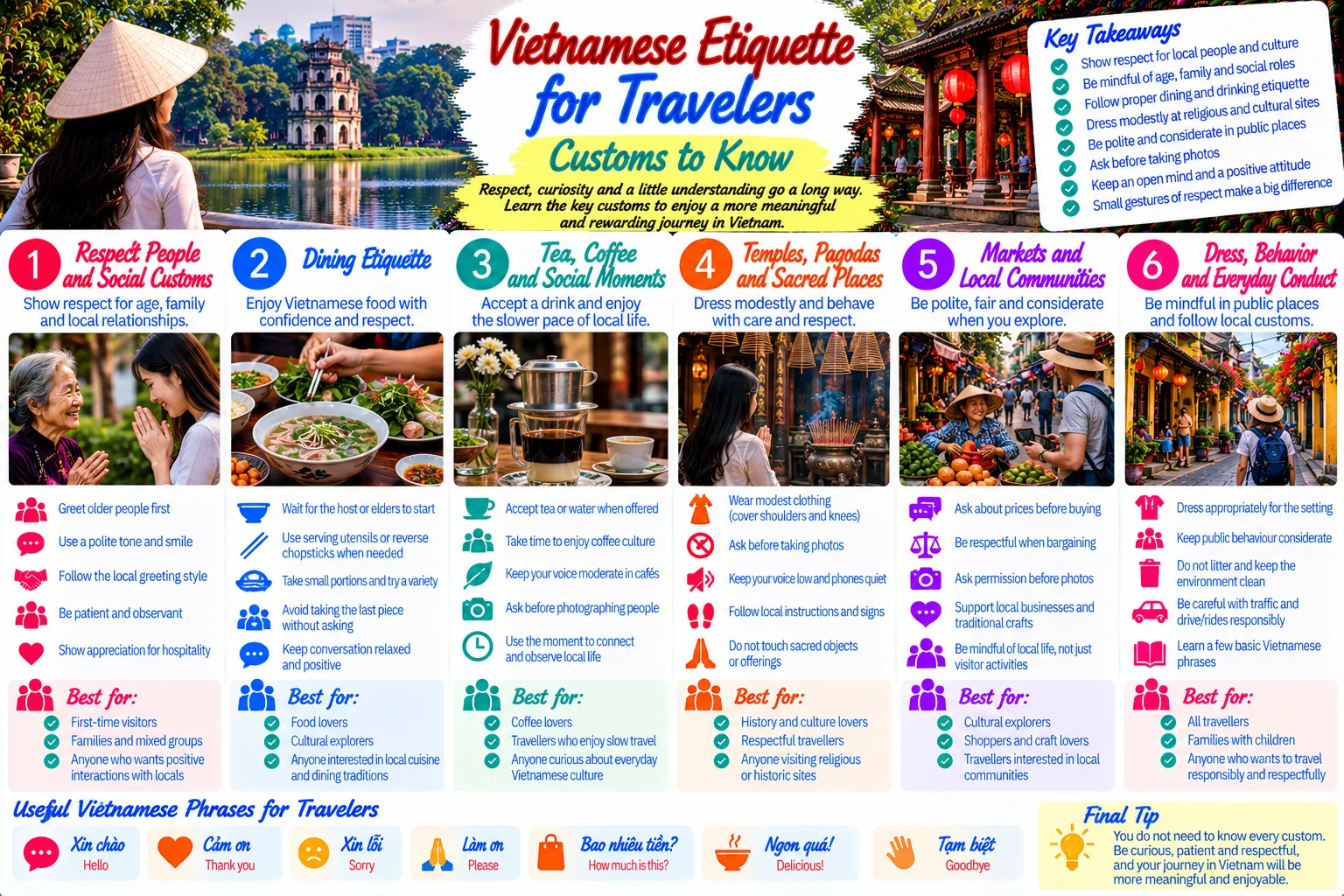
The basic etiquette is simple: acknowledge the offer, receive the cup carefully, and allow the host to set the rhythm. You do not need expert knowledge or elaborate gestures. A smile, a small nod, and a sincere “cảm ơn” are enough to show appreciation. If you do not drink tea, say so kindly and early rather than leaving a full cup untouched without explanation.
A practical sequence
- Pause and acknowledge the offer. Look toward the person serving you and thank them. This recognizes the social gesture before you focus on the drink.
- Receive with care. In a formal setting, using both hands can communicate respect, especially when accepting something from an older person. In casual settings, follow what everyone else does.
- Let the tea cool. Take a small sip when comfortable rather than treating it like a drink to finish quickly. Very hot tea is common, and conversation may continue while you wait.
- Notice the host’s cues. The host may refill cups, invite you to try another tea, or move the conversation along. You can accept, decline, or ask for water without embarrassment.
- Thank the person who served it. A brief word of appreciation matters, even if the flavor is unfamiliar.
There is no need to perform a complicated pouring ritual unless your host or guide specifically teaches one. Copying an unfamiliar gesture without understanding it can feel more theatrical than respectful. Attentive participation is better than imitation.
Conversation, age, and the social meaning of the table
A tea table is often a place where relationships become visible. Older relatives may be served first or receive particular attention. A guest may be invited to sit before questions begin. Someone may keep an eye on empty cups while another person carries the conversation. These details are not a universal rulebook, but they can help you read the room.
When visiting a Vietnamese household, do not assume the person who made the tea is the only host. A younger family member may prepare it while an elder welcomes you. Thank everyone involved when appropriate, and avoid turning the preparation into a photo opportunity without asking.
Conversation may move from travel to family, work, hometowns, food, and the reason for your visit. You can ask what tea you are drinking, where it comes from, or when the household usually serves it. Questions framed with curiosity are more welcome than declarations about what Vietnamese tea “should” be.
Tea can also soften the first moments of a meeting when there is a language gap. You do not need to fill every silence. In many cultures, including Vietnam’s varied social settings, sitting comfortably together can be part of hospitality. Put your phone away, listen to the person speaking, and allow the exchange to take its own pace.
Understanding flavor without turning tea into a test
Vietnam produces many kinds of tea, and taste can change with growing conditions, processing, water, brewing time, and personal preference. You may encounter green tea, scented tea, black tea, or locally made preparations. The same broad type can taste very different from one household or region to another.
Instead of asking whether a tea is “good” in an absolute sense, describe what you notice. You might say that it is floral, grassy, bitter, light, smoky, or stronger than you expected. If the tea is too intense, ask whether it can be diluted or served lighter. A respectful question gives the host room to explain without forcing them to defend their taste.
Questions that open a useful conversation
- Is this tea grown locally or brought from another region?
- Is it usually served before or after meals in this household?
- Do people here prefer it strong, light, hot, or iced?
- Is the tea connected to a festival, family tradition, or special occasion?
- What should a visitor notice about the way it is prepared?
These questions are especially valuable in places where tea is connected to farming, craft, or heritage. A visit to a tea-producing area can become more meaningful when you learn about labor and landscape rather than treating the leaves as a souvenir alone. The Vietnam Tourism account of Tea Factory 1927, for example, presents tea-making as a process shaped by history, machinery, makers, and the development of Lam Dong’s industry.
Tea, family visits, and sacred spaces
Tea may appear during a home visit, but that does not mean every part of the home is open to visitors. Many Vietnamese homes include family photographs, memorial objects, or an ancestor altar. These spaces can carry deep significance, and a traveler should wait for an invitation before approaching, photographing, touching, or asking someone to explain them.
If tea is served near a meaningful family area, keep your attention on the people and conversation rather than framing the altar as decoration. Do not place your cup, bag, camera, or feet on a sacred or commemorative surface. When in doubt, ask quietly and follow the host’s direction.
The same principle applies in temples, memorial sites, and festival settings. Tea may be part of hospitality, but hospitality does not cancel the character of the place. Dress and behavior should suit the setting, and photography should be guided by local permission. For broader planning around sacred places, see Visiting Temples and Sacred Places Respectfully.
How to explore tea traditions as a traveler
The most rewarding tea experiences usually combine tasting with context. Look for a family-run visit, a responsible workshop, a tea-growing landscape, or a cultural venue where the people explaining the tradition can speak about their own work. Ask who benefits from the experience, whether photography is welcome, and whether products are sourced from the makers described.
Do not assume that a highly styled tea room represents every Vietnamese household. It may offer a valuable interpretation, but it is one setting among many. Balance a formal tasting with ordinary observation: tea at breakfast, a small glass after a meal, or a quiet pause in a market or guesthouse. These everyday moments often reveal more about social use than a staged demonstration.
If your trip includes performances, festivals, or craft communities, place tea in that wider cultural landscape. The site’s Traditional Arts & Performances and Vietnamese Festivals guides can help you think about how hospitality, music, ceremony, and public celebration overlap without assuming they are interchangeable.
Common mistakes to avoid
- Calling every tea moment a ceremony: Some occasions are formal, but many are simply everyday hospitality.
- Refusing without explanation: If you cannot drink tea, be warm and clear. A health, dietary, or personal reason is enough.
- Over-focusing on equipment: Beautiful pots and cups can be interesting, but the host’s generosity is the central point.
- Comparing immediately: Saying that the tea is weaker, sweeter, or less refined than tea from home can close the conversation.
- Photographing people or family spaces without permission: Ask first, especially in a private home or spiritual setting.
- Buying without asking about origin: If you want tea to take home, ask about its source, storage, brewing, and the people who produced it.
These habits are small, but they prevent a common travel mistake: treating a living custom as a backdrop. The goal is not to leave with perfect tasting notes. It is to leave having recognized the welcome and respected the people who offered it.
A simple mindset for your next cup
When someone offers you tea in Vietnam, begin with attention rather than anxiety. Notice the setting, acknowledge the host, receive the cup carefully, and let the conversation guide you. Ask questions when invited, accept that practices vary, and avoid turning a personal exchange into a performance for your camera.
Vietnamese tea culture is valuable precisely because it moves between ordinary and special. It belongs to homes, meetings, weddings, meals, friendships, farms, workshops, and heritage experiences. Travelers who approach it with patience will find that a small cup can explain much more than flavor: it can introduce a way of welcoming, remembering, and making time for other people.
JOIN THE CONVERSATION
Comments (0)
No comments yet. Be the first to share a thought.