Vietnam’s ethnic minority textiles are more than colorful souvenirs. They can carry information about place, skill, family life, ceremony, work, and identity. For travelers, the most respectful way to learn is to slow down: notice how cloth is made, ask who created it, and avoid treating every patterned garment as interchangeable. This guide explains how to look at ethnic minority clothing and textiles in Vietnam, where to learn with context, how to shop responsibly, and how to turn a brief encounter into a more meaningful cultural experience.
Why Vietnam’s ethnic minority textiles deserve a closer look
Vietnam is home to 54 officially recognized ethnic groups, including the Kinh majority and 53 ethnic minority groups. That diversity means there is no single “hill tribe style” or universal Vietnamese ethnic costume. Clothing traditions vary between communities and may also differ by locality, age, occasion, household history, and the person wearing them.
The Vietnam Museum of Ethnology explains that its collections are organized through several lenses, including ethnicity, use, clothing, jewelry, tools, musical instruments, religion, weddings, funerals, and other social activities. This is a useful reminder for visitors: a textile is not only a decorative object. It belongs to a wider system of daily life and social meaning.
When you see a woven skirt, embroidered panel, head covering, sash, or indigo-dyed cloth, begin with curiosity rather than a quick label. Ask what you can actually know from the setting, and what would require a guide, maker, or community member to explain.
How to read an ethnic minority textile without oversimplifying it
Start with material and technique
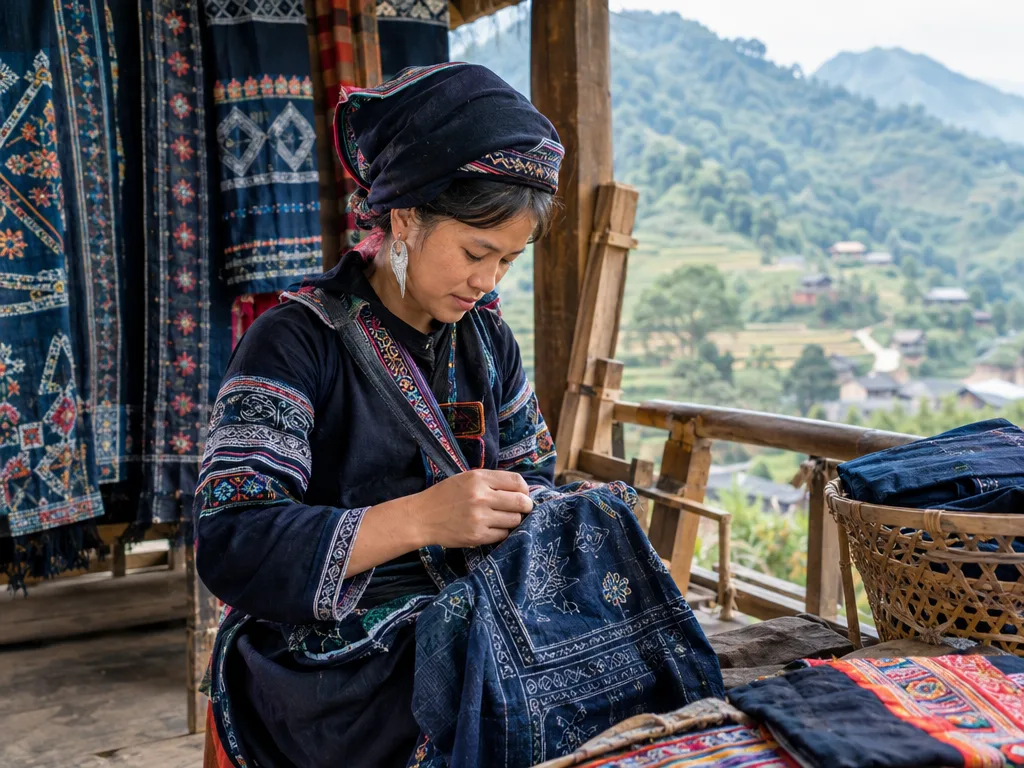
Look first at the physical work. Is the fabric woven, sewn, appliquéd, embroidered, printed, or dyed? Can you see changes in texture, repeated motifs, or areas where the maker had to join separate pieces? A close look at construction helps you appreciate labor without pretending that every symbol has one fixed translation.
The museum’s permanent exhibition describes a rich variety of ethnic textiles, including loincloths, skirts, and scarves decorated through different traditional techniques. It also places clothing alongside baskets, agricultural tools, musical instruments, ritual objects, photographs, and film. That combination is valuable because textiles make more sense when considered with the activities and environments in which they are used.
Notice how cloth relates to place
Architecture and textiles can provide connected clues. In the museum’s outdoor area, visitors encounter reconstructed buildings associated with several communities, including Hmong, Dao, Tay, Ede, Ba-na, Ha Nhi, Gia-rai, Co Tu, and Cham communities. The point is not to turn a museum visit into a checklist of ethnic “types,” but to notice how homes, tools, clothing, and landscapes can form a cultural context.
For a traveler visiting a village, ask whether the item is made locally, used in everyday life, reserved for ceremonies, or produced especially for visitors. These questions are more useful than asking whether a design is “real.” Living traditions can include adaptation, experimentation, and new markets without becoming less meaningful.
What the Vietnam Museum of Ethnology can teach visitors
A museum is a strong first stop when you want background before traveling to a village or market. The Vietnam Museum of Ethnology’s permanent exhibition presents cultural materials from all 54 ethnic groups and includes clothing, jewelry, domestic objects, tools, instruments, and ritual materials. Its displays also use photographs and documentary films to show both tangible and intangible aspects of community life.
This kind of setting helps correct a common travel mistake: arriving in a community with no context and expecting local people to explain their entire culture in a few minutes. A museum cannot replace community knowledge, but it can give you better questions and reduce the temptation to make broad assumptions.
During a visit, choose one theme—such as clothing, housing, or agricultural life—and follow it through the galleries. Compare what changes between communities, but also look for what the exhibition refuses to flatten into one story. Take notes on names and spellings, because “ethnic minority” is a broad category rather than a complete cultural description.
The museum’s official visitor information states that its permanent displays use Vietnamese, English, and French, with additional multilingual visitor materials available. Check the museum’s own website before visiting for current opening information, closures, and fees rather than relying on an old guidebook.
What Hmong and Dao displays reveal about cultural context
Learning from the Hmong house display
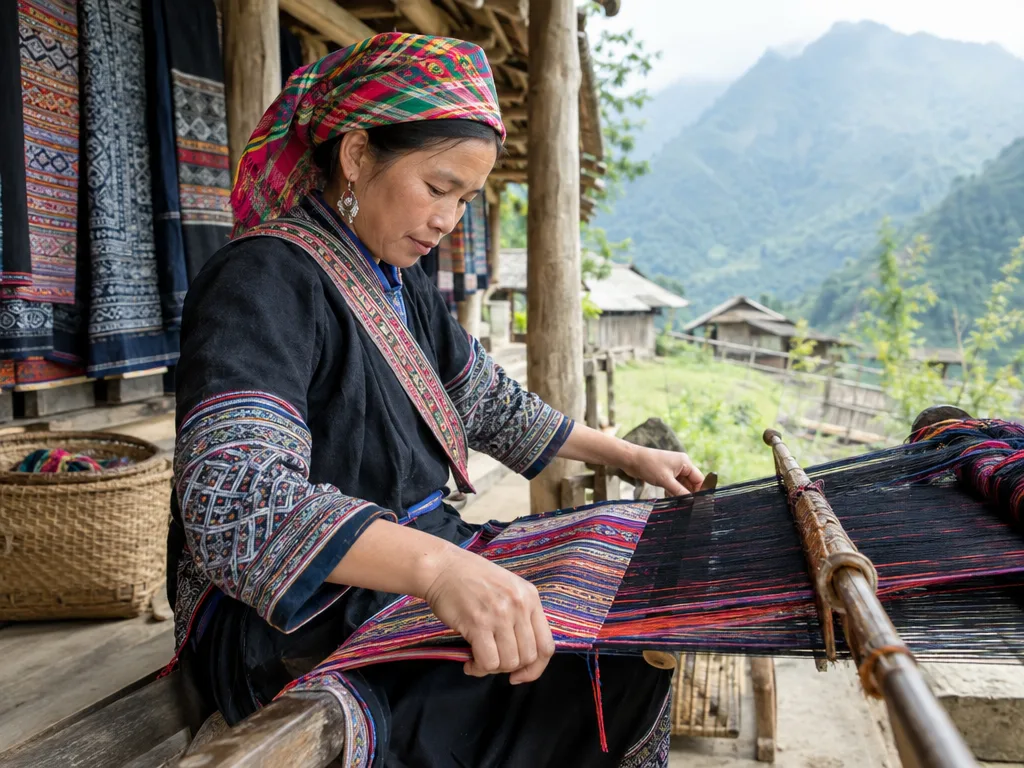
The museum’s Hmong house display was reconstructed by Hmong people from its original community context. The museum describes the building as using pơ mu wood and includes spaces associated with guests, worship, household life, and domestic work. It also identifies a place where light could be increased for weaving by moving a roof plank.
For visitors, the lesson is simple: textile production is not an isolated craft activity. It can be connected to house design, available materials, work rhythms, family spaces, and the practical organization of daily life. If you encounter Hmong textiles in a village, avoid viewing the cloth without considering the people, places, and skills behind it.
Learning from the Dao house display
The museum’s Dao house display describes a half-raised, half-ground-floor form adapted to steep mountain conditions. It also notes a space connected to the house where women could soak indigo and dye cloth, as well as wash and dry clothing.
That detail shows why “traditional clothing” should not be separated from landscape and labor. Dyeing is part of a process involving materials, water, time, knowledge, and household organization. It also explains why a good cultural visit should leave room for process: seeing only the finished garment hides much of the work that gives it value.
These displays should not be used to generalize about every Hmong or Dao community. They are specific museum interpretations of particular houses and histories. Use them as invitations to ask better questions, not as templates for judging how another community “should” look.
How to visit a village or market respectfully
If your itinerary includes an ethnic minority village, begin by finding out who organizes the visit and who benefits from it. A community-led guide, locally managed homestay, or direct relationship with makers can give you more context than a stop designed only for quick photographs and souvenir sales.
- Ask before photographing people, homes, clothing, children, ceremonies, or work areas.
- Use the community’s and individual’s preferred name rather than a vague label such as “tribe.”
- Do not touch garments, tools, household objects, or ceremonial items without permission.
- Allow people to decline questions, photographs, or sales conversations.
- Ask whether a textile is intended for everyday use, ceremony, or display before wearing or handling it.
- Pay fairly and, when possible, buy directly from the maker or a clearly identified local cooperative.
- Avoid bargaining as entertainment, especially when you do not understand the time and labor involved.
Respect also includes accepting that a community may not want every cultural detail turned into a visitor experience. A quiet walk, a short conversation, or a purchase made without demanding a performance can be more supportive than an intrusive “authenticity” hunt.
How to buy ethnic minority textiles responsibly
Before buying, ask practical questions: Who made this? Where was it made? Is it handmade or partly machine-produced? What materials were used? Is the design connected to a particular community or simply inspired by a regional look? How should the item be washed and stored?
Good answers do not need to be romantic or dramatic. A seller who explains that an item is made for the tourist market is giving you useful information. Adaptation is not automatically exploitation, and a contemporary product can still support skills and livelihoods. The important issue is whether the description is honest and whether money reaches the people doing the work.
Buy what you can care for. A small textile with a clear story and manageable use may be a better choice than a large garment you will never wear. Keep the maker’s explanation with the item, and avoid presenting it later as a ceremonial object or as clothing from a community you cannot identify.
Be cautious with claims such as “ancient,” “sacred,” or “one of a kind” unless the maker or a reliable local source explains what they mean. Ask permission before reproducing a distinctive motif in your own design, marketing, or social media project. Admiration does not create ownership.
Questions that lead to better cultural conversations
Visitors often ask, “What does this pattern mean?” That question can be interesting, but it may be too broad. Try questions that leave room for a specific answer:
- Who usually wears or uses this textile?
- When would someone choose this garment?
- Which part takes the longest to make?
- What materials are gathered or purchased locally?
- Are younger people learning or adapting this technique?
- Is this piece made for local use, visitors, or both?
- What is the best way to care for it?
Listen for uncertainty and variation. Two people from the same broad ethnic category may describe a garment differently because they come from different places or generations. That is not a problem to solve; it is part of learning how culture works in real communities.
Plan a textile-focused cultural experience in Vietnam
A meaningful visit can follow a simple sequence: learn in a museum, meet a local guide or maker, observe a process, ask permission, and spend thoughtfully. Do not pack too many stops into one day. Time matters because rushed visits encourage photographing surfaces rather than understanding relationships.
Before leaving, write down the community name, the maker’s name if they offer it, and one fact about the process. Back at your accommodation, check whether your notes preserve the maker’s meaning rather than your own assumptions. If you share photographs, identify the place accurately and avoid captions that turn a person or garment into a generic symbol of “mountain culture.”
Textiles are a particularly good entry point into Vietnam’s ethnic minority cultures because they connect visible design with invisible work: memory, skill, household organization, land, trade, and identity. Approach them patiently, and your visit becomes less about collecting images and more about recognizing living knowledge.
A careful textile visit also changes how you travel afterward. You may notice the difference between a market object and a household object, recognize that a familiar color can have different local associations, and become more patient with translation. That patience is part of responsible cultural travel: it gives people space to describe their own work instead of making visitors’ expectations the center of the encounter.
Final takeaway
To understand Vietnam’s ethnic minority textiles, look beyond color and pattern. Learn the community name, place the garment in its daily or ceremonial context, ask permission, support makers fairly, and accept that no single display can represent everyone. The best souvenir is not the most “exotic” object; it is an honestly described piece that you can care for while remembering the people and knowledge behind it.
JOIN THE CONVERSATION
Comments (0)
No comments yet. Be the first to share a thought.