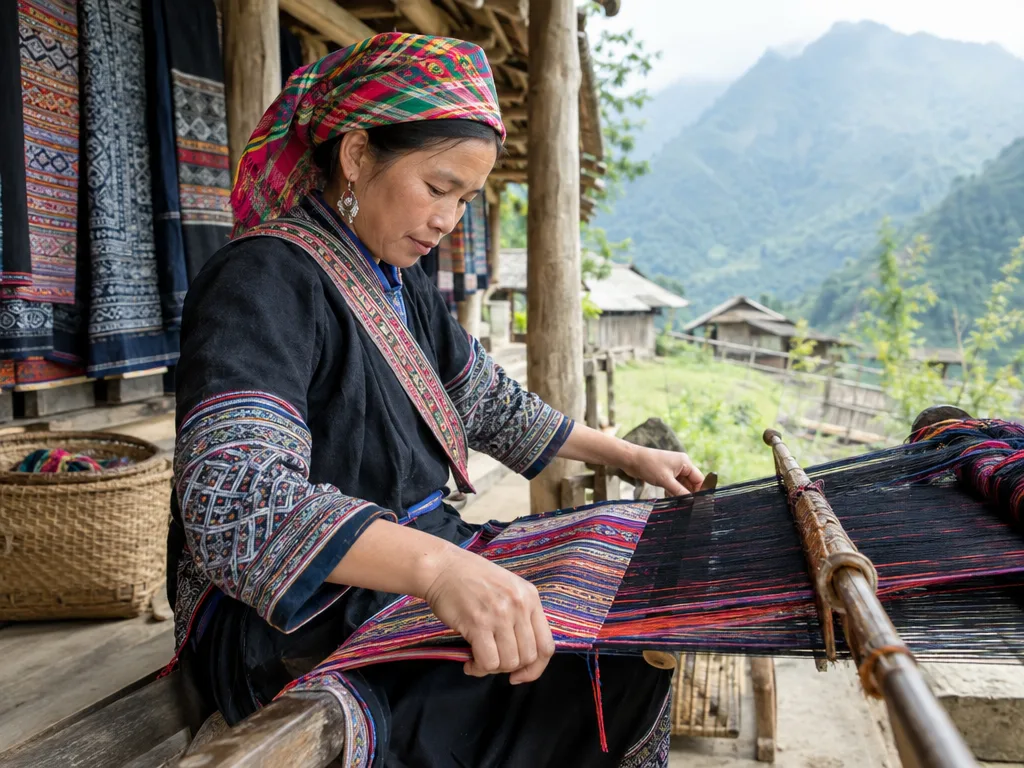
Vietnam’s ethnic minority textiles are more than colorful souvenirs. They can carry knowledge about place, family, work, ceremony, and identity, while also reflecting the choices of contemporary makers. For travelers, the rewarding question is not simply “What should I buy?” but “How can I look, listen, and spend in a way that respects the people who made this?”
This guide focuses on a narrower and more useful search intent than a general overview of Vietnam’s ethnic groups: how to understand ethnic minority textiles, prepare for a respectful learning experience, and choose a purchase or workshop with care. It is designed for visitors who may encounter weaving, embroidery, indigo dyeing, appliqué, or clothing in a museum, market, village, homestay, or community-led experience.
Why ethnic minority textiles deserve context
Textiles are often introduced through appearance: bold colors, geometric borders, animal forms, or intricate stitching. Those details matter, but a quick visual label can flatten a living tradition into a pattern catalogue. A textile may be connected to a particular community, a local environment, a life stage, a family skill, or a changing economy. The same broad technique can also be interpreted differently by different groups.
Vietnam is home to 54 officially recognized ethnic groups, including the Kinh and 53 ethnic minorities. The Vietnam Museum of Ethnology presents this diversity through exhibitions about the peoples of Vietnam, the peoples of the world, and an architectural garden. That structure is a useful reminder: culture is not only an object in a display case. It is connected to homes, tools, landscapes, language, music, beliefs, and everyday relationships.
Approach a textile as evidence of knowledge rather than as a decorative label. Ask who made it, where the materials came from, when it is used, how long it takes, and whether the design has a particular meaning. If nobody can answer, do not invent an explanation from its colors or motifs.
Start with the maker, not the motif
When you see a textile in a village, market, workshop, or museum, begin with the maker or interpreter. A respectful conversation might cover:
- Which community or local group is associated with the textile?
- Is the piece handwoven, hand-embroidered, machine-made, or a combination?
- Who made it, and was the maker paid directly or through a cooperative?
- Is it intended for everyday use, ceremony, display, or contemporary fashion?
- Which parts of the process are still practiced locally?
These questions are better than asking whether a pattern is “authentic.” Authenticity is not a single visual test. Communities adapt materials, colors, products, and selling methods as circumstances change. A contemporary bag made with local skill can be culturally meaningful even if it is designed for travelers. Conversely, an object marketed with a dramatic story may not have the provenance the seller implies.
Listen for the speaker’s own terms. Community names, craft names, and local pronunciations are preferable to broad labels such as “tribal,” which can make diverse peoples sound interchangeable. If you are unsure how to describe a group, ask politely and use the answer in your own notes.
Learn to notice the process
A textile becomes easier to understand when you follow its making sequence. Depending on the tradition, the work may involve preparing fibers, spinning thread, setting up a loom, weaving a ground cloth, adding supplementary patterns, dyeing, embroidering, sewing, or finishing the edges. Not every maker performs every step, and not every contemporary product uses the full traditional process.
Look for the relationship between technique and time. A repeated pattern may be built into the structure of the cloth, added later with needlework, or produced through dye-resist methods. These choices affect durability, labor, and price. Instead of assuming that a higher price is automatically fair or that a lower price is automatically a bargain, ask what work the price represents.
If you visit a museum first, use the visit to build vocabulary and questions rather than to memorize a list of “typical” objects. The Vietnam Museum of Ethnology’s permanent-exhibition information separates “The Peoples of Vietnam,” “The Peoples of the World,” and an “Architectural Garden.” Even without seeing every display, that arrangement encourages visitors to connect objects with broader cultural and built environments.
Choose a learning experience with care
Not every textile encounter is equally useful or respectful. A strong workshop, demonstration, or homestay usually makes the practitioner visible, explains what participation involves, and gives you time to observe rather than rushing you toward a purchase.
Signs of a thoughtful experience
- The host identifies the community, practitioner, or organization involved.
- The activity explains a real process instead of offering only a photo opportunity.
- You can ask questions without pressuring anyone to perform private rituals or personal stories.
- The fee, purchase arrangement, or community benefit is explained clearly.
- The group size and schedule leave room for conversation and concentration.
Questions to ask before booking
- Who leads the session and what is their relationship to the craft?
- Will the activity take place in a working home, cooperative, museum, or commercial studio?
- Are photographs, recordings, or social-media posts allowed?
- What happens to finished pieces that participants make?
- Can the experience accommodate a slower pace or a visitor who prefers observation?
Be cautious when an itinerary promises an instant transformation, a guaranteed “secret” technique, or access to sacred clothing without explaining boundaries. A good experience does not need to make a culture seem mysterious to be valuable.
Buy textiles responsibly
Buying directly can support makers, but “directly” should not be assumed. Ask whether the person speaking with you is the maker, a family member, a cooperative representative, or a reseller. If the answer is unclear, buy because you value the object, not because a dramatic claim has persuaded you.
Before purchasing, check the practical details:
- What are the fiber, dye, and care requirements?
- Is the item suitable for regular use, or is it fragile and primarily decorative?
- Does the design have a specific cultural or ceremonial context?
- Can the seller explain who made it and how payment is distributed?
- Is the price fixed, and if bargaining is customary, can you negotiate without making the maker absorb an unreasonable loss?
Do not treat clothing, ceremonial pieces, or objects with religious significance as interchangeable souvenirs. Ask whether an item is appropriate for outsiders to wear or display. When in doubt, choose a contemporary product clearly made for visitors and credit the maker or cooperative when sharing it.
Photography and permission matter
Textile work often happens in domestic or semi-private spaces. A loom, sewing basket, dye pot, or finished garment may be part of someone’s livelihood or personal life. Ask before photographing people, children, work in progress, ceremonial dress, or household interiors. A nod toward a camera is not the same as informed permission, especially when language differences or social pressure are involved.
Explain what you want to do with the image. “May I take a photo for my private travel notes?” is different from “May I photograph this for a public post?” If a person says no, accept it without asking for a reason. If permission is granted, avoid directing the maker into a staged pose that changes the working situation. A short conversation and a purchase are not substitutes for consent.
When posting, use the name the person or community gives you, avoid claiming expertise you do not have, and do not reveal a precise home location if that could create unwanted attention. Good cultural travel protects dignity after the visit, not only during it.
Build a respectful textile-focused day
A textile-focused day does not need a crowded checklist. Start with one place where you can gain context, then choose one slower encounter with a practitioner, workshop, cooperative, or community host. Leave time to reflect and to buy only after you understand what you are seeing.
A practical sequence is:
- Begin with a museum or well-explained exhibition to learn broad context.
- Write down two or three questions about process, use, and local terminology.
- Join a small, clearly described activity or visit with permission built into the format.
- Observe the working environment before taking photographs or handling objects.
- Purchase selectively, ask about care, and keep the maker’s information.
- Afterward, record what you learned and what remains uncertain.
The museum’s official visitor information lists daily operation from 8:30 to 17:30 except Mondays and New Year’s Holiday, but travelers should still check the official site before visiting because schedules can change. Its location in Hanoi also makes it a practical orientation stop before a longer cultural journey, rather than a replacement for meeting living communities on their own terms.
Respect regional and community variation
There is no single “ethnic minority textile” style that represents northern mountains, central highlands, or southern communities as a whole. Materials, climate, trade routes, language, and local history all shape what people make and wear. Even within one named community, practice may vary between villages, families, generations, and contemporary cooperatives.
This is why a careful guide should resist turning one photographed garment into a universal symbol. Treat examples as examples, ask where a piece comes from, and keep your description geographically and socially specific when the maker provides that information. If a guide, seller, or caption uses a broad label, you can ask what it means in that particular setting. Precision is not pedantry here; it is a way of recognizing that cultural diversity exists inside the category you are trying to learn about.
Questions that lead to better understanding
Useful questions are open, specific, and easy to decline. Try asking: “When would someone use this?” “Which part takes the most time?” “Has this design changed for contemporary customers?” “What should visitors avoid doing?” or “Is there a local word you would prefer me to use?”
Avoid questions that rank one group against another, demand a single explanation for a complex design, or ask someone to perform identity on command. You do not need to collect a dramatic story from every encounter. Sometimes the most respectful learning is noticing how a textile is handled, stored, repaired, sold, or worn in ordinary life.
What a meaningful visit leaves you with
The best outcome is not a suitcase full of textiles or a perfect explanation of every motif. It is a more accurate sense of the labor, choices, and relationships behind what you saw. You may leave with one carefully chosen object, a new craft vocabulary, a contact for a community-led experience, or a better understanding of why some questions should remain unanswered.
Approach Vietnam’s ethnic minority textiles as living work. Look for context, follow the process, ask permission, pay attention to who benefits, and allow uncertainty to remain. That combination of curiosity and restraint turns a shopping stop into cultural learning—and gives makers and communities more control over how their traditions are encountered.
JOIN THE CONVERSATION
Comments (0)
No comments yet. Be the first to share a thought.