Vietnamese festivals are not simply dates on a tourism calendar. They are moments when families return home, villages honor protective spirits, neighborhoods prepare food together, and public spaces become stages for memory, devotion, music, and play. For visitors, the most rewarding approach is to arrive with curiosity rather than a checklist: learn what a celebration means locally, notice who is participating, and accept that some parts are public while others belong to families or communities.
This guide explains how to understand Vietnamese festivals, choose an experience, and participate respectfully. It focuses on the practical questions travelers ask—when celebrations happen, what they may see, how to behave at sacred sites, and how to avoid turning a living tradition into a photo opportunity.
What makes Vietnamese festivals different?
Vietnamese festivals often combine several layers of life at once. A single event may include ancestor remembrance, offerings, processions, traditional performance, children’s games, market activity, and a communal meal. The balance changes from place to place. A city festival may be highly programmed, while a village celebration may follow local custom and feel less predictable to an outsider.
The Vietnamese lunar calendar shapes many important occasions. Tết Nguyên Đán, commonly called Tết, marks the first day of the first lunar month and is the country’s best-known annual celebration. It is associated with family reunion, renewal, ancestor veneration, visiting, food, decorations, and wishes for good fortune. The timing changes in the Gregorian calendar, so travelers should check the year-specific calendar rather than rely on a fixed date. Background descriptions of Tết customs and its lunar timing are available in this reference overview of Tết.
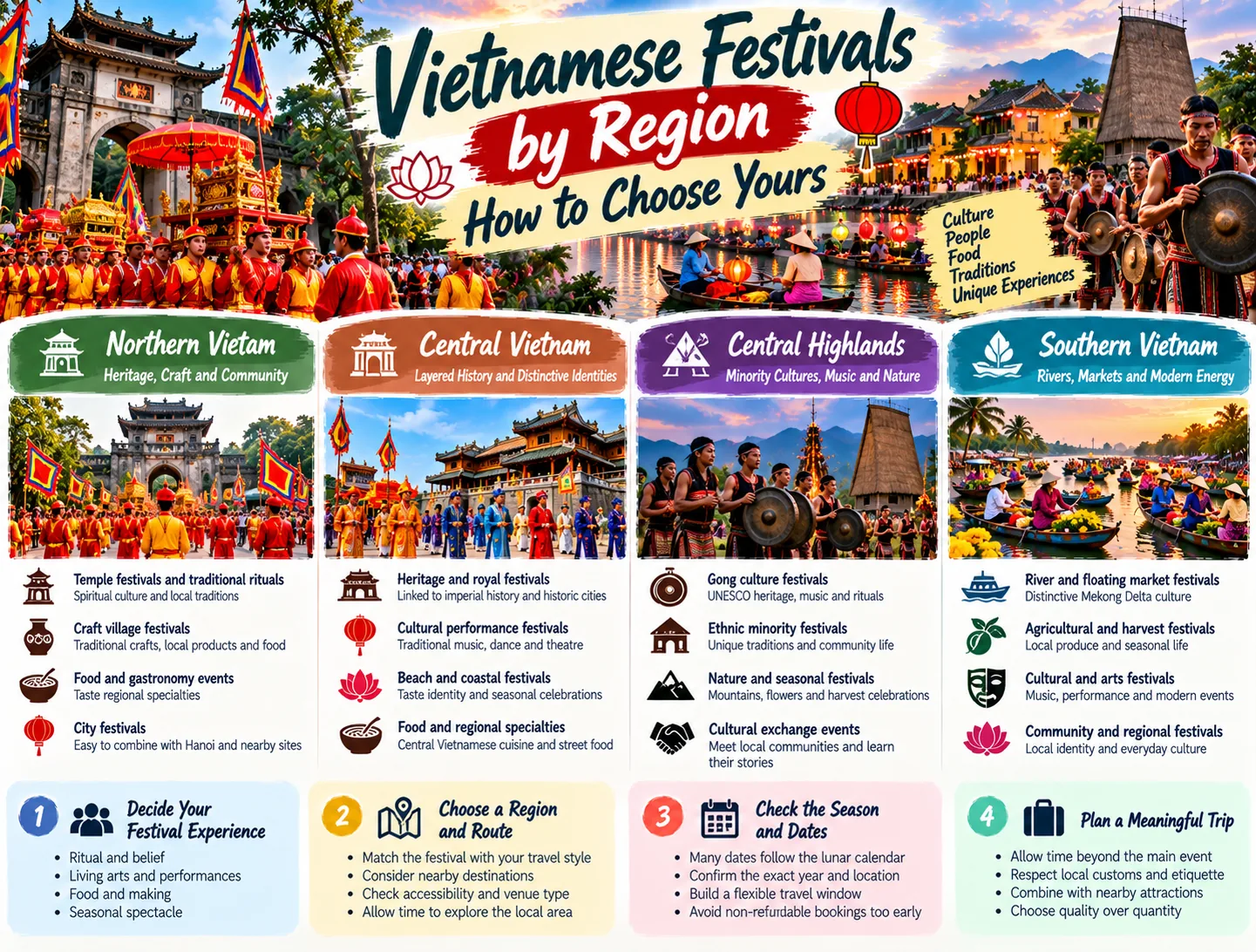
Other festivals may be tied to a temple, a village founder, a local historical event, a harvest, or a regional identity. That is why “Vietnamese festival” is a useful search term but not a single type of experience. The meaning of a procession in a northern village can differ greatly from the atmosphere of a lantern-filled evening in a central or southern city.
When should you visit for Vietnamese festivals?
Use the lunar calendar as a starting point
Many major Vietnamese festivals follow lunar dates, but the public program may extend before or after the central ritual. A festival can therefore be experienced in several ways: preparation days, the main ceremony, cultural performances, or the quieter period afterward. Search for the local organizer or provincial tourism authority once you know your destination, because dates and public access can change from year to year.
Expect different rhythms across the country
Tết is observed nationwide, but its visible expression varies by region and family. In large cities, public decorations and countdown events may be prominent. In smaller communities, the focus may be on returning home, cleaning and decorating houses, visiting relatives, and honoring ancestors. During the holiday period, transport demand can be high and some businesses may close or operate on reduced schedules. Build flexibility into your itinerary instead of planning a tightly packed sequence of attractions.
Mid-Autumn celebrations, known in Vietnam as Tết Trung Thu, are especially associated with children, lanterns, mooncakes, lion or dragon dances, neighborhood gatherings, and family time. The broader festival falls on the fifteenth day of the eighth lunar month; the Vietnamese form has its own local meanings and practices. For context on the festival’s regional connections and calendar basis, consult this Mid-Autumn Festival reference page, then look for local Vietnamese information before making specific plans.
Major Vietnamese festival experiences to understand
Tết: family, renewal, and return
Tết is often the most visible answer to the question “What are the major festivals in Vietnam?” Yet it is not primarily a street spectacle. It is a time of reunion and ritual. Families may prepare special foods, clean their homes, display flowers, visit ancestors, exchange good wishes, and give lucky money to children. Visitors may see decorated streets, flower markets, public performances, and fireworks in some places, but access to private family customs should never be assumed.
If you travel during Tết, be patient with changes to transport, opening hours, and availability. Avoid treating an altar, family home, or ritual offering as a casual backdrop. A simple greeting, modest clothing, and willingness to follow local guidance go further than trying to reproduce a ceremony for a photograph.
Tết Trung Thu: lanterns and children’s traditions
Mid-Autumn events often create a more playful public atmosphere. Children may carry lanterns, watch lion dances, join neighborhood activities, and share festival foods. Streets can become crowded, especially where a ward or community has organized a public program. The most considerate way to observe is to stand at the edge of the activity, keep walkways clear, and ask before photographing children or performers at close range.
Local temple and village festivals
Across Vietnam, local festivals can honor a deity, hero, founder, or sacred place. Some include offerings, incense, drums, flags, processions, wrestling, boat racing, folk games, or traditional arts. These events are valuable precisely because they are rooted in a particular community. Research the place and the festival together: a title alone rarely tells you whether the event is religious, historical, recreational, or a combination of all three.
Before visiting, read the guidance in Visiting Temples and Sacred Places Respectfully. It offers a useful foundation for clothing, photography, movement, and behavior around sacred spaces.
How to participate without taking over
Observe first
When you arrive, spend a few minutes watching before joining. Notice whether people are moving toward a ritual area, waiting in a queue, making offerings, or simply watching a performance. A public event is not automatically an invitation to enter every space. Follow barriers, signs, volunteer instructions, and the behavior of local participants.
Ask before photographing
Wide photographs of a public procession may be acceptable, but close portraits, children, altars, worshippers, and private preparations require more care. Ask using a guide, translator, or simple gesture when language is limited. If someone declines, lower the camera without argument. Do not use flash during solemn moments or block a route to capture a better angle.
Dress and behave with context in mind
At temples, communal houses, shrines, and ritual spaces, choose clothing that covers shoulders and knees where practical. Remove hats or shoes when local practice requires it. Keep your voice low near worship, avoid touching objects, and do not place personal items on altars. Festival crowds can be lively, but sacred areas still deserve calm attention.
Spend locally and avoid pressure
Buying food, crafts, or a small festival item can support residents, but do not bargain aggressively during a community celebration or pressure children to perform for money. If a performance is ticketed or a donation is requested, use the official route where possible. A thoughtful visitor contributes without demanding access in return.
How to plan a festival day
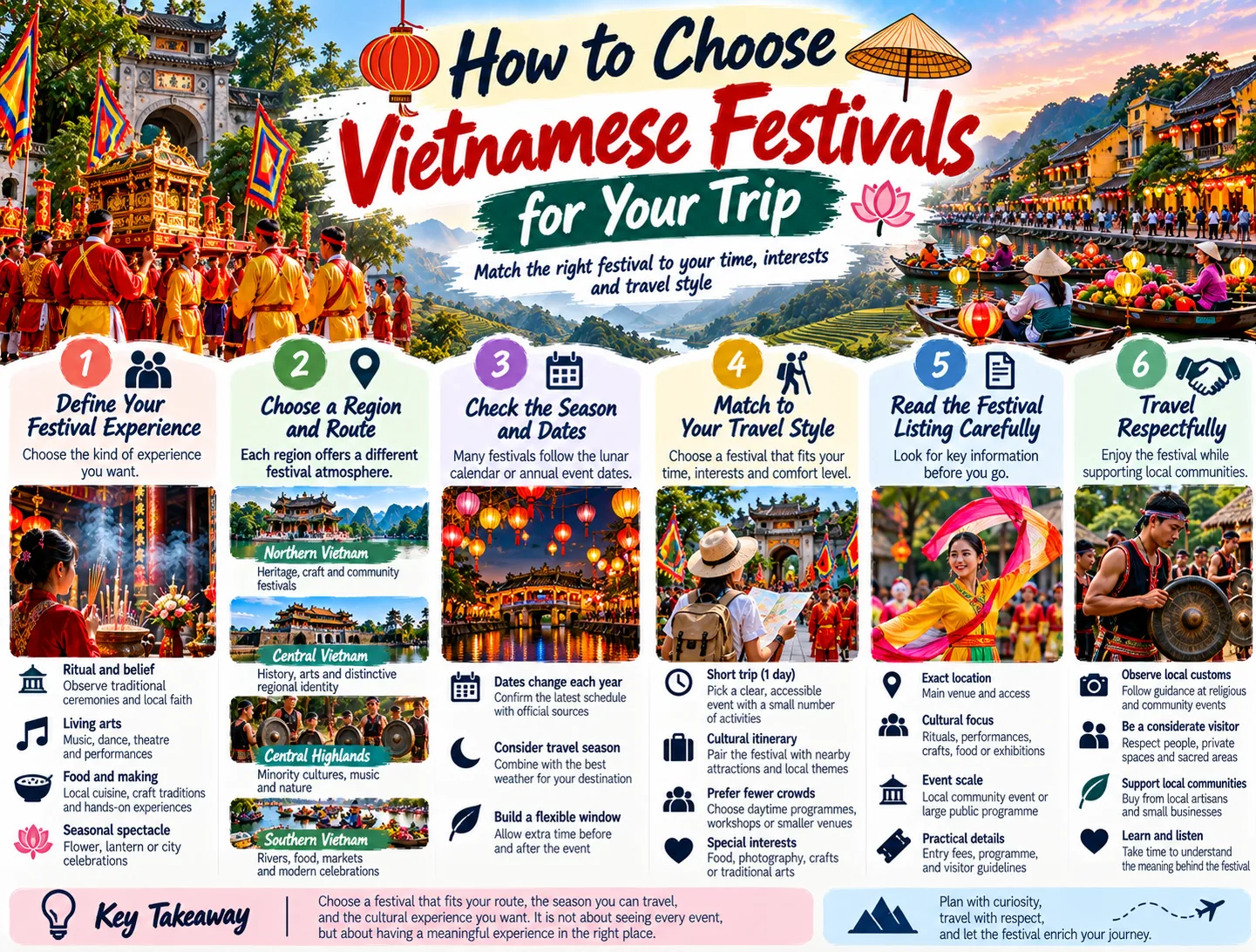
Choose one anchor event
Start with one ceremony, procession, performance, or market rather than attempting to cover an entire festival. Confirm the venue, approximate timing, transport options, and whether the activity is public. Then leave space for walking, waiting, weather, crowds, and unexpected changes. Festival programs are human events, not guaranteed stage schedules.
Plan arrival and departure separately
Public transport and roads may be busier than usual. Arrange a meeting point that is easy to recognize, keep your phone charged, and save the address in Vietnamese if you are traveling independently. If the event is outside a major city, ask your accommodation about the final local connection rather than assuming a ride-hailing service will be available late at night.
Bring less
A small bag, water, sun protection, and comfortable shoes are usually more useful than extensive camera equipment. Crowded events are easier to navigate when your hands are free. Carry cash only in a sensible amount, protect your phone, and avoid placing valuables in open pockets. These are practical precautions, not reasons to approach a community with suspicion.
Find the cultural context before you go
A festival becomes more understandable when you learn about the place hosting it. Read about local history, arts, foodways, and sacred geography rather than searching only for a list of “things to see.” The site’s Historical Sites & Heritage category can help you connect celebrations with the stories of a destination. For performances, music, and theatrical traditions, explore Traditional Arts & Performances.
It is also worth reading Listening for the Story in Vietnamese Traditional Arts before attending a festival performance. The aim is not to memorize every instrument or legend, but to practice looking beyond spectacle. Ask what the performance communicates, who maintains it, and whether it belongs to a ritual setting or a staged cultural program.
For broader itinerary planning, Planning a Cultural Trip That Leaves Room to Listen offers a useful reminder: leave time for conversation, observation, and changes of pace. Festivals reward travelers who are present rather than hurried.
Use language and local guidance well
A few Vietnamese words can make a festival visit warmer and less intrusive. “Xin chào” is a simple greeting, while “cảm ơn” means thank you. If you need permission to take a photograph, ask politely and accept the answer. Carry the festival name, venue, and your accommodation address in written Vietnamese so that a driver or local resident can help when pronunciation becomes difficult.
Local hosts are often the best source for details that do not appear online: which entrance visitors should use, whether a ceremony is private, where to stand during a procession, or when a road will close. Treat this guidance as part of the experience rather than an inconvenience. If an organizer asks visitors not to film, respect that request even when other people appear to be recording.
Language also helps you avoid flattening different events into one category. Ask whether an activity is a lễ hội, a religious ceremony, a cultural program, or a neighborhood gathering. The answer can change how you dress, where you stand, and what kind of participation is appropriate.
Common mistakes visitors can avoid
- Do not assume every festival has a single official English-language schedule.
- Do not describe a religious ceremony as entertainment simply because visitors can watch it.
- Do not enter restricted areas, touch offerings, or imitate ritual gestures for a photograph.
- Do not photograph children, monks, worshippers, or grieving families without permission.
- Do not promise that a festival will look the same every year; local programs evolve.
- Do not judge a quiet event as less authentic than a crowded one. Participation may be intentionally local.
When information is unclear, ask a local host, guide, organizer, or community volunteer. A respectful question is better than confident guesswork, especially when customs vary by region, religion, and family.
A more meaningful way to experience Vietnamese festivals
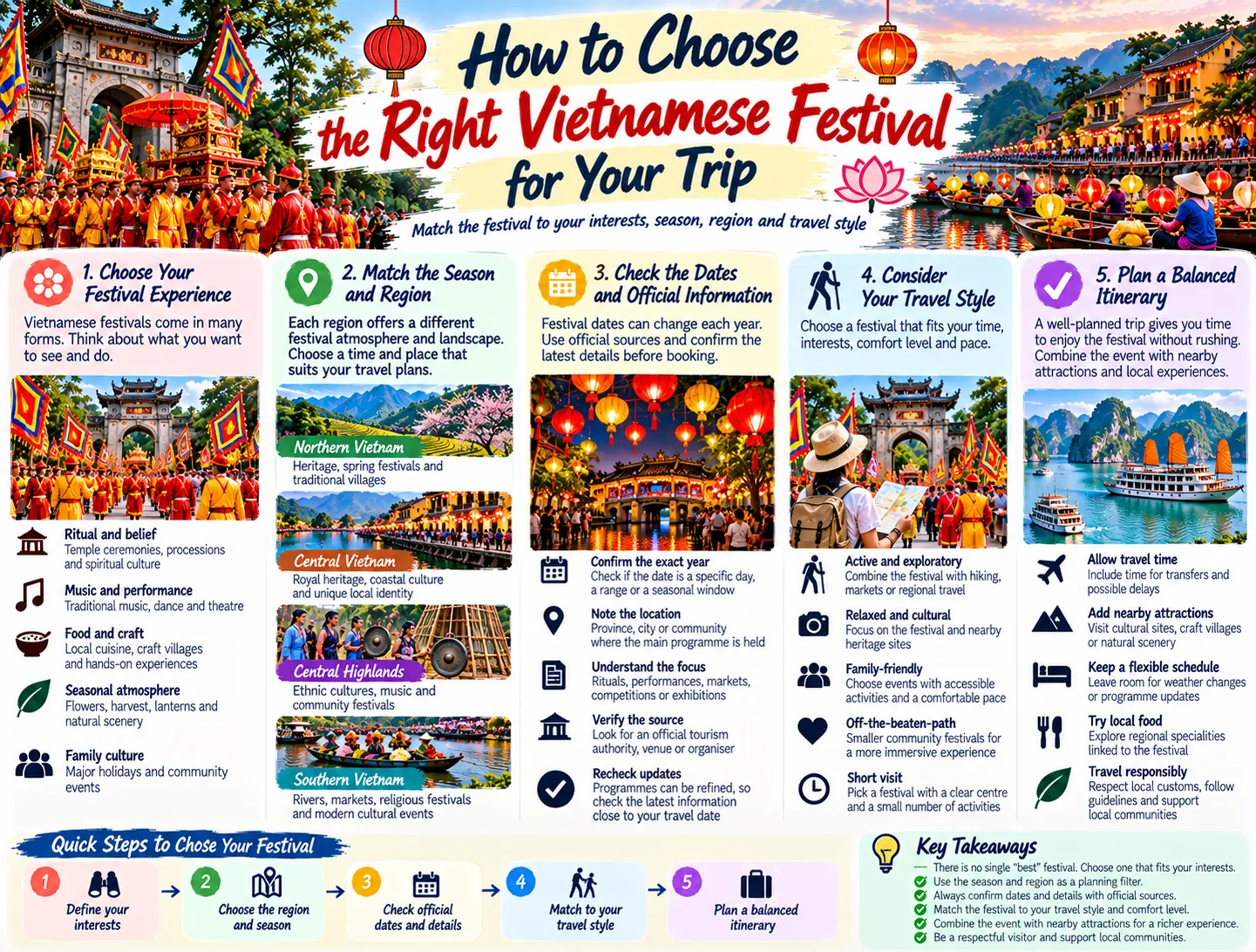
The best Vietnamese festival experience is not necessarily the largest or most photogenic. It may be a short walk through a decorated neighborhood, a temple visit made with care, a conversation about a village tradition, or an evening spent watching families share food and stories. Let the community set the rhythm. Listen before interpreting, observe before photographing, and accept that some moments are meaningful precisely because they are not staged for visitors.
With that mindset, a festival becomes more than an item on a Vietnam itinerary. It becomes an opportunity to understand how memory, belief, family, place, and public life meet—and to travel through that meeting with humility.
JOIN THE CONVERSATION
Comments (0)
No comments yet. Be the first to share a thought.