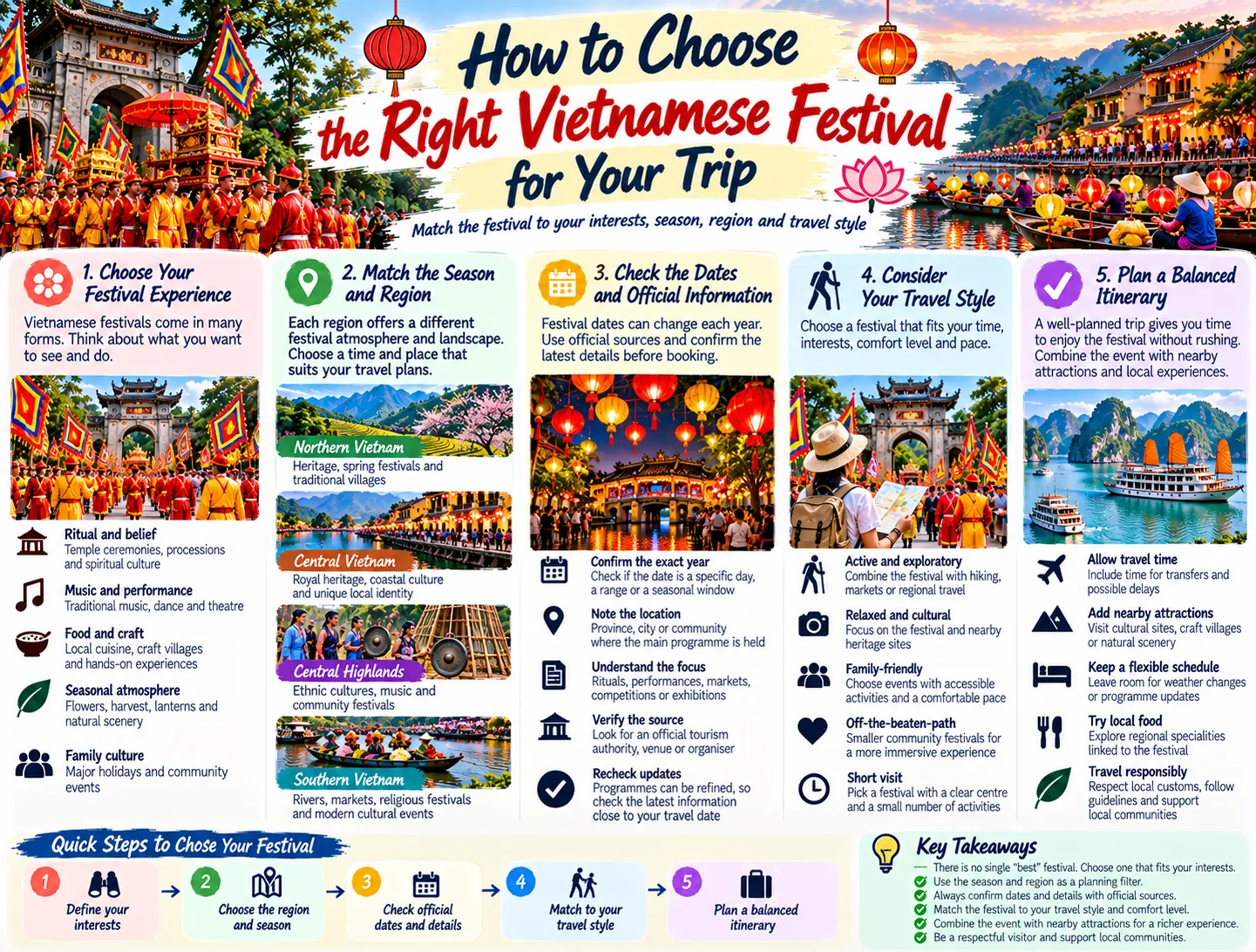
Vietnamese festivals are not a single kind of travel experience. Some are family-centered holidays, some are temple celebrations, and others are community events where music, ritual, food, craft, or seasonal landscapes become the focus. The most useful way to plan is not to collect the longest festival list, but to match a Vietnamese festival to the place, season, pace, and level of participation you actually want. This guide explains how to make that choice while leaving room for local customs and last-minute event updates.
Start with the kind of festival experience you want
The phrase “Vietnamese festivals” covers events with very different rhythms. A large national holiday can affect transport, accommodation, family visits, and business hours across the country. A local temple festival may be concentrated in one neighborhood and make sense as part of a heritage walk. A cultural festival in the Central Highlands may reward a slower trip built around performances, craft, landscape, and conversations rather than a quick stop.
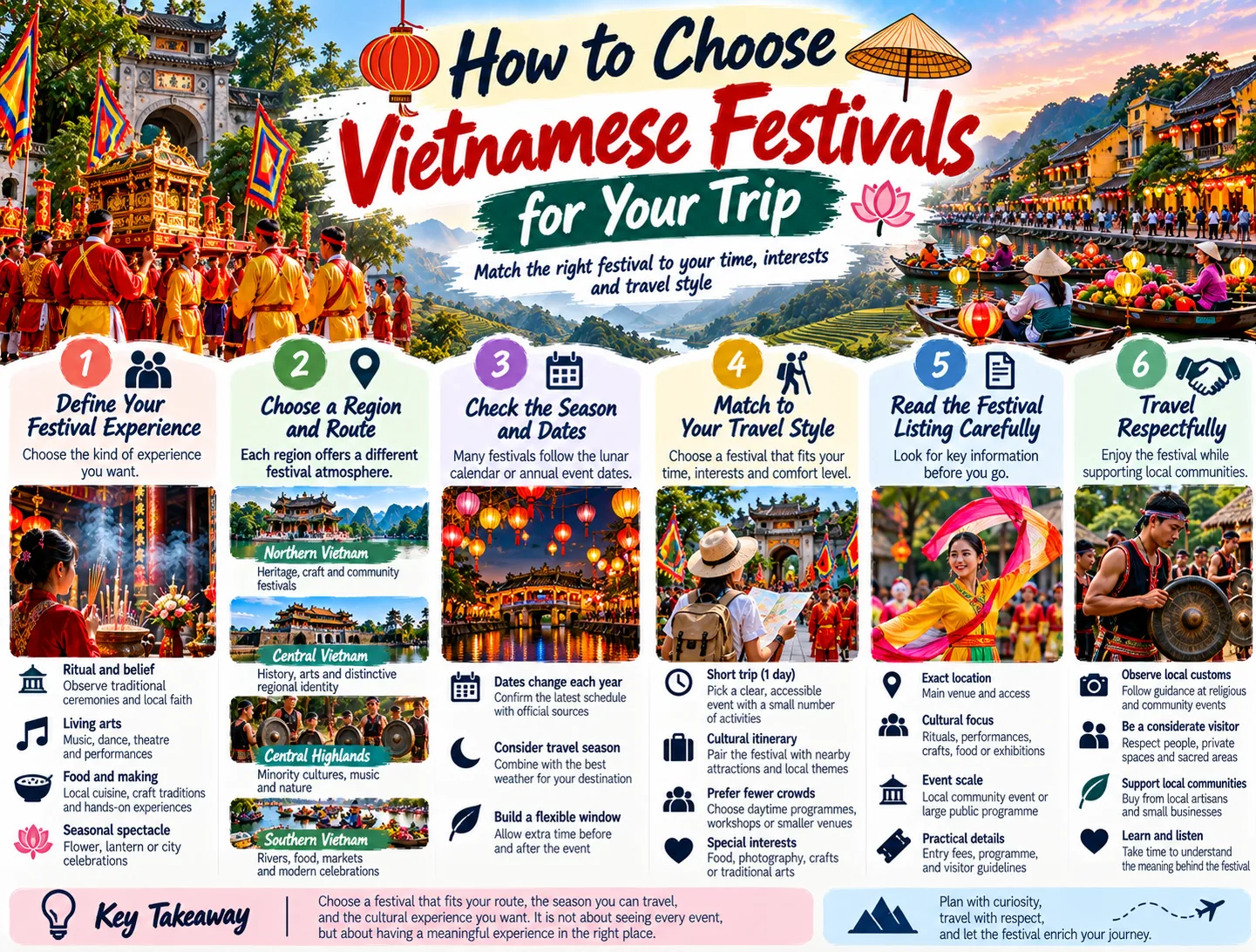
Before choosing a date, decide what you hope to notice:
Seasonal atmosphere: Choose an event connected to flowers, harvest, moon-viewing, or the changing weather if visual setting matters most.
Ritual and belief: Look for a festival where religious or ancestral meaning is central, and plan to observe rather than treat sacred moments as a show.
Music and performance: A festival featuring traditional instruments, dance, or theatre may suit travelers who want a structured evening program.
Food and craft: Community markets and craft-focused celebrations can be a better fit for hands-on curiosity than a crowded headline event.
Family culture: Major holidays offer insight into reunion, offerings, home decoration, and hospitality, but public travel may require extra patience.
This decision also helps you avoid repeating the broad approach in Experiencing a Vietnamese Festival as a Visitor. Use that existing guide for general etiquette, then use the planning framework here to select a more suitable festival style.
Match the festival to the season and region
Vietnam stretches from the Red River Delta to the Mekong Delta, so a festival calendar is also a regional travel calendar. A date that looks convenient on paper may not fit the weather, landscape, or transport pattern of the destination. Treat the month as a starting point, then verify the specific year with the official organizer or tourism authority before booking non-refundable plans.
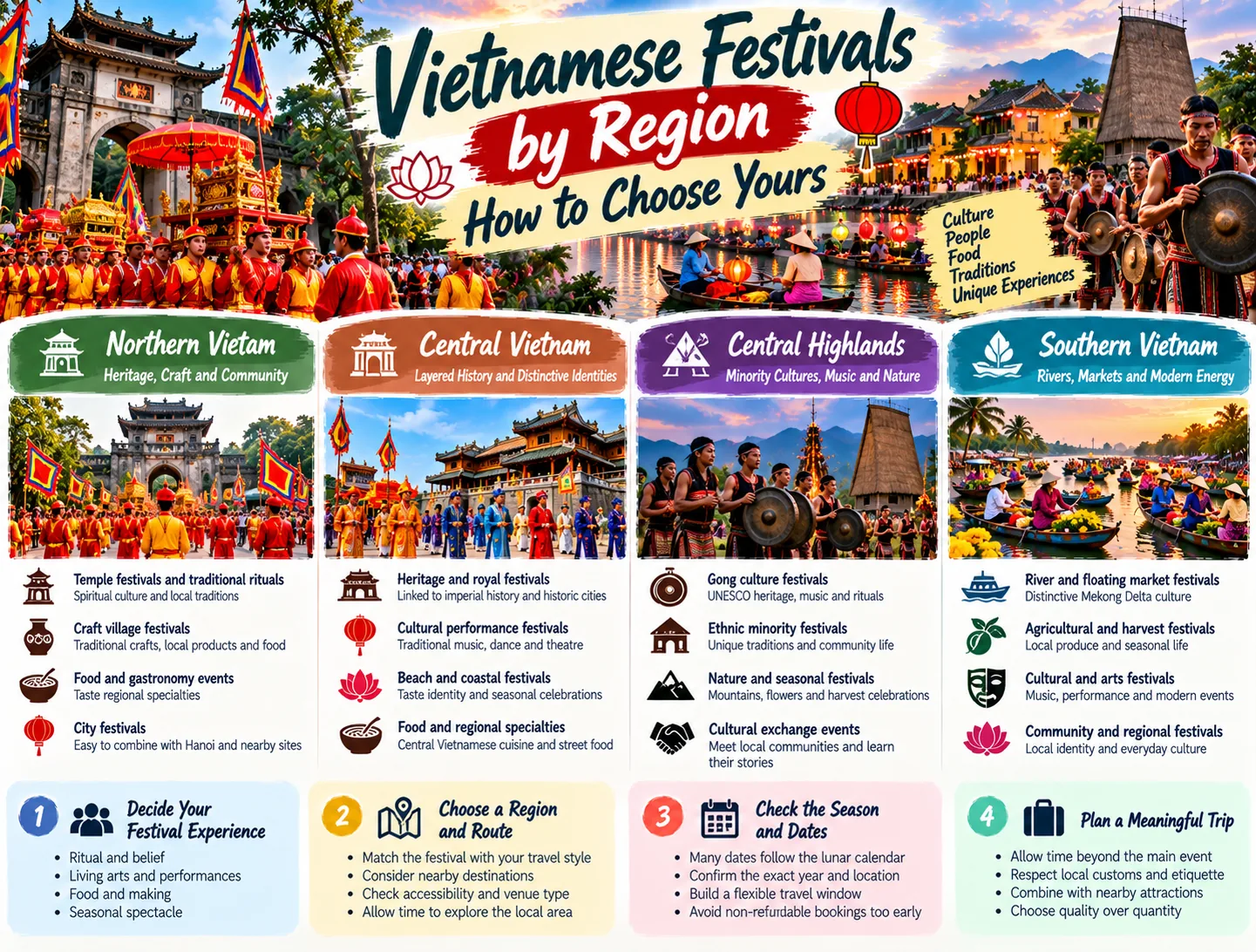
North: heritage, spring, and public holidays
Northern Vietnam is often appealing when you want to combine a festival with old quarters, village temples, historic architecture, or a short cultural route. Spring celebrations can bring vivid public activity, but they may also overlap with a period when families are traveling and local businesses are taking time off. Build flexibility into your schedule rather than assuming every attraction will follow a normal weekday routine.
Central Vietnam: ritual and place-based identity
Central festivals can work well for travelers who enjoy connecting a celebration with royal, coastal, religious, or craft heritage. The strongest itinerary is usually not “festival only.” Pair the event with one nearby museum, historic site, or workshop so you have context before and after the busiest program. The site’s Historical Sites & Heritage category can help you build that second layer.
South and the Central Highlands: community scale and cultural variety
In the south and Central Highlands, look for events where music, community identity, agricultural landscapes, or ethnic traditions shape the program. These may be especially rewarding if you prefer an immersive regional trip to a checklist of famous attractions. They also require respectful expectations: a visitor can attend, listen, and learn without assuming every ceremony is open for close participation.
Use official event information without overplanning
Festival dates can be announced, refined, or presented as a date range. The official Vietnam Tourism listing for the 2026 Kate Festival gives October 1–31, 2026, in Lam Dong, and describes it as an important annual religious event for the Cham Brahman people. It also identifies rituals including bathing and dressing statues, traditional music, dancing, and offerings. That combination tells a traveler two important things: the event is culturally significant, and a visit should be planned as respectful observation rather than casual entertainment.
The same principle applies to the Central Highlands Gong Culture International Festival. Vietnam Tourism lists it for October 1–31, 2026, within Visit Vietnam Year 2026–Gia Lai, and describes performances, rituals, and cultural experiences connected with the UNESCO-recognised Space of Gong Culture. For a traveler, this suggests an itinerary that allows time for performances and regional exploration instead of arriving for one brief photo opportunity.
When checking a festival page, record five details:
The exact year and whether the date is a confirmed day, a range, or a typical seasonal window.
The province, city, or community where the main program is held.
Whether the description emphasizes rituals, performances, markets, competitions, or exhibitions.
Whether the page names an official tourism authority, venue, or organizer.
Whether the event page has been updated for your travel year.
Do not turn a date range into a promise that every activity runs every day. Keep the official page open while planning, and recheck the detailed program when it becomes available.
Choose an itinerary length that leaves room for meaning
A festival day can be busy, noisy, and visually rich. That does not mean you should fill every hour around it. A one-day visit may work for a compact urban event, while a regional celebration deserves at least one buffer day for weather, transport, rest, or a change in program.
For a short trip
Choose a festival close to your existing route. Arrive before the most important public program, learn where visitors are expected to stand, and leave enough time to move away from the crowd without rushing. A short trip is best when the festival is one element of a city stay, not the only reason you crossed a difficult distance.
For a slower cultural trip
Spend a day learning the setting first. Visit a museum, historic neighborhood, craft village, or cultural center, then attend the festival with better questions. The site’s A More Curious Visit to Vietnam’s Museums offers a useful companion approach: look for the people, objects, and interpretations that help you understand what you are seeing.
A slower itinerary also gives you time to notice what is not on the headline schedule: families preparing offerings, musicians rehearsing, vendors adapting a familiar food for a crowd, or residents choosing when to join and when to watch from the edge. These details are often more informative than trying to see every official activity.
Plan your behavior before you arrive
Good festival etiquette is less about memorizing a perfect list and more about recognizing that the event belongs to the community first. Dress in a way that suits the setting, especially when the program includes temples, shrines, ancestral spaces, or religious ceremonies. Watch how local people move through the space. If others lower their voices, wait, bow, remove shoes, or keep a distance, follow that pattern rather than treating the moment as a performance staged for visitors.
Ask before photographing people, offerings, ritual objects, or children. A camera can make a visitor feel more intrusive than a quiet observer does, particularly during a ceremony. If someone declines, accept the answer without bargaining. Avoid blocking processions, performers, entrances, or family groups for a better view.
Participation should be invited or clearly public. Buying food, listening to music, joining a workshop, or watching a parade is different from entering a restricted ritual area or handling an object with ceremonial meaning. When the boundaries are unclear, ask an organizer, guide, or host in a low-pressure way. The goal is not to gain access to everything; it is to understand what respectful access looks like.
For broader preparation, pair this article with Everyday Vietnamese Customs Visitors Can Meet with Care, especially if you are unsure how to respond to invitations, offerings, greetings, or shared meals.
Build practical plans around uncertainty
Festival schedules are living plans. Weather, safety decisions, crowd management, performer availability, and local priorities can change the order or location of activities. Use the published program as a guide, not a guarantee. Confirm the main venue, the latest start time, and any visitor instructions shortly before you travel.
Keep your arrival and departure simple. If the festival is outside the city where you sleep, avoid booking a final connection immediately after the closing program. Crowds can slow local movement, and the most meaningful part of an event may happen later than the headline time suggests. Carry only what you need, keep valuables secure, and choose a meeting point if you are traveling with others.
Think about comfort without turning the article into a shopping list. Wear shoes suitable for standing and uneven surfaces, carry water according to the venue’s rules, and protect yourself from sun or rain. If you have mobility, dietary, hearing, or sensory needs, contact the organizer or accommodation in advance with specific questions. A smaller event with clearer access may be a better choice than a famous one that creates avoidable strain.
Use the site’s Cultural Travel Experiences category to compare festival planning with other forms of culture-led travel, and Traditional Arts & Performances when music, dance, or theatre is the main reason you are considering an event.
Know what makes a festival a good fit
The best Vietnamese festival for you is not automatically the biggest or most photographed. It is the one whose scale, timing, meaning, and setting match the way you travel. Choose a major public holiday when you want to understand national family traditions and can accept busy logistics. Choose a local religious festival when you are willing to observe carefully and give sacred space priority. Choose a regional cultural festival when you can slow down, learn the background, and spend money and attention in ways that support local hosts.
As you compare options, ask:
Can I explain why this festival matters beyond its visual appeal?
Will I have enough time to arrive without rushing?
Do I know which parts are public and which may be private or restricted?
Have I checked a current official page rather than relying on an old calendar?
Can my itinerary remain enjoyable if the schedule changes?
Those questions turn a festival search into a cultural decision rather than a date hunt.
Conclusion: travel toward the story, not just the spectacle
Vietnamese festivals reward visitors who arrive with curiosity, patience, and a willingness to follow local rhythms. Start with the experience you want, match it to a region and season, verify current details, and leave room for the event to be more complex than its photographs. When you observe respectfully and plan with flexibility, a festival becomes more than a colorful stop: it becomes a way to listen to the beliefs, memories, arts, and relationships that give a place its living culture.
JOIN THE CONVERSATION
Comments (0)
No comments yet. Be the first to share a thought.