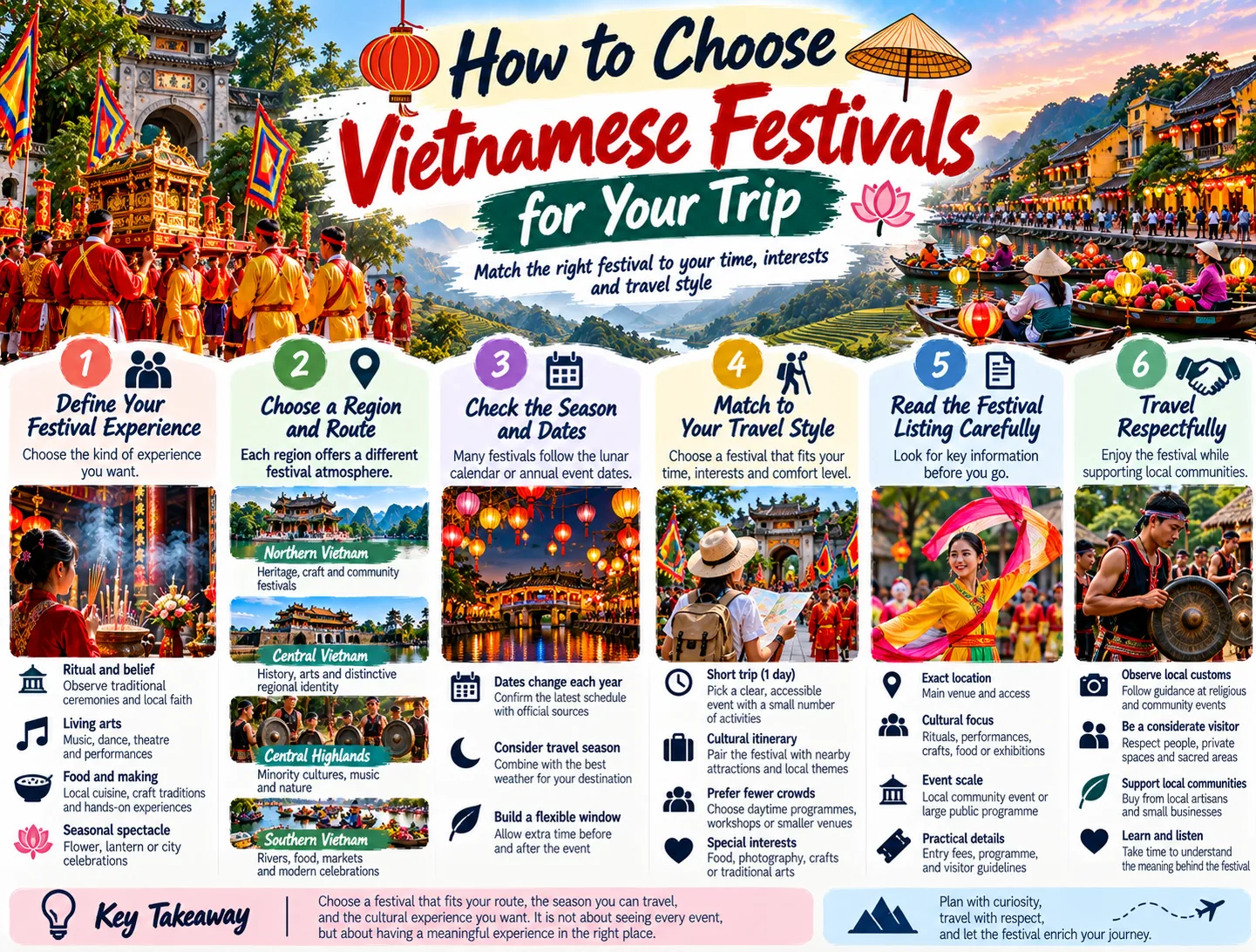
Vietnamese festivals are not one single kind of travel experience. Some are intimate family observances, some are large public celebrations, and others are living expressions of a community’s religious or artistic identity. The best choice depends less on finding the “biggest” event than on matching a festival to your time, interests, comfort with crowds, and willingness to participate respectfully. This guide offers a practical way to choose Vietnamese festivals, understand what you may encounter, and plan without treating culture as a checklist.
Start with the kind of festival experience you want
Before looking at dates, decide what you want the day to feel like. A festival centred on worship may reward quiet observation, while a city programme may be designed for movement between performances, food stalls, exhibitions, and public spaces. This distinction matters because the same word—festival—can describe very different relationships between visitors and hosts.
For cultural learning
Choose an event where the meaning is visible in rituals, music, dress, offerings, or stories passed through generations. The Kate Festival, for example, is described by Vietnam’s official tourism authority as the most important annual religious event for the Cham Brahman people in Vietnam. Its programme includes rituals involving statues, traditional music, dancing, and offerings honouring gods and kings. A visitor should approach such an event as an observer first, not as a staged performance created for tourists.
For lively public celebration
Look for a festival with a broad cultural-tourism programme. These events may suit first-time visitors because they can combine food, craft, music, and a destination’s wider attractions. They can also be busy and spread across several venues, so a flexible plan is more useful than trying to see everything.
For a slower, creative day
Craft, flower, food, and arts festivals often work well for travellers who prefer browsing and conversation to standing in a dense crowd. They give you more opportunities to notice materials, techniques, regional flavours, and the work behind an object. The site’s guide to visiting a Vietnamese craft village thoughtfully is a useful companion when a festival includes artisan demonstrations or market-style displays.
Use the season as a planning filter
Vietnamese festivals follow both the lunar calendar and local event calendars, so dates vary. Some observances are closely tied to a lunar month or religious tradition; others are announced as annual cultural-tourism programmes with dates that can change. Treat a festival listing as a planning lead, then confirm the current edition with the organiser or an official tourism source before booking non-refundable travel.
Autumn can be a particularly active period for public cultural programming. On the official Vietnam Tourism events calendar consulted for this guide, the 2026 Kate Festival is listed for 1–31 October in Lam Dong, while the Hanoi Craft Village Tourism & Gastronomy Festival is listed for 1–31 October in Ha Noi. These are year-specific listings, not proof that every future edition will use the same dates. They do show how one month can offer different styles of festival: a community religious celebration in the Central Highlands region and an urban programme focused on craft and food.
December brings another contrasting example. The 11th Da Lat Flower Festival 2026 is listed for 1–31 December, with activities extending across Da Lat and neighbouring districts to showcase Lam Dong’s flower industry. If you prefer a destination-wide cultural event, this kind of listing may suit you; if you want one concentrated ceremony, it may feel too dispersed. Always check the detailed programme when it becomes available.
Match the festival to your travel style
If you have only one free day
Choose a festival with a clear centre and a small number of accessible activities. Arrive early enough to understand the layout, identify a quiet place to pause, and select one or two experiences rather than racing between every stage. A day trip should leave time for ordinary local life around the event: a meal, a walk, or a visit to a nearby cultural site.
If you are building a cultural itinerary
Pair the festival with an adjacent theme rather than adding unrelated attractions. A craft-focused programme can connect naturally with the Traditional Craft Villages category. A performance-led event can sit alongside the site’s guide to listening for the story in Vietnamese traditional arts. These links help you prepare your eyes and ears before arriving, so the festival becomes part of a cultural conversation rather than an isolated photo stop.
If you dislike crowds
Prioritise daytime programmes, workshops, exhibitions, or smaller connected venues. Avoid assuming that the headline ceremony is the only worthwhile part. Ask whether the event has multiple locations, and leave room to step away when a space becomes too crowded. A festival can be meaningful without staying until the final performance.
Read a festival listing for practical clues
A concise event page usually gives you four important clues: date, location, cultural focus, and scale. The official listing for the Hanoi Craft Village Tourism & Gastronomy Festival 2026 describes a programme celebrating culinary excellence and traditional craft villages while connecting artisans, businesses, and visitors. That wording suggests a visitor should expect a public-facing exchange between makers and guests, but it does not guarantee a particular workshop, product, price, or timetable. Those details need separate confirmation.
Likewise, the official Da Lat listing calls the flower festival a major cultural-tourism event attracting millions of visitors and spreading across Da Lat and neighbouring districts. The practical implication is not that every activity will be crowded; it is that transport, accommodation, and daily routing deserve more attention than they would for a small neighbourhood observance. Read descriptions for planning implications, but do not turn promotional language into promises.
Confirm the edition year and exact dates.
Check whether the location names a city, province, district, or several venues.
Look for a programme, organiser, venue map, or visitor notice.
Separate confirmed activities from your assumptions about what “usually” happens.
Know when to observe and when to participate
Participation is not automatically more respectful than observation. At a religious ceremony, your most appropriate role may be to stand quietly, follow local instructions, and avoid entering restricted areas. At a public craft or food programme, conversation and purchasing may be welcome, but it is still better to ask before photographing a person, a ritual object, or an unfinished piece of work.
Wear practical, modest clothing when the programme includes sacred spaces or formal ceremonies. Keep your voice low during prayers, processions, or offerings. Do not touch objects simply because they are displayed within reach. If you are unsure, watch what local attendees do and ask a staff member or host. The broader principles in this guide to visiting temples and sacred places respectfully also apply when a festival temporarily changes how a familiar venue is used.
Photography deserves special care. A wide scene in a public square is different from a close portrait during a solemn ritual. Ask first, accept “no” without debate, and avoid blocking the path of participants. If a festival’s meaning is tied to a community rather than a performance for visitors, your attention and restraint are part of the experience.
Build a festival day around people, not just events
A good festival plan has a centre but does not reduce the destination to that centre. Allow time to understand who hosts the event, which communities are represented, and how the programme connects to everyday life. The site’s Ethnic Minority Cultures category can help you approach community-based celebrations with more context, while Cultural Travel Experiences offers a broader framework for travelling with patience and reciprocity.
Plan one anchor activity, one unhurried period, and one practical buffer. The anchor might be a confirmed ceremony, talk, parade, or performance. The unhurried period is for looking, listening, eating, or speaking with a maker. The buffer covers queues, weather, a changed venue, or simply the need to pause. This structure is more resilient than a minute-by-minute itinerary.
Food can be an important part of the day, but avoid treating a festival as a guaranteed restaurant guide. Look for clearly identified vendors, ask about ingredients when you need to, and choose busy stalls with transparent preparation. If a programme highlights regional cuisine, let it introduce you to flavours and stories rather than chasing every dish on a list.
Check current information before you commit
Festival details change more easily than the cultural traditions behind them. A date may be provisional, a venue may move, or a programme may be divided between several districts. The official Vietnam Tourism website is a useful starting point because it publishes event listings with dates, locations, and short descriptions. Its 2026 listings also show why checking the year matters: Kate Festival, the Hanoi craft and gastronomy event, and the Da Lat Flower Festival each have different locations, formats, and planning implications.
Use official tourism information for the broad outline, then look for the local organiser, destination authority, venue, or event notice for operational details. Confirm transport and accommodation separately. Do not assume that an old blog post’s opening hours, ticket process, parade route, or crowd advice remains current. If no reliable update is available, write your plan around confirmed facts and keep your schedule flexible.
For a deeper approach to festival etiquette and preparation, begin with the site’s existing guide to experiencing a Vietnamese festival as a visitor, then use the specific festival listing to narrow your choices. This avoids repeating generic advice while still giving you a practical starting point.
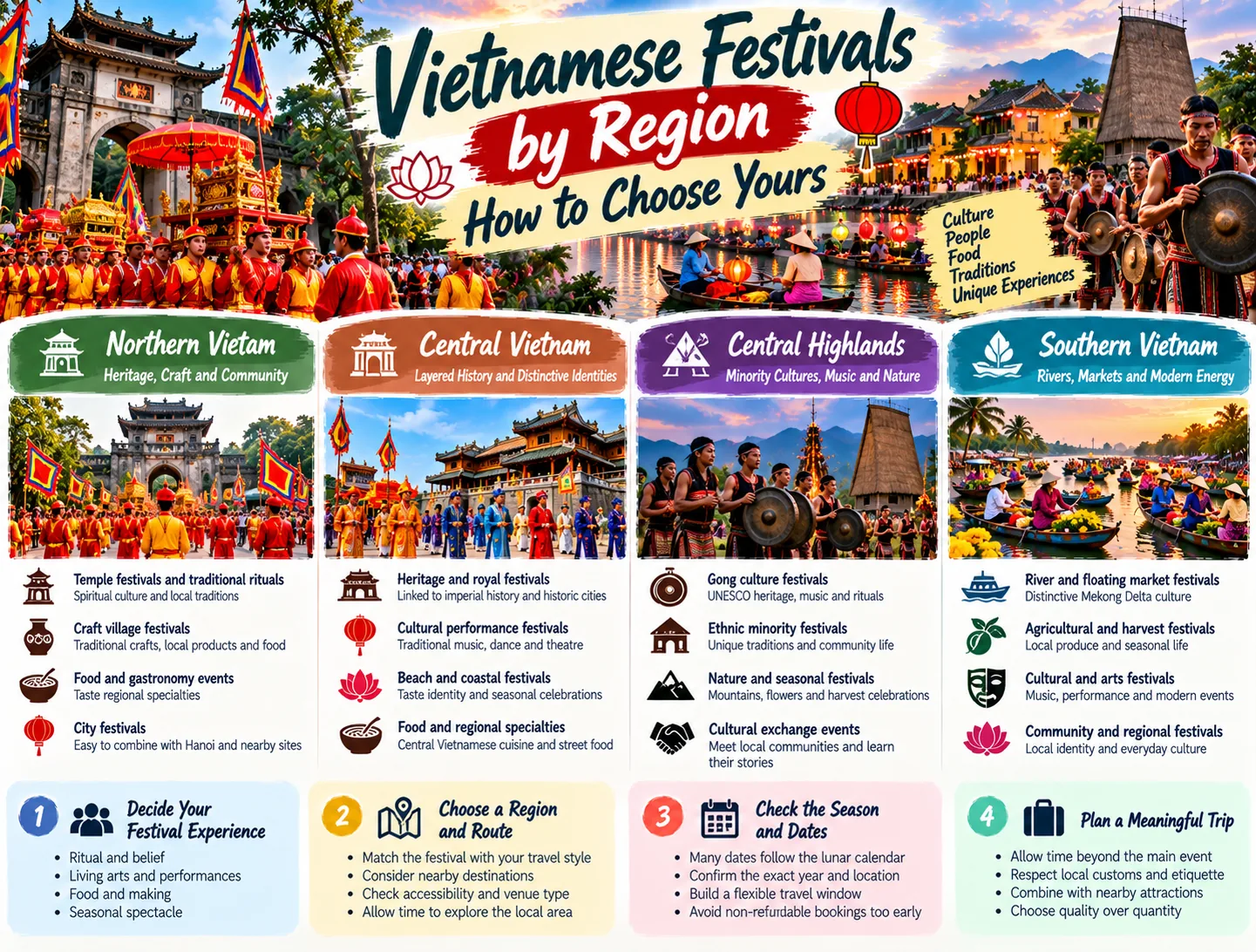
Choose by cultural focus, not just destination
Two festivals in the same region can offer completely different ways of meeting local culture. A religious festival may centre on continuity, ancestors, sacred figures, and community responsibilities. A craft or gastronomy event may centre on exchange: makers explain techniques, visitors ask questions, and organisers connect local products with a wider audience. A flower or city festival may use public space to tell a regional story through design, exhibitions, performances, and seasonal produce.
That difference helps you set realistic expectations. Do not judge a ceremony by the number of activities listed, or a public festival by whether it resembles a traditional ritual. Instead, ask what the event is trying to do. Is it honouring a deity, preserving an art, introducing a local industry, welcoming visitors, or bringing residents together? Once you know the purpose, you can choose better behaviour, better clothing, and better questions. You can also decide whether to spend an hour, a full day, or several days in the destination.
When a listing is brief, use its wording carefully. Terms such as “religious event,” “cultural-tourism event,” “craft village,” or “traditional music” are signals to research further, not invitations to fill gaps with assumptions. The most rewarding festival planning often begins with one unanswered question and enough time to let local people answer it.
Conclusion: choose meaning over magnitude
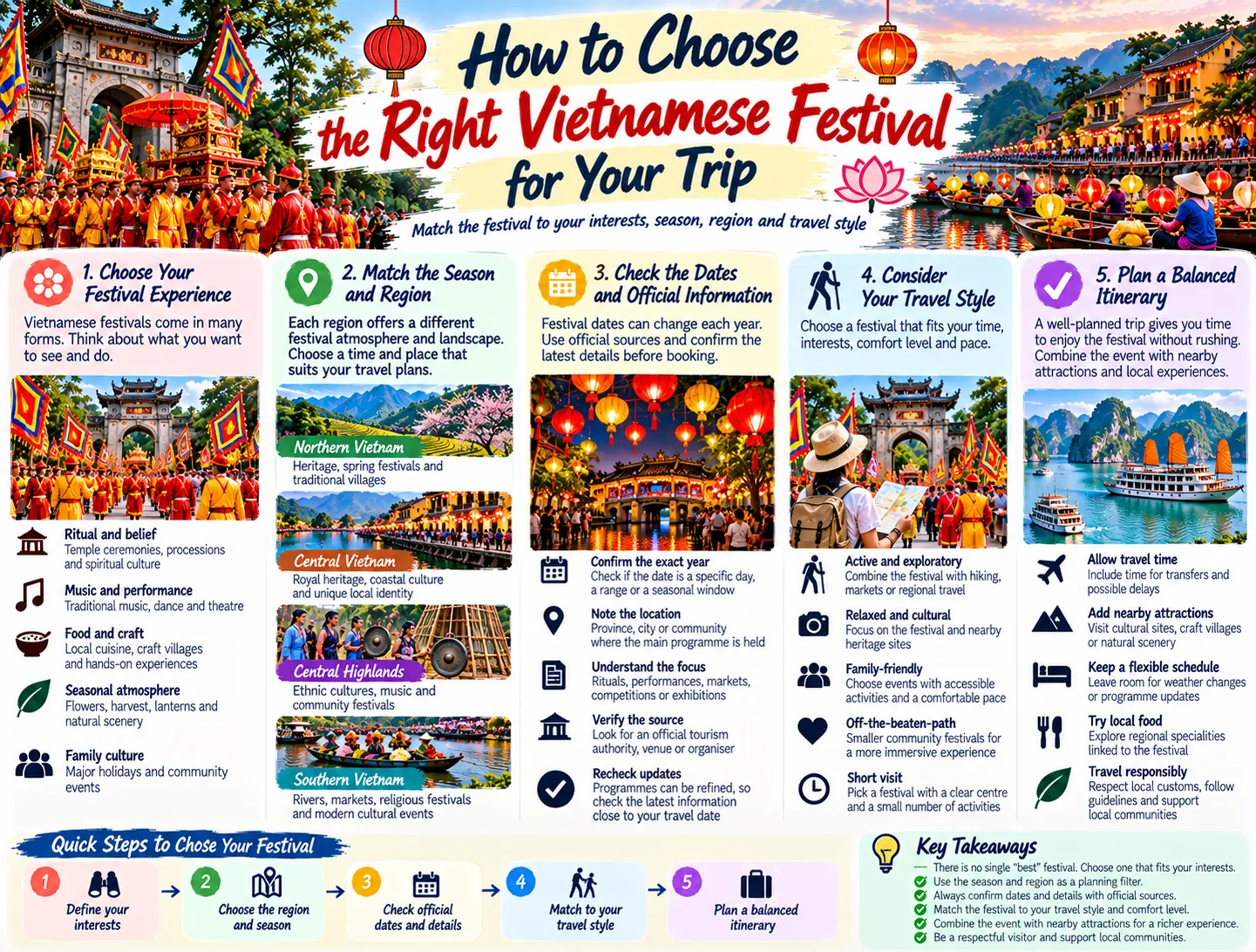
The best Vietnamese festivals for travellers are not necessarily the largest or most photographed. They are the ones whose timing, setting, cultural purpose, and visitor role fit the trip you want to have. Start with your preferred experience, filter by season and location, read the official listing carefully, and leave room to observe without rushing. Whether you choose a community religious celebration, a craft and food programme, or a destination-wide flower event, arrive prepared to listen. That attitude turns a festival visit from a spectacle into a more thoughtful encounter with Vietnam’s living culture.
JOIN THE CONVERSATION
Comments (0)
No comments yet. Be the first to share a thought.