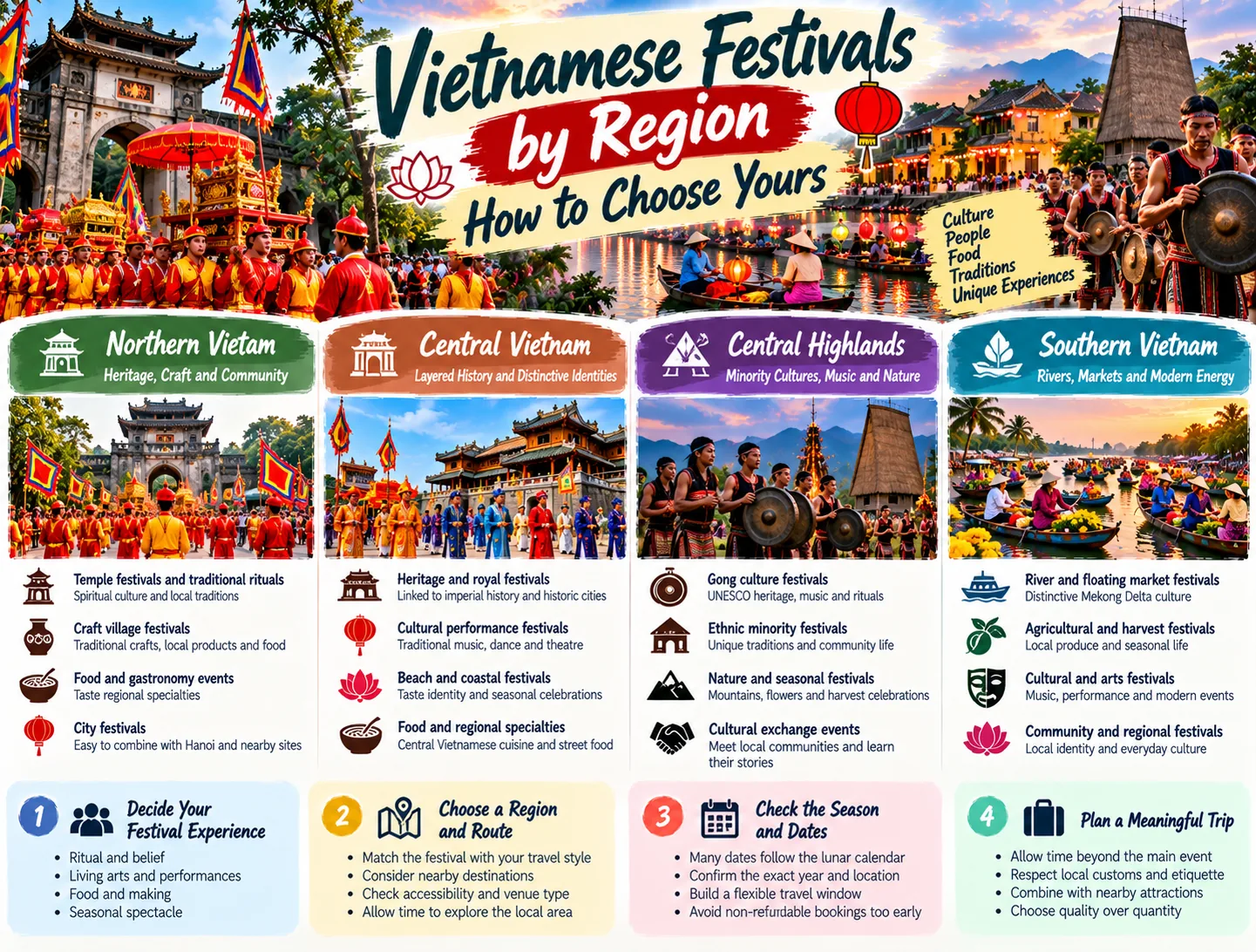
Vietnamese festivals are not one single travel experience. Some are intimate religious observances, some foreground music and performance, and others connect food, craft, flowers, or regional identity with a much larger public programme. The most useful way to choose is not to collect the biggest names, but to match a festival to your route, the season you can travel, and the kind of cultural encounter you want. This guide to Vietnamese festivals by region gives you a practical framework for making that choice without treating a living tradition as a tourist checklist.
Start with the experience you actually want
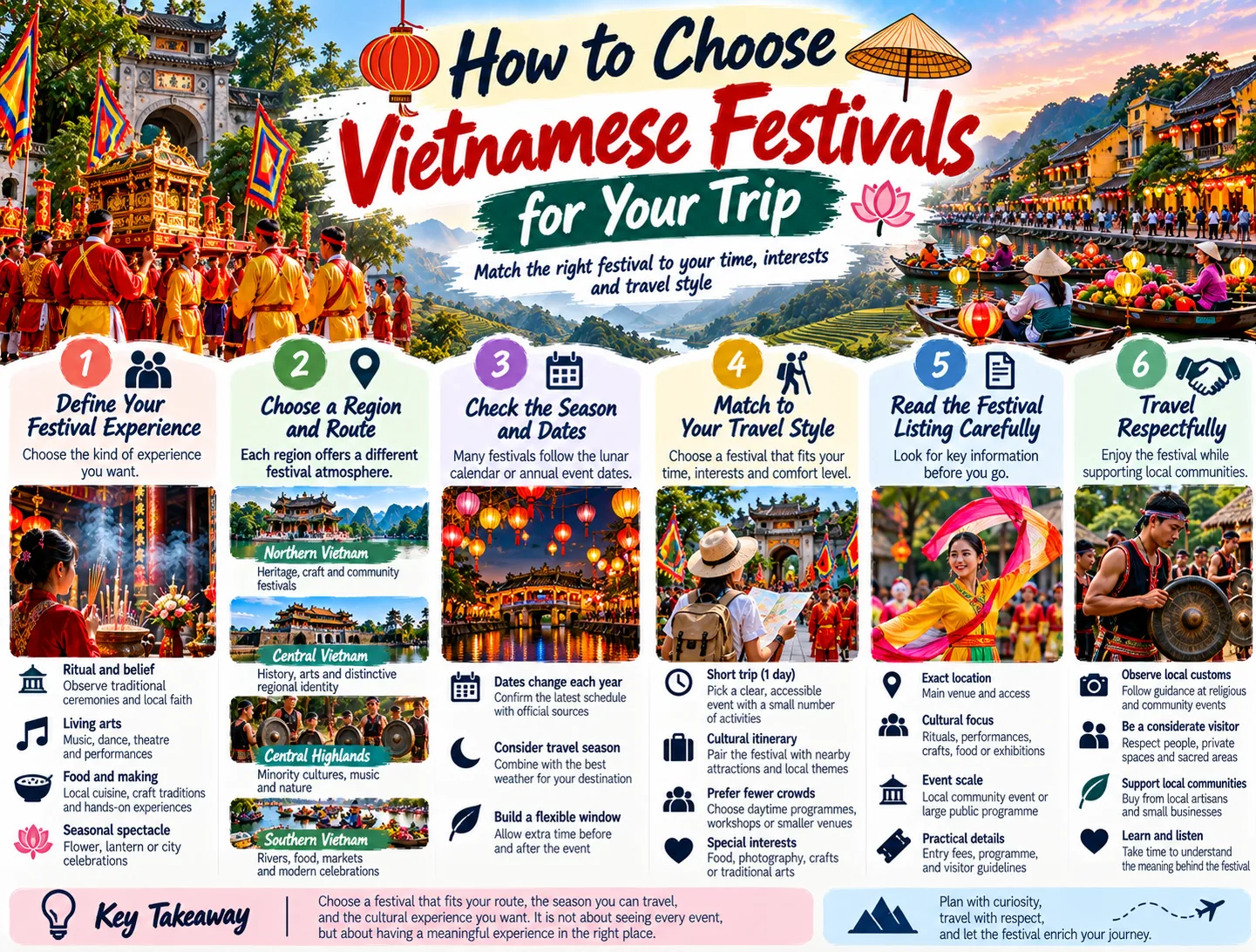
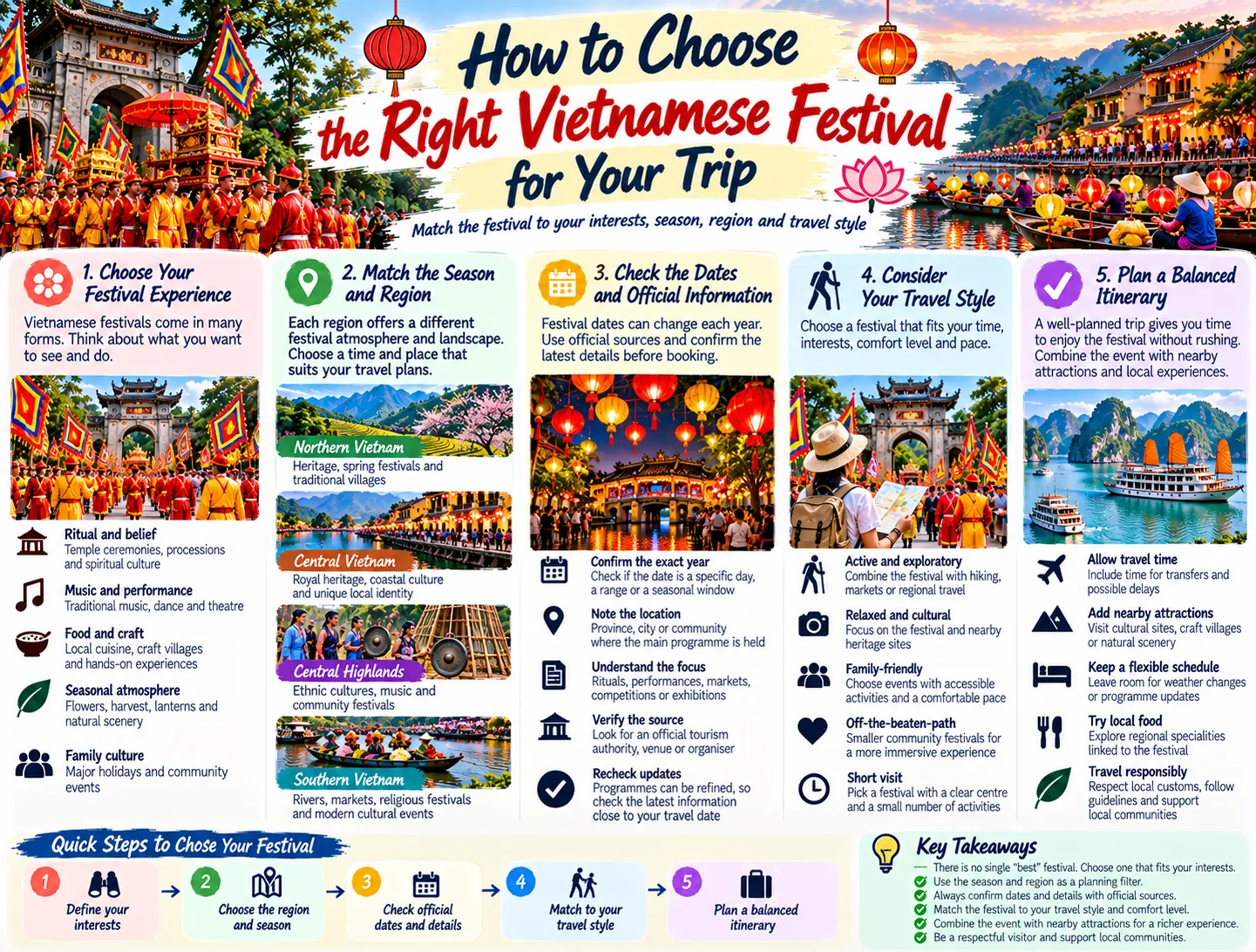
Before looking at a calendar, decide what “festival” means for your trip. A visitor who wants ritual and heritage should make different choices from someone seeking public performances, food, craft demonstrations, or a lively city programme. This first decision prevents a common mistake: choosing an event because its name is familiar, then discovering that its atmosphere does not suit your interests or comfort level.
Four useful festival profiles
Ritual and belief: Look for events where offerings, processions, sacred spaces, music, or community ceremonies are central. Your role is mainly to observe quietly and follow local instructions.
Living arts: Choose a festival built around traditional music, dance, instruments, theatre, or a particular performance culture. This works well if you want to connect your festival visit with the site’s wider arts scene.
Food and making: Craft, village, gastronomy, and agricultural events are a good match for travellers who learn through demonstrations, conversations, and hands-on cultural context.
Seasonal spectacle: Flower, lantern, or city festivals can offer an accessible introduction to regional identity, especially on a first visit, while still rewarding slower attention beyond the headline programme.
For a wider approach to planning a culturally attentive itinerary, see Planning a Cultural Trip That Leaves Room to Listen. The point is not to attend everything. It is to choose one event whose rhythm gives you time to understand where you are.
Choose a region before you choose a date
Vietnam’s festivals are strongly connected to place. A regional choice helps you build a realistic route and gives the event a cultural setting rather than reducing it to a temporary show. Think in broad travel zones, then verify the exact location and dates through the organiser or an official tourism listing before booking non-refundable arrangements.
Northern Vietnam: heritage, craft, and community settings
The north suits travellers who want to pair a festival with historic neighbourhoods, temples, craft villages, or museums. A city-based event can be an easy entry point: the official Vietnam Tourism listing for the Hanoi Craft Village Tourism & Gastronomy Festival 2026 describes a programme connecting culinary excellence and traditional craft villages with artisans, businesses, and visitors. That makes this type of event a natural fit for a short Hanoi stay or for travellers who want festival culture linked to making and food rather than a single stage performance.
Do not assume that a northern festival is automatically a convenient urban outing. Some celebrations are rooted in village or sacred sites, where transport, crowd movement, and visitor behaviour require more patience. Use the city as a base only when the official programme and venue details support that plan.
Central Vietnam: layered history and distinctive identities
Central Vietnam can be a strong choice when you want festivals alongside historic cities, coastal routes, or regional food traditions. The best decision here is often one of emphasis: do you want a sacred observance, a heritage performance, or a public cultural programme? Read the event description for the stated purpose, not just the promotional images, and allow time to understand the local setting before arriving.
The Central Highlands and south: minority cultures, music, and seasonal landscapes
The Central Highlands and southern regions reward travellers who are prepared to follow a festival’s own cultural frame. The official listing for the Central Highlands Gong Culture International Festival says that the event promotes the UNESCO-recognised Space of Gong Culture through performances, rituals, and cultural experiences. That description points to a richer search intent than “where is the concert?”: visitors should ask what the music means in its community context and how the event connects to the region’s cultural landscape.
For background before you go, the site’s guide to ethnic diversity in Northern Vietnam offers a useful reminder that cultural groups are not interchangeable. Apply that same care when reading festival descriptions in any region.
Use the season as a planning filter, not a promise
Searches for a “Vietnam festival calendar” often imply that every event has a fixed annual date. In practice, many festival dates follow a lunar calendar, local religious timing, or a programme that changes from year to year. Even an official listing may be time-specific. Treat a date as a planning signal that needs confirmation, not as a permanent rule.
Build a flexible festival window
Choose the month or travel season you can realistically manage.
List festivals that fit your route and the experience profile you want.
Check the current official listing for the exact year, location, and stated programme.
Keep a buffer before and after the event in case transport or accommodation choices need to change.
For example, the official Vietnam Tourism page for Kate Festival lists a 2026 date range of October 1–31 and describes it as the most important annual religious event for the Cham Brahman people in Vietnam. It also identifies the festival as National Intangible Cultural Heritage and mentions rituals involving statues, traditional music, dancing, and offerings. The useful lesson is not that every October will look identical; it is that a current listing can reveal the festival’s cultural focus and help you decide whether it matches your trip.
Similarly, the 11th Da Lat Flower Festival listing gives a December 1–31, 2026 date range and describes an event extending across Da Lat and neighbouring districts to showcase the diversity of Lam Dong’s flower industry. That is a very different planning proposition from a single-venue performance: you may need to think about scale, multiple locations, and how much time you want to spend moving between related activities.
Match the festival to your travel style
The same event can feel rewarding or exhausting depending on how you travel. Make the decision concrete by matching the festival to your time, mobility, and tolerance for uncertainty.
If you have only two or three days
Choose a festival in or near the city already on your itinerary, with a clearly stated venue or programme. Hanoi-based craft and gastronomy events may suit this style because they can connect naturally with village, food, and museum interests. Do not add a distant event simply because it appears on a list; the travel time can leave you seeing less of the local context.
If you want a slower cultural journey
Pick a regional event where the surrounding landscape and communities matter as much as the headline programme. Add a day for a museum, heritage site, craft village, or guided cultural experience. The category page for Cultural Travel Experiences can help you think beyond the event itself and design a trip with room for listening, walking, and reflection.
If accessibility and predictability matter
Prioritise official listings with clear dates and locations, then confirm step-free access, seating, toilets, transport, and crowd conditions directly with the organiser or venue. Avoid assuming that a large public festival has the same facilities as a modern concert venue. If you need medication, dietary support, or a quieter viewing position, ask specific questions before arrival.
If you are travelling with children
Choose an event with a manageable duration and a clear family-friendly setting, but explain that not every colourful activity is entertainment. A ritual may require quiet observation. Prepare children to ask before touching objects, entering a restricted area, or photographing people. This turns the visit into cultural learning rather than passive consumption.
Read the programme for what it leaves unsaid
Festival listings are useful, but short descriptions rarely answer every visitor question. Once you find a promising event, make a second research pass. Look for the official organiser, venue, provincial tourism authority, or cultural institution responsible for the current programme. Confirm whether the listed dates refer to the main ceremony, a month-long series, or a wider season of activities.
Questions worth answering before booking
Is the event one central ceremony or a programme spread across several locations?
Which activities are public, and which are intended for community members or worshippers?
Are there stated rules about photography, dress, food, seating, or entry?
Does the programme use a temporary venue, a sacred site, or a busy public street?
What is the realistic plan if weather, traffic, or crowd levels change?
These questions also help you separate a cultural festival from a general entertainment event. Neither is inherently better. They simply require different expectations and different kinds of preparation.
Attend respectfully and avoid the “festival as backdrop” mistake
Respect is practical. Dress in a way that does not distract from a sacred or community setting, keep your voice low during rituals, and follow barriers or staff instructions even when you cannot see the reason immediately. Ask before photographing people, especially elders, performers preparing backstage, children, or anyone involved in prayer or offerings.
Do not enter a restricted area to get a better angle, handle ceremonial objects, or imitate a ritual for a social-media image. If a performance is open to visitors, watch attentively rather than treating the audience as a stage. Buying from local makers can be meaningful when you understand what you are buying and do not pressure artisans to pose or reduce a price for the sake of a story.
For more context on listening to performance rather than consuming it, read Listening for the Story in Vietnamese Traditional Arts. You can also browse the site’s Traditional Arts & Performances category when you want to extend a festival visit into a broader arts itinerary.
A simple decision table for your shortlist
When several festivals look appealing, score each one against the same five questions. This keeps the decision grounded in your actual trip instead of in search-result popularity.
Fit: Does the event match your interest in ritual, arts, food, craft, or seasonal spectacle?
Place: Does the location add cultural meaning to your route, or only extra travel?
Timing: Is the current date confirmed, and can you keep a flexible window?
Participation: Can you attend as an observer without intruding on community activities?
Depth: What will you do before or after the event to understand the region?
A festival that scores well on all five is usually a better choice than the most famous event on a generic list. The best memory may be a smaller, more coherent day: a ceremony observed quietly, a conversation with a maker, or music heard in the place whose history gives it meaning.
Conclusion: choose the festival that fits the journey
Choosing among Vietnamese festivals by region becomes easier when you start with experience, then filter by place, season, and practical fit. Use official listings to verify current dates and descriptions, keep year-specific information tied to its year, and make space for the cultural setting around the event. A thoughtful festival visit is not measured by how many activities you collect. It is measured by whether you arrive prepared to observe, learn, and let the community’s own meaning lead the experience.
JOIN THE CONVERSATION
Comments (0)
No comments yet. Be the first to share a thought.