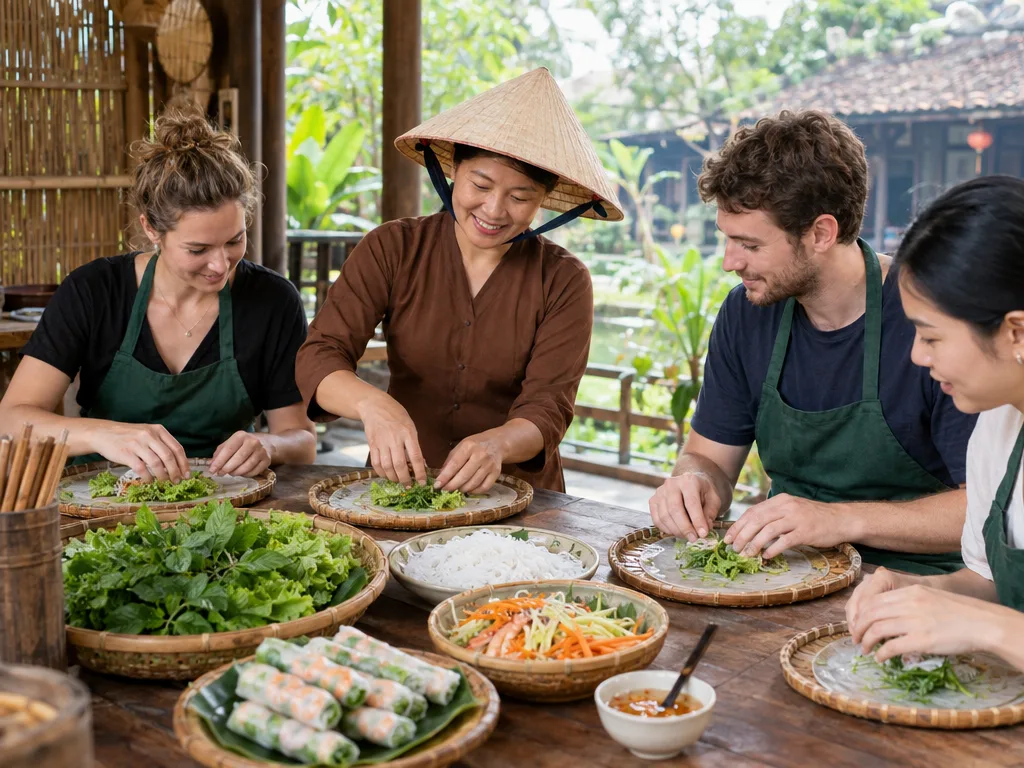
Vietnamese cultural workshops turn a holiday into a conversation with place. Instead of only looking at finished objects or tasting a dish at a restaurant, you spend time with a process: shaping clay, working with cloth, preparing ingredients, printing a pattern, or learning the meaning behind a performance. The best Vietnamese cultural workshops are not just photo opportunities. They give you enough context to understand what you are doing, enough practice to participate, and enough respect for the practitioner whose knowledge makes the experience possible.
This guide focuses on how to choose and enjoy a hands-on workshop in Vietnam. It covers cooking and food traditions, craft and textile sessions, community-led learning, questions to ask before booking, and simple ways to leave with more than a souvenir.
What counts as a Vietnamese cultural workshop?
A cultural workshop is a guided learning experience built around a local practice. It may be a short class in a city studio, a farm-to-table cooking session, a visit to a craft village with practical work, or a small-group lesson led by an artist or cook. The common thread is participation. You should have a chance to handle materials, follow a sequence, ask questions, and understand why the practice matters.
Formats vary widely. A cooking workshop may begin with a market visit and continue with preparation and shared eating. A pottery session may introduce clay, shaping, decoration, and firing, even if the final piece is collected later. A textile experience might show spinning, dyeing, or weaving rather than asking visitors to complete an entire garment. Traditional music, dance, paper, lantern, embroidery, and food-preservation sessions can also fit the category.
Look for the difference between demonstration-only and hands-on learning. A demonstration can be valuable, especially when the technique is too complex or delicate for a short visit, but the listing should say what you will actually do. Clear descriptions usually mention the practitioner, the activity, the approximate group size, and what the fee supports.
Choose a workshop by the kind of learning you want
Food and cooking workshops
Cooking classes are a natural entry point because food connects ingredients, family habits, geography, and celebration. A useful session goes beyond making a familiar dish. It may explain how herbs are balanced, how texture is created, how a dish changes between regions, or when a food appears in household and festival life.
Vietnam Tourism describes xôi ngũ sắc, or five-colour sticky rice, as a food rooted in the beliefs and customs of ethnic groups in the northern mountainous regions. Its colours are associated with the five elements, and natural plants, roots, and fruits can be used to colour the rice. That kind of context shows why a food workshop should make room for meaning, not only technique. If a class includes a regional specialty, ask whether the instructor will explain its place in everyday meals, ceremonies, or hospitality.
Craft, textile, and making workshops
Craft sessions are strongest when they reveal a chain of work rather than reducing a tradition to a single souvenir. Vietnam Tourism’s account of the country’s silk villages describes stages including raising silkworms, spinning, warping, weaving, dyeing, and finishing. In Hoi An’s Duy Xuyen Silk Village, the source describes a tradition of more than 300 years and a process that can be followed from the mulberry garden to woven cloth.
You may not complete every stage in one afternoon, but a good workshop can help you see how much knowledge sits behind a scarf, a bowl, a print, or a basket. Choose a session that explains materials and tools, introduces the person leading the work, and lets you make a modest piece without pretending that a brief class equals mastery.
Performing arts and storytelling
Some workshops are less about producing an object and more about learning how an art form communicates. An introductory session in a traditional instrument, folk dance, puppetry, calligraphy, or storytelling may include listening, repetition, and an explanation of symbols or roles. The goal is not to perform perfectly. It is to understand the structure of the art and the discipline involved in sustaining it.
Questions to ask before booking
Workshop descriptions can be brief, so ask practical questions before you commit. The answers help you compare experiences without relying only on polished photos.
- Who leads the session, and what is their relationship to the practice?
- How much time is spent doing the activity rather than watching?
- Is the group small enough for individual guidance?
- Are materials, translation, transport, or food included, and what is not included?
- Will the activity involve a home, a religious setting, a working studio, or a community space?
- Can the workshop adapt for allergies, mobility needs, children, or beginners?
- What happens to the item you make if it needs drying, firing, or finishing later?
- How does the price support the practitioner, host, or community?
Do not be embarrassed to ask whether photography is welcome. In a small studio or family home, a quiet request is better than assuming. If people appear in your photos, ask first, especially when the workshop takes place in an everyday working environment rather than a staged visitor attraction.
How to recognize thoughtful cultural interpretation
A workshop becomes more meaningful when it explains variation. Vietnamese traditions are not identical across the country, and a practice may differ by region, ethnic community, family, or material. Be cautious of descriptions that promise a single “authentic” Vietnam or present a living tradition as frozen in the past.
Good interpretation connects technique with people. An instructor might explain why a dye is chosen, how a recipe changes with local produce, or which parts of a process are traditionally shared among family members. They should also be comfortable saying that a practice has changed. Contemporary tools, new markets, tourism, and younger practitioners can all shape how a tradition continues.
Respectful language matters too. Avoid treating a community as an attraction or expecting a host to perform private customs on demand. A workshop is a learning exchange, not permission to inspect someone’s life. Listen when the guide sets boundaries, and accept that some knowledge may not be demonstrated publicly.
Finding the right setting: city studio, village, or community space
City workshops are often convenient for travelers with limited time. They may offer clear instruction, translated explanations, and equipment prepared for beginners. Their strength is focus: you can learn one process without spending much of the day in transit.
A village-based workshop can add landscape and working context. Vietnam Tourism’s overview of silk villages includes Van Phuc near Hanoi, Nha Xa in Ha Nam, Tan Chau in An Giang, and Duy Xuyen in Hoi An. The article emphasizes that these places are connected to long-running production, local materials, and visible stages of making. When visiting a craft village, remember that it is also a lived-in place. Keep your group together, avoid blocking work areas, and buy directly when you genuinely want an item.
Community-based workshops may be especially rewarding when the host explains how participation is organized and paid. That does not mean every rural experience is automatically better. Travel time, group size, and the quality of teaching still matter. Choose the setting that lets you pay attention rather than rushing between several stops.
Making the most of the session
Arrive ready to be a beginner. Wear practical clothing, tie back long hair for food or craft work, and bring only what you need. If the activity uses natural materials, ask before touching or collecting anything outside the planned exercise. Follow demonstrations closely before trying to improvise.
Ask open questions instead of turning the session into a quiz. “How is this usually used at home?” or “What changes by region?” invites a fuller answer than “Is this the real way?” Notice the order of tasks, the tools that seem ordinary to the practitioner, and the small decisions that affect the final result.
Leave time after the workshop to reflect. Taste the finished dish slowly, examine the uneven edge of a handmade object, or write down a new word. The point is not to leave with a perfect result. It is to remember who taught you, what the process revealed, and how the practice fits into a larger culture.
Buying, photographing, and sharing responsibly
If a workshop includes a finished piece, ask whether it was made by you, completed by the instructor, or produced separately by the studio. All three can be worthwhile, but clear information helps you value the work accurately. When buying additional items, ask about materials, care, and whether the maker receives the sale.
Photographs should document your own learning, not turn people into background decoration. Ask before photographing faces, private spaces, tools in use, or unfinished work. When sharing online, name the workshop or practitioner if they welcome it, and avoid claiming expertise after a single lesson.
Consider carrying the lesson forward in a small way. Cook the dish again, wear the textile, use the bowl, or tell a friend about the process rather than only the destination. Repeated use is often a more respectful souvenir than a purchase that stays in a suitcase.
A simple decision checklist
Before choosing among Vietnamese cultural workshops, compare each option against five points:
- Context: does the description explain the practice and its local setting?
- Participation: will you do enough to understand the process?
- People: is the practitioner named or meaningfully introduced?
- Practical fit: does the duration, location, language, and accessibility work for you?
- Reciprocity: is it clear what your payment supports, and are local boundaries respected?
If an experience answers these questions well, it is more likely to feel substantial. You do not need the longest class or the most elaborate itinerary. You need a workshop that makes room for attention, honest explanation, and a relationship with the people who keep the practice alive.
Conclusion
The best cultural workshops in Vietnam are small acts of learning by doing. They can introduce the symbolism of food, the patience of weaving, the logic of a tool, or the memory carried by a performance. Choose carefully, ask permission, and let the practitioner set the pace. When you leave with curiosity rather than a checklist, a short workshop can become one of the most lasting parts of your Vietnam journey.
JOIN THE CONVERSATION
Comments (0)
No comments yet. Be the first to share a thought.