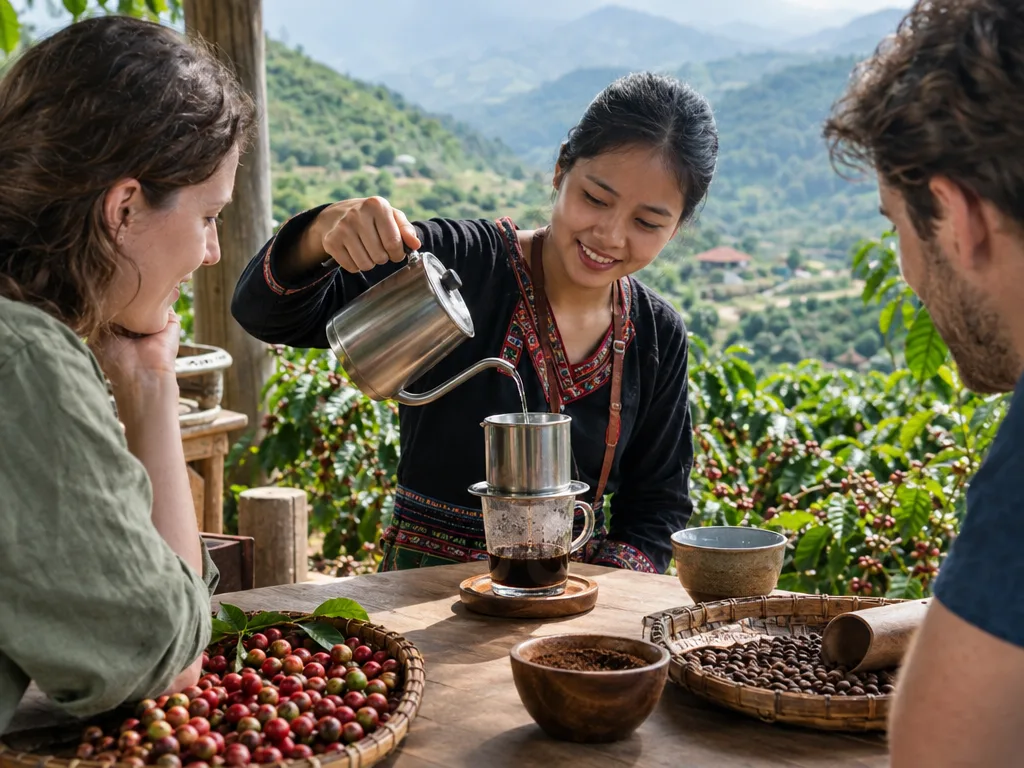
A Vietnamese coffee workshop can be much more than a tasting. It can show you how coffee moves from highland soil to hand processing, how the phin shapes a slow daily ritual, and why a drink often becomes a place for conversation. The best experiences let you do something, ask questions, and understand who benefits from your visit.
What makes a Vietnamese coffee workshop meaningful?
Vietnamese coffee workshops vary widely. One may be a short urban class focused on brewing with a phin. Another may combine a farm walk, processing demonstration, roasting, grinding, and cupping. A third may explore the social life of coffee through local drinks such as cà phê sữa đá, egg coffee, or salt coffee.
The strongest workshop is not necessarily the longest or most technical. Look for a clear learning journey: an explanation of the beans, a practical activity, time to taste, and space to speak with the person leading the session. A workshop should make the work visible rather than presenting coffee as a decorative souvenir.
- Choose an experience led by a coffee farmer, roaster, barista, or knowledgeable local host.
- Ask what you will actually do, not only what you will drink.
- Look for small-group attention and a realistic pace.
- Check whether the fee supports the people and place providing the experience.
- Prefer a workshop that explains uncertainty instead of promising a single “authentic” version of Vietnamese coffee.
Choose between a city coffee class and a farm-to-cup workshop
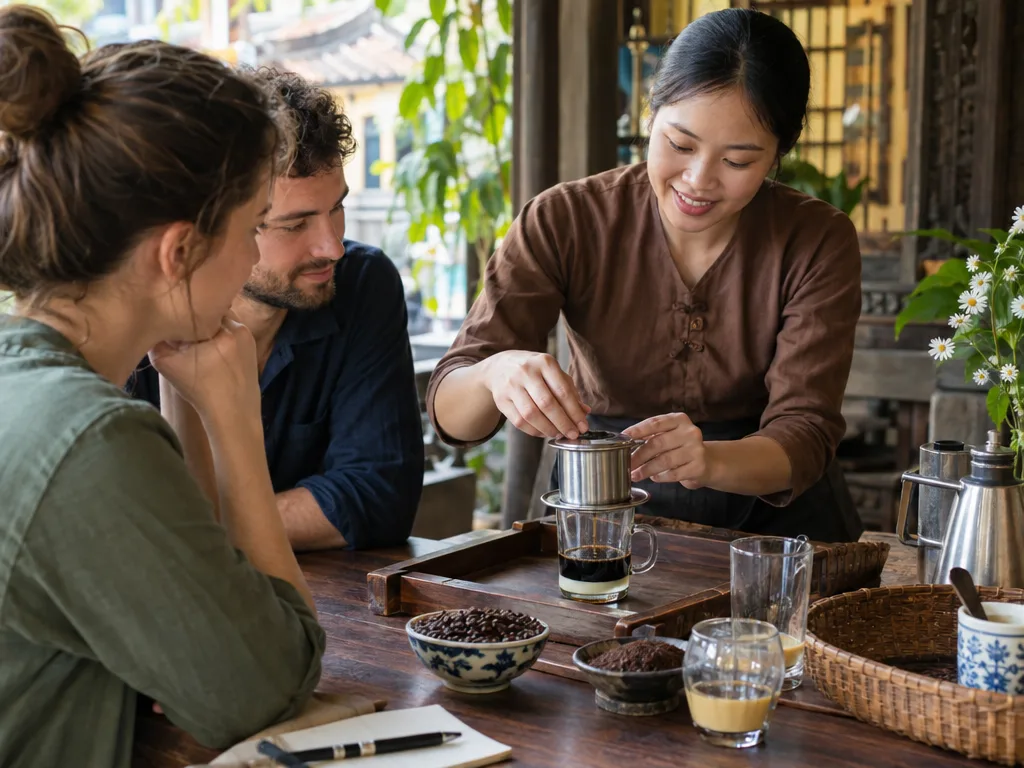
Your first decision is the setting. An urban Vietnamese coffee class is convenient if you have limited time. It can focus on the phin, ingredient choices, drink preparation, and café culture. This format works well for travelers who want a practical skill they can repeat at home.
A farm-to-cup workshop takes more planning but connects the drink to land and labor. Vietnam Tourism describes coffee-growing areas in the Central Highlands, including Đắk Lắk and Gia Lai, as important parts of the country’s coffee story. In Đà Lạt, the K’Ho Coffee Farm and Roastery is presented as a hands-on example that follows coffee from trees and harvesting through processing, roasting, brewing, and tasting.
Neither format is automatically better. Choose the city option when access and a focused lesson matter most. Choose a farm visit when you want to understand cultivation, processing, and the relationships behind a cup. In either case, read the itinerary carefully and avoid assuming that a short demonstration represents every coffee-growing community in Vietnam.
Learn the Vietnamese coffee basics before you book
A little vocabulary will help you compare workshops. The phin is the small metal filter traditionally placed over a cup or glass. It uses gravity rather than pressure, so the brewing process is deliberately slow. A workshop that includes phin brewing should explain grind size, dose, water, timing, and how the filter is adjusted. You do not need to memorize a recipe, but you should leave understanding why small changes affect the cup.
Vietnam Tourism’s coffee-culture guide describes dark-roasted robusta as a familiar foundation of Vietnamese coffee, while also noting the role of Arabica in highland areas. The guide connects coffee styles to place and history, including condensed-milk iced coffee in the south, egg coffee in Hanoi, and salt coffee associated with Huế. Treat these as distinct expressions rather than a single national formula.
Ask whether the workshop uses robusta, Arabica, or a blend; whether the beans are roasted locally; and whether the host will explain the origin. Be cautious with sweeping claims about what all Vietnamese people drink. Coffee habits differ by region, generation, family, café, and personal taste.
What you may do during a coffee workshop
Brewing with a phin
A phin lesson usually gives you the clearest hands-on skill. You may prepare the grounds, place the filter, add water, and observe the drip. The point is not speed. Notice how the host balances strength, sweetness, temperature, and dilution. If condensed milk is included, taste the coffee before and after mixing so you can identify what changes.
Roasting, grinding, and tasting
Some workshops introduce roasting or show how a roast develops aroma and color. Others let you grind beans and compare brewed samples. During a tasting, smell first, take small sips, and describe what you notice without worrying about specialist vocabulary. “Nutty,” “bright,” “smoky,” or “smooth” are useful starting points when they reflect your experience.
Farm work and processing
At a farm, the activity may include looking closely at coffee cherries, learning about varieties, sorting beans, or seeing how coffee is dried and hulled. The official tourism account of the K’Ho farm describes washed, natural, and honey processes, along with hand selection, drying, roasting, grinding, and cupping. Details will differ by farm and season, so ask what is happening on the day you visit rather than expecting a staged sequence.
Why the Central Highlands matter to coffee learning
The Central Highlands are useful context for a coffee workshop because they connect geography, farming, and cultural history. Vietnam Tourism’s national tourism site places coffee’s story in highland landscapes and identifies robusta production as part of the country’s modern coffee identity. A visit should help you see coffee as an agricultural system, not just a café trend.
The K’Ho Coffee Farm example also shows why a community story needs care. The tourism account describes K’Ho family involvement, a cooperative model, agroforestry practices, and efforts to improve farmer income by reducing dependence on middlemen. Those claims belong to that specific enterprise; do not generalize them to every ethnic minority community or coffee farm.
If your workshop includes a community or family business, ask how the hosts describe their own work. Listen for the difference between learning about a living community and consuming a simplified story about it. Pay for permission-based activities, do not enter private areas without an invitation, and avoid photographing people at work unless they agree.
How to judge a workshop before reserving
Use the description as an editorial document, not just a sales pitch. A useful listing should name the setting, approximate duration, activities, language support, group size, and what is included. It should identify the host or organization clearly enough for you to understand who is responsible for the experience.
- Does the description explain the learning outcomes?
- Does it distinguish tasting from farm work or production?
- Does it say whether transport, food, or equipment is included?
- Does it explain accessibility and physical demands honestly?
- Are cancellation terms and seasonal changes easy to find?
- Can you ask questions before paying?
Do not choose solely because a workshop promises a secret recipe, an “untouched” village, or a guaranteed perfect cup. Those phrases can turn culture into a product and may hide what participants actually do.
Plan the day without inventing certainty
Leave room around the workshop. Farm visits can be affected by weather, harvest conditions, drying cycles, and the host’s daily work. A city class may run on a fixed schedule, but you should still confirm the meeting point and start time directly with the provider. Current prices, opening hours, and transport arrangements can change, so use the provider’s latest information rather than relying on an old blog post.
Wear practical clothing if you will walk through a farm or handle coffee cherries. Bring water, sun protection, and shoes that can cope with uneven ground. If you have dietary restrictions, ask whether the experience includes lunch, condensed milk, eggs, or other ingredients. If you are sensitive to caffeine, tell the host and taste modestly.
For a multi-stop day, keep the coffee workshop as the main activity rather than adding several unrelated attractions. The value is in attention: seeing a process, hearing a story, trying a technique, and reflecting on the connection between producer and drink.
Participate respectfully in a coffee workshop
Arrive ready to learn from the host’s method, even if you already make coffee at home. Ask before touching equipment, entering growing areas, or photographing people. If the workshop is held in a home, cooperative, or working café, follow the host’s boundaries. Do not treat family members, farmers, or staff as props for your travel photos.
Good questions are specific and open-ended:
- Which part of the process is most difficult here?
- How does the season change the work?
- What does the host want visitors to understand?
- Which skills are learned in the family or community?
- What can visitors buy that directly supports the work?
When buying coffee, textiles, or other products, ask who made them and how they are connected to the workshop. Purchase because you value the work, not because you feel pressured. A thoughtful review can also help, but describe the experience accurately and avoid revealing private details.
Build a better coffee tasting
You do not need a formal tasting sheet. Start with appearance and aroma, then take a small sip before adding sugar, milk, or ice. Notice body, bitterness, acidity, sweetness, and aftertaste. Compare two coffees only when the host says the comparison is fair; different roast levels and brew methods can change the result as much as bean origin.
Ask to taste the coffee in the way the host recommends. Vietnamese coffee culture includes strong social and sensory traditions, so the “right” drink may be a slow phin brew, a sweet iced coffee, or a regional specialty rather than a plain black cup. The goal is understanding, not ranking one style above another.
Continue learning after the workshop
Take home notes about the bean, roast, brew method, and story behind the experience. If you buy coffee, store it well and use it while the aroma is fresh. Try repeating the technique without chasing an exact café result. The better lesson is to notice how water, grind, time, temperature, and serving style work together.
You can also deepen your cultural learning by comparing a farm workshop with a city café, museum visit, or regional food experience. Keep the comparisons modest: each setting reveals one part of Vietnam’s coffee culture. A workshop is valuable when it leaves you more curious about producers, places, and everyday hospitality—not when it claims to explain everything in one morning.
Final checklist for choosing a Vietnamese coffee workshop
- Choose a clear format: city brewing class, roastery lesson, or farm-to-cup visit.
- Confirm the host, activities, group size, duration, meeting details, and current cost.
- Look for a real connection to growers, roasters, baristas, or local educators.
- Ask what the fee supports and whether community stories are presented with consent.
- Plan for weather, uneven ground, caffeine limits, and changing farm conditions.
- Participate with permission, buy thoughtfully, and leave room for conversation.
A Vietnamese coffee workshop is at its best when a cup becomes a map: to highland farms, patient processing, regional tastes, skilled hosts, and the ordinary social pleasure of sitting together. Choose an experience that lets you follow that map carefully, and you will leave with more than a souvenir drink.
JOIN THE CONVERSATION
Comments (0)
No comments yet. Be the first to share a thought.