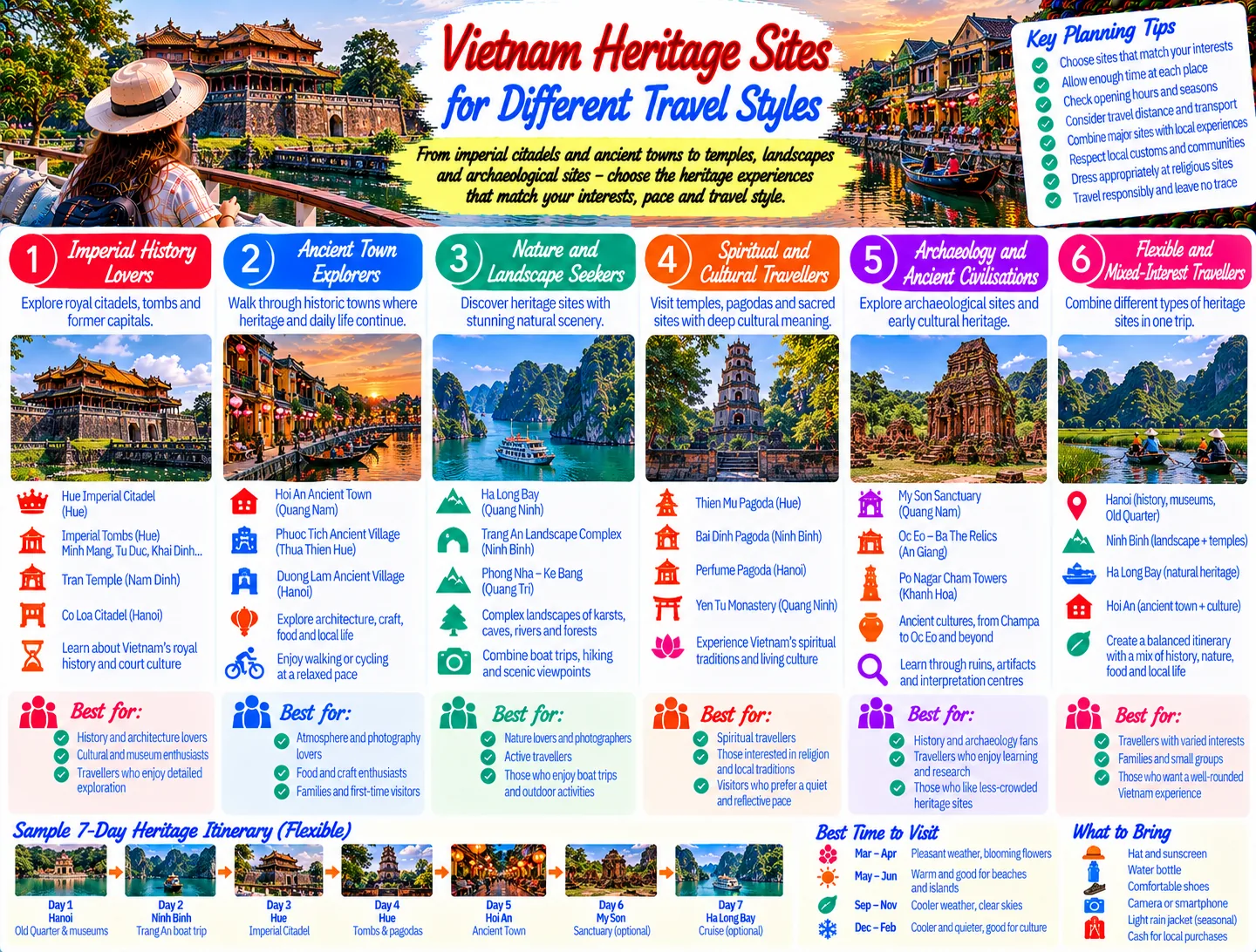
Vietnam’s historic places are not one interchangeable list. A royal citadel, a trading port, a sacred complex, and an archaeological landscape each ask you to travel differently. The useful question is not simply “Which are the best historical sites in Vietnam?” It is “Which kind of heritage will reward the time, pace, and curiosity I can bring?”
This guide offers a practical way to choose. It uses Hue and Hoi An as especially clear examples, then shows how to plan a visit that leaves room for context rather than reducing heritage to a photograph. For a wider approach to responsible cultural travel, see Planning a Cultural Trip That Leaves Room to Listen.
Start with the kind of history you want to encounter
“Historic site” can mean several different experiences. Some places are designed around political power: gates, walls, ceremonial buildings, tombs, and the spatial order of a former court. Others are living urban districts where houses, streets, worship, craft, food, and commerce still overlap. Some are archaeological landscapes, where the main task is to imagine what is missing. Others are spiritual places, where the visitor’s manner matters as much as the monument itself.
Before choosing a destination, write down the experience you want in one sentence:
I want to understand a former capital and its court culture.
I want to walk through an old town and notice how trade shaped daily life.
I want a quieter encounter with ruins, landscape, and archaeology.
I want to connect built heritage with living ritual, craft, or performance.
This simple step prevents a common mistake: selecting a famous place whose scale or atmosphere does not match your interests. A traveler who loves architectural detail may need more time in one compact complex than in a rushed tour of several headline attractions.
Choose Hue for imperial space and layered court history
What makes the experience distinctive
Hue is the clearest choice when your interest is the architecture and culture of a Vietnamese imperial court. The Hue Monuments Conservation Centre presents the heritage of the former capital through tangible heritage, intangible heritage, documentary heritage, research, events, and visitor information. Its own site also shows how court heritage extends beyond buildings: ceremonial performance, royal objects, conservation work, and public interpretation all belong to the story.
That breadth changes how you should visit. Do not treat Hue as a single stop where you enter, take a few pictures, and leave. Read the spatial sequence. Notice how entrances, courtyards, walls, halls, gardens, and views establish degrees of access and formality. Then look for the less obvious layer: what kinds of music, dance, objects, or ritual knowledge helped make the court a culture rather than merely a collection of structures.
Who will enjoy Hue most
Hue suits travelers who like chronology, architecture, restoration, and quiet observation. It is also a strong fit for visitors who want to divide a heritage day into different moods: a major monument in the morning, a museum or conservation story later, and a slower period for reading or sketching. If your interests include royal material culture, pair this visit with a more curious museum habit; A More Curious Visit to Vietnam’s Museums offers a useful way to look beyond labels and vitrines.
Plan to ask what has been restored, what remains original, and how the site explains uncertainty. Conservation is not an invisible act. A repaired roof, stabilized wall, or carefully protected object reflects choices about evidence, use, and the future. Asking those questions makes the visit more historically honest.
Choose Hoi An for a living historic town
Look beyond the postcard streets
Hoi An offers a different heritage experience. The official Hoi An World Heritage site describes the town as a well-preserved former trading port that developed from the fifteenth century, and its current information connects the old town with events, traditional performance, craft villages, food, walking spaces, and visitor guidance. The important point is that Hoi An’s history is legible through urban life: streets, houses, workshops, performances, and seasonal activity help explain why the town mattered.
That means the best visit is not a checklist of façades. Walk slowly enough to see how the town’s buildings relate to one another. Notice changes in street width, thresholds, shopfronts, courtyards, worship spaces, and the movement between public and private areas. Then give yourself time to encounter one living practice—perhaps a performance, craft activity, food tradition, or local event—without assuming that every cultural activity exists only for visitors.
Who will enjoy Hoi An most
Hoi An works particularly well for travelers who prefer atmosphere, walking, photography, food culture, and the relationship between heritage and everyday commerce. It is also useful for families or first-time visitors because the historic core can be explored at a human pace. Yet ease should not become carelessness. A preserved town is still a community, not an open-air stage.
Before photographing people, ask. Keep your voice and movement considerate in worship spaces and residential lanes. Choose locally rooted experiences where possible, and remember that a good souvenir is not simply attractive; it can also keep a skill, workshop, or material tradition visible. The site’s own visitor resources include traditional arts, craft villages, food, and pedestrian-oriented spaces, which makes it easier to plan a visit around more than architecture.
Match the destination to your preferred pace
Heritage travel is partly a time-management problem. A large monumental complex rewards a focused half-day or full day. A historic town can absorb several shorter walks at different times. An archaeological landscape may require more interpretation and less rushing. Choose the place whose rhythm matches your attention span.
If you like structured learning
Choose one principal site and build a small research question around it: How was power displayed? Which materials survive? What changed after a political transition? What does the conservation authority choose to explain first? Take notes under three headings—space, objects, and living practice. This creates a stronger memory than collecting isolated facts.
If you like wandering
Choose a compact historic district, but set boundaries for your wandering. Spend the first hour orienting yourself, the second following one theme such as trade or domestic architecture, and the final part revisiting a place that caught your attention. This gives an unhurried walk a shape without turning it into a rigid tour.
If you have limited mobility or energy
Ask the site or a local operator about surfaces, distances, rest points, vehicle access, and which areas can be appreciated without climbing or prolonged standing. Do not assume that “small” means easy or that a famous complex has one universally accessible route. Good planning is not a lesser form of heritage travel; it is what allows you to stay present.
Build a heritage day around interpretation, not just entry
Admission gets you through a gate, but interpretation helps you understand what you are seeing. Before arrival, read one reliable overview and identify two or three questions. On site, look for official panels, maps, conservation notes, museums, demonstrations, or performances that answer those questions. Afterward, compare your first impression with what you learned.
At Hue, interpretation can help connect architecture with court ceremony, objects, and performance. At Hoi An, it can connect streets and houses with trade, craft, food, and the town’s continuing public life. In both cases, avoid treating a single plaque as the complete story. A monument may carry several periods, communities, and meanings, and a visitor sees only one layer in a short visit.
For practical preparation, use the site’s official information before you travel and verify current arrangements directly. Events, access routes, conservation work, and visitor procedures can change. Do not rely on an old blog for opening hours, ticket prices, or temporary restrictions. If a detail matters to your day, confirm it close to departure.
Connect historic sites with living culture
Historic places become more intelligible when you connect them to practices that continue outside the monument. In Hue, courtly performance and royal objects show that heritage includes skills and memory, not just masonry. In Hoi An, traditional performance, craft villages, food, and festivals show how a historic town remains culturally productive.
This is where internal planning matters. A visit to a historic site can lead naturally into the site’s Traditional Arts & Performances coverage, or into Traditional Craft Villages if you want to understand materials and making. If your trip includes sacred buildings, the guidance in Visiting Temples and Sacred Places Respectfully can help you carry the same attentiveness into religious spaces.
The goal is not to add activities for the sake of an itinerary. It is to ask what made the historic place possible and what keeps its meaning active. A palace without ceremony, a trading town without exchange, or a craft village without makers becomes an incomplete picture.
Travel with respect for conservation and residents
Heritage sites are fragile because they are valued, visited, and often still used. Stay within marked areas, do not touch surfaces or objects unless permission is clearly given, and follow photography rules. In a living neighborhood, keep doorways clear, avoid turning private homes into backdrops, and support businesses in ways that do not pressure residents to perform.
Respect also means accepting that conservation can look unfinished. Scaffolding, closed rooms, protective barriers, and altered routes may be part of responsible care. Rather than judging a site only by how much is open, ask what the restrictions protect and whether an alternative interpretation is available.
Finally, resist the urge to compress every historical place into a ranking. Heritage value is not a contest. A modest room, a repaired wall, a workshop, or a recurring performance may be the detail that gives a grand monument meaning. Patience is one of the most useful things a visitor can bring.
A simple way to choose your next heritage stop
Use this three-part test before booking a day:
Theme: Do I want imperial history, urban trade, archaeology, sacred culture, or living craft?
Rhythm: Will I enjoy a focused monument, a walkable town, or a slower landscape?
Depth: Can I give the place enough time to read, observe, and revisit one detail?
If your answers point to court culture and architecture, begin with Hue. If they point to an old town where history and daily life overlap, begin with Hoi An. If neither feels right, use the same test for another destination rather than following a generic “top sites” list. For more context on reading historic places thoughtfully, continue with How to Read Vietnam’s Historic Places Beyond the Plaque and browse the Historical Sites & Heritage category.
Conclusion: choose the history you can meet attentively
The best historical site in Vietnam is not the same for every traveler. Hue rewards attention to imperial space, conservation, and court culture. Hoi An rewards a slower reading of streets, trade, craft, performance, and community life. The wider lesson is simple: choose a place whose scale and rhythm allow you to notice relationships, not just monuments. Arrive with a question, verify practical details, move respectfully, and leave enough time for the site to become more than a backdrop.
JOIN THE CONVERSATION
Comments (0)
No comments yet. Be the first to share a thought.