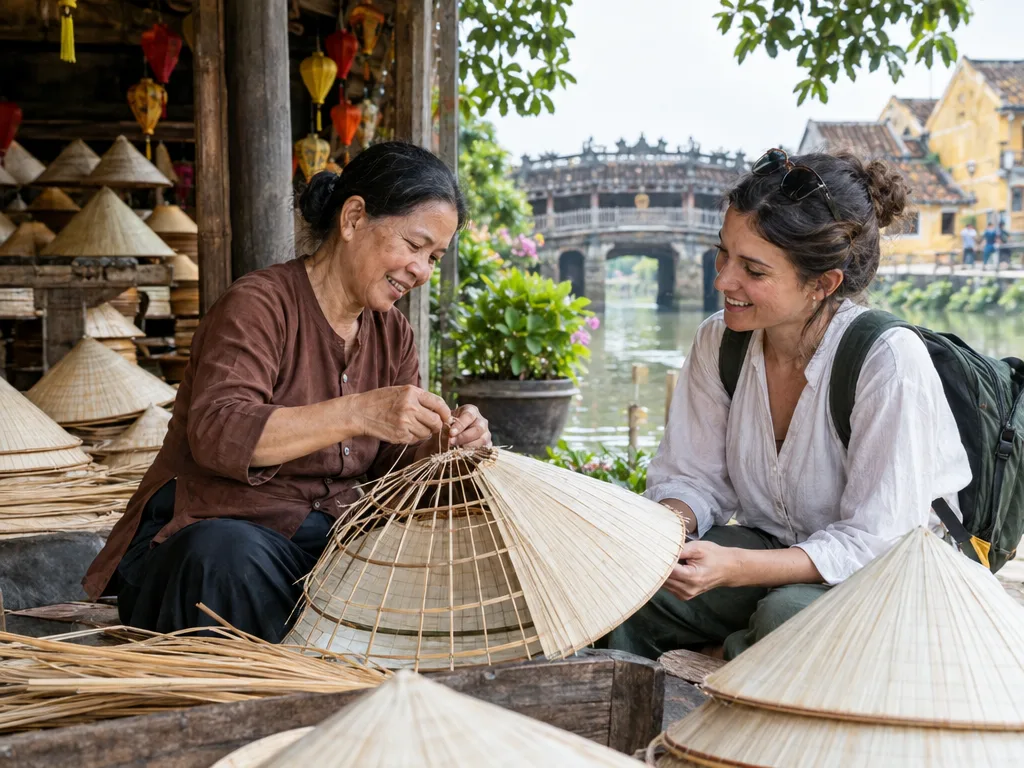
Vietnam cultural immersion is less about collecting landmarks than choosing experiences that let you notice how history, craft, belief, food, and everyday life connect. A thoughtful cultural travel experience may be a guided walk through a living heritage quarter, a conversation with a craft maker, a small-group workshop, or a meal where the host explains why a dish belongs to a particular place. The best choices give context without turning local life into a performance.
This guide explains how to choose meaningful Vietnam cultural experiences, what questions to ask before booking, and how to participate with care. It is designed for travelers who want more than a checklist while still needing practical ways to compare options.
Start with the kind of connection you want
“Cultural experience” can describe very different activities. Begin by naming the connection you want rather than searching for the most famous attraction. Do you want to understand a city’s layered history, learn a hand skill, share a meal, hear traditional music, or spend time in a rural community? Each goal points toward a different format.
- Choose a heritage walk when buildings, migration, religion, and urban history interest you.
- Choose a workshop when you learn best by making, tasting, weaving, shaping, or cooking.
- Choose a community-led visit when you want local interpretation and a slower pace.
- Choose a performance when music, movement, language, and storytelling are your main interests.
- Choose a market or food experience when everyday routines matter more than formal monuments.
This first decision prevents a common mistake: booking an activity because it is photogenic, then discovering that it offers little explanation or meaningful contact. A smaller experience that matches your curiosity will usually be more memorable than a crowded stop chosen only because it appears on every itinerary.
Look for experiences rooted in a real place
Strong cultural travel experiences begin with place. Ask what makes this activity belong in this neighborhood, village, city, or region. The answer should be more specific than “Vietnamese culture.” It might be a river trade history, a local craft material, a religious community, a regional foodway, or a landscape that shaped work and settlement.
Hoi An is a useful example of place-based interpretation. Vietnam’s official tourism portal describes the historic town as a long-standing trading center shaped by Cham, Vietnamese, Chinese, Japanese, European, Arab, and other Asian connections. Its architecture, temples, assembly halls, museums, canals, and family homes make more sense when read as evidence of exchange rather than as isolated photo stops. That is the difference a good guide or well-designed route can provide: it connects what you see to why it is there.
When comparing tours, read the description for local detail. Does it name a neighborhood, community, craft, river, market, or historical relationship? Does it explain who leads the experience? Does it tell you what you will actually do? Vague language about “authenticity” is less useful than a clear description of place and participation.
Choose a host, guide, or practitioner—not just an activity
The person leading an experience shapes its quality. A knowledgeable local guide can explain differences within a tradition, correct stereotypes, and help visitors behave appropriately. A craft practitioner can show the decisions behind an object instead of presenting it as a souvenir with no story. A family host can help you understand routines that would be invisible on a standard sightseeing route.
Before booking, look for evidence that the leader has a real relationship with the subject. Useful signals include a named practitioner, a clear biography, a community organization, a stated language ability, or an explanation of how local partners are paid. These details do not guarantee perfection, but they are stronger than anonymous claims of exclusivity.
Also consider group size and conversation time. A large group may be suitable for a general heritage overview, while a workshop or household visit often works better with fewer participants. If the listing avoids saying whether the experience is private, shared, or capped, ask before paying. A responsible operator should be able to explain the format without promising access to private life that the host has not freely offered.
Compare learning depth with visitor comfort
Meaningful does not have to mean difficult, uncomfortable, or intrusive. Look for experiences that explain the level of physical effort, walking, heat, noise, food, seating, toilets, and language support. Practical clarity helps you arrive prepared and reduces pressure on the host to manage surprises.
For a workshop, check whether the activity is demonstration-only or hands-on, whether materials are included, and whether the finished item is yours to keep. For a food experience, ask whether the menu can accommodate allergies and whether the host will explain ingredients without presenting one regional style as the only Vietnamese cuisine. For a heritage visit, ask how much walking and standing are involved and whether sacred or residential spaces are included.
Do not confuse luxury with cultural depth. A polished venue may provide excellent comfort, but comfort alone does not make an experience locally grounded. Conversely, a simple setting can be rewarding when the host is prepared, the expectations are clear, and participants are treated with dignity. Choose the balance that fits you, then judge the experience by the quality of interpretation and exchange.
Use craft villages as a model for respectful participation
Traditional craft villages show why process matters. An official Vietnam Tourism feature describes Van Phuc Silk Village near Hanoi as a long-established weaving community where visitors can observe artisans at looms and see village features such as banyan trees, old wells, and communal houses. It also describes silk traditions in Nha Xa, Tan Chau, and Duy Xuyen, including stages such as spinning, warping, weaving, dyeing, and raising silkworms.
The practical lesson is to look beyond the finished object. A cultural experience becomes richer when it introduces materials, labor, tools, design choices, and the people who keep a practice going. If you visit a craft village, allow time to watch before shopping. Ask permission before photographing a person or workspace. If you buy, ask what is handmade locally, how to care for the item, and whether the purchase comes directly from the maker or through a reseller.
Be cautious of activities that reduce a living tradition to a quick photo opportunity. A short demonstration can still be worthwhile, but it should be described honestly. You do not need to pretend that a staged display is ordinary daily life. Clear expectations protect both visitors and practitioners.
Read heritage places as living environments
Historic places are not automatically museums. In Hoi An’s Ancient Town, official tourism guidance emphasizes that the old quarter remains a real place where people live, work, pray, trade, and maintain customs. That perspective changes how you move through it. A home, assembly hall, temple, shop, or riverfront is not merely scenery arranged for visitors.
When choosing a cultural walk, favor one that gives you a way to observe respectfully. A guide might explain architectural details, migration, religious practice, or the relationship between a house and its street. You can contribute by keeping your voice low in sacred spaces, not blocking entrances, asking before entering private areas, and avoiding photographs of people who are not participating in the tour.
Plan for pauses. Cultural understanding rarely comes from rushing through ten sites. One carefully explained house, museum, market, or place of worship can provide more insight than a long list of names. Leave space to notice who uses the place and how the setting changes at different times of day, while avoiding assumptions about routines you have observed only briefly.
Ask how money, credit, and consent are handled
Responsible cultural travel is not only about polite behavior. It is also about the relationship between the visitor, the operator, and the people whose knowledge or labor makes the experience possible. Before booking, look for plain information about local ownership, practitioner payment, group limits, and photography.
- Who receives the booking revenue?
- Are local hosts paid for their time and knowledge?
- Can participants decline photographs or questions?
- Are children present because they choose to participate, or because visitors are expected to watch them?
- Does the experience encourage buying directly without pressuring guests?
- What happens if a community event, family need, or weather makes the planned activity unsuitable?
No listing can answer every ethical question, but evasive language is useful information. Prefer operators that explain their partnerships and set boundaries. Avoid experiences that promise unrestricted access to private homes, ceremonies, or vulnerable communities as though consent were part of the product.
Build a cultural day with room for context
Once you select an experience, avoid stacking it between too many unrelated attractions. A practical cultural day might combine one substantial activity with a museum, a neighborhood walk, or an unhurried meal. The point is not to turn culture into a theme park schedule; it is to give your mind time to connect what you have heard with what you see.
Prepare by learning a few basic words, reading the operator’s instructions, and checking clothing expectations when a religious or family space is involved. Arrive on time. Bring water, but avoid treating the setting as a backdrop for constant phone use. Afterward, write down the names of places, materials, and people you encountered. This makes it easier to remember the experience accurately instead of flattening it into “traditional Vietnam.”
If the experience raises questions about history, identity, religion, or regional difference, keep asking with humility. A good host may offer one perspective rather than a final answer. That is a strength: culture is not a single script, and regional, family, ethnic, and generational experiences can differ.
A simple checklist before you book
Use this checklist when comparing Vietnam cultural experiences:
- Is the activity tied to a specific place, practice, or community?
- Is the guide or practitioner clearly identified?
- Does the description explain what participants will do and learn?
- Are group size, duration, accessibility, food, and photography expectations clear?
- Does the experience protect private life and allow people to decline participation?
- Is there a credible explanation of local benefit or payment?
- Can you participate without buying more than you want?
- Will you have enough time to listen rather than rush?
If most answers are yes, you have probably found a better fit than a generic “authentic Vietnam” listing. If several answers are no, keep researching. The goal is not to find a perfect experience; it is to choose one built on clarity, consent, context, and mutual respect.
Conclusion: travel with attention, not performance
The most meaningful cultural travel experiences in Vietnam are often the ones that make you slow down. They may reveal how a trading port became a layered town, how silk passes through many stages before it becomes clothing, or how a workshop connects a visitor with a living skill. Choose experiences with identifiable people, specific places, honest descriptions, and room for questions. Participate gently, spend thoughtfully, and remember that the people you meet are not scenery. Cultural immersion begins when curiosity becomes attention.
JOIN THE CONVERSATION
Comments (0)
No comments yet. Be the first to share a thought.