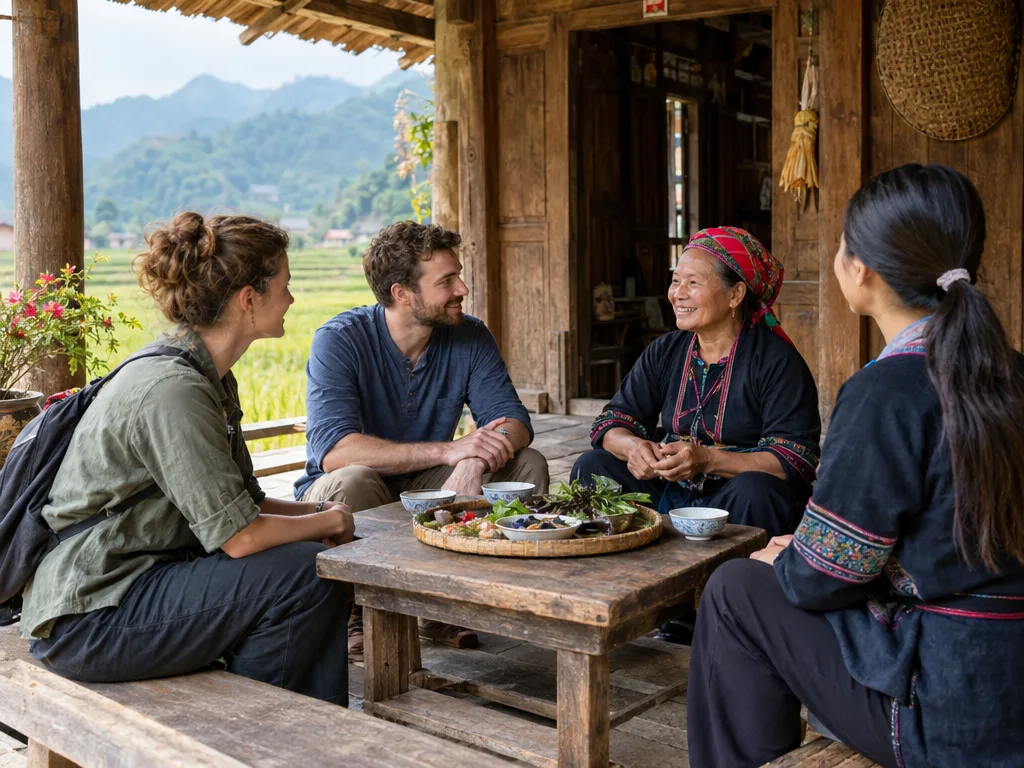
A cultural homestay in Vietnam can be one of the most memorable ways to travel: you sleep in or near a family home, share meals, notice how a community lives, and learn through ordinary conversation rather than a staged tour. The experience is rewarding when the relationship is clear and respectful. It is less successful when visitors arrive expecting a hotel, a performance, or a simplified picture of local culture.
The best choice is not automatically the most photogenic house or the cheapest available room. It is the homestay that explains who hosts visitors, what participation looks like, how money reaches the community, and which parts of daily life are private. Use this guide to compare options and prepare for a stay that gives you more than a bed for the night.
What makes a homestay a cultural experience?
“Homestay” can describe several different arrangements. In one, guests sleep in a family’s traditional house and eat meals prepared by the household. In another, a village has purpose-built guest rooms managed by local families. Some properties use the word for a small lodge with local staff, while the owners may not live on site. None of these models is automatically better, but they offer different kinds of contact.
Look for a clear explanation of the host relationship. Does the listing name the family or community partner? Are meals, a village walk, craft demonstration, or farm activity optional rather than compulsory? Does the description acknowledge that traditions vary between regions and households? Specific, modest language is usually more useful than promises of an “authentic” experience.
A genuine cultural stay is also more than an attractive setting. In Mai Chau, for example, the official Vietnam Tourism destination guide describes White Thai family homestays in the villages of Lac and Pom Coong, along with stilt-house accommodation, home-cooked meals, local weaving, cycling, and village paths. These details show how accommodation can connect to a wider landscape and living community without claiming that every household offers the same experience.
Choose the community before choosing the room
Start with the kind of place you want to understand. A valley of rice fields, a lakeside village, a mountain settlement, and a delta town will produce very different stays. Think about the setting, the community, the pace of travel, and the activities that naturally belong there.
- Valley villages: These can suit travelers who want walks, cycling, agricultural landscapes, and time around raised houses or village lanes.
- Lakeside communities: A stay may include boating, fishing, or conversation about life shaped by water, but only if the host actually offers those activities.
- Mountain villages: These are often a base for guided walks and learning about farming, textiles, food, or medicinal plants. Weather and terrain can make plans change.
- Rural outskirts of cities: These may be easier to reach and can reveal food, gardening, craft, or family routines without requiring a long expedition.
Vietnam Tourism’s cultural guide presents a lakeside Tay homestay around Ba Be Lake as one possible way to learn through boating, fishing, and time in a raised house. The useful lesson is not to copy one itinerary. It is to choose a destination where the activity you want is connected to the host community rather than added as a generic excursion.
Questions to ask before booking
A few practical questions can prevent disappointment and help you identify a responsible operator. Ask them before paying, especially when the listing uses broad phrases such as “local life” or “immersive culture.”
- Who owns and manages the homestay?
- Will the host family be present during the stay?
- Is the sleeping space inside a family home, in a separate room, or in a separate building?
- What is included in the rate: breakfast, dinner, transport, activities, or guide services?
- Are shared bathrooms, hot water, air-conditioning, fans, Wi-Fi, or quiet hours described accurately?
- How are meals handled for allergies, vegetarian diets, or other dietary needs?
- Which activities are led by local people, and are they optional?
- How does the host or community benefit from the booking?
- Are photography and video welcome in shared spaces, and are there areas where cameras should not be used?
Clear answers matter more than polished marketing. A simple homestay that explains its arrangements honestly may offer a better experience than a highly photographed property that says little about its hosts.
Read the accommodation details carefully
Cultural travel works best when comfort expectations are realistic. Many traditional or village-based properties have features that differ from an urban hotel. You might sleep on a mattress in a shared raised house, hear household activity early in the morning, or use facilities that are clean but basic. That is not a defect if it is explained in advance; it becomes a problem when the description is vague.
Check the actual room arrangement. “Private room” may mean a private sleeping area with a shared bathroom. “Traditional house” may mean an original home, a restored structure, or a newly built property designed in a traditional style. Ask about stairs, floor mattresses, insects, noise, luggage storage, and weather protection if any of these could affect your stay.
Do not treat comfort and cultural respect as opposites. A host can preserve a traditional building while providing clean bedding, safe food, and clear information. Likewise, a visitor can appreciate a simple setting without romanticizing inconvenience. Honest communication allows both sides to decide whether the arrangement is suitable.
Look for participation, not performance
Choose activities that allow you to learn with people rather than simply watch them. Cooking a meal with a host, walking through a village with a local guide, visiting a garden, learning about weaving, or sharing stories over tea can create space for questions and exchange. The activity should be paced by the people leading it, not by a visitor’s demand for constant entertainment.
Be cautious with experiences that turn residents into scenery. A staged costume photo, an unannounced visit to a home, or a request to photograph children may feel intrusive even when it is marketed as cultural discovery. Ask permission before taking portraits, and accept a no without trying to negotiate. If a guide introduces a ritual, household object, garment, or sacred space, listen to the explanation and follow local directions.
Vietnam Tourism’s overview of ethnic-cultural encounters covers Dao or Yao herbal traditions, Hmong-guided hikes, Tay homestays, Bahnar communal architecture, and Khmer pagodas. The range is a reminder that “Vietnamese culture” is not one uniform product. Choose an experience that names the community and lets local people explain their own context.
Make your spending support the host community
Price is only one part of value. A slightly higher rate may include meals cooked by the household, local guiding, transport arranged through residents, or a community contribution. A lower price may be reasonable, but ask what it covers and who receives it. If an intermediary manages the booking, look for a clear explanation of the host’s role.
Spend thoughtfully beyond the room. Buy useful crafts directly when possible, pay agreed guide fees promptly, and avoid bargaining over a small handmade item simply to win a token discount. Do not assume that every product sold in a village was made there. Ask about the maker and the material if origin matters to your purchase.
Responsible spending also means not creating waste that the host must absorb. Carry a refillable bottle where practical, limit disposable packaging, and use water and electricity with awareness. Follow local instructions about waste and bathrooms. These actions are small, but a homestay places you inside someone’s working environment rather than a self-contained resort.
Prepare for meals and shared routines
Food is often central to a cultural homestay. A shared meal can teach you about ingredients, seasonality, cooking methods, and hospitality, but it is still important to communicate clearly. Tell the host about allergies and dietary restrictions before arrival, not when a dish is already on the table. If you avoid meat or fish, explain what you can eat rather than assuming a generic vegetarian menu.
Observe before changing the rhythm of the meal. Wait to see where people sit, whether dishes are shared, and how serving works. Try what you can, compliment food sincerely, and do not make a spectacle of unfamiliar ingredients. If you cannot eat something, a polite explanation is enough. Bringing a small, appropriate gift can be thoughtful, but it is not a substitute for paying the agreed rate.
Shared routines extend beyond meals. Hosts may work early, care for children, tend animals, or close common areas at a particular time. Keep voices low at night, ask before using private spaces, and remember that friendly conversation does not mean the family is available every minute.
Plan transport and time with flexibility
Rural and community-based stays often take longer to reach than a city hotel. Confirm where you will meet the host, how the final transfer works, and what happens if weather affects the route. Do not invent a precise arrival time when the last part of the journey depends on local roads or a boat connection; give updates instead.
Leave room in the itinerary. A homestay is weakened when guests arrive late, eat quickly, sleep, and leave before a conversation can begin. One or two nights may be enough for a first visit, while a longer stay can make activities feel less like a checklist. The right length depends on the host’s schedule and what you hope to learn.
Use local guidance for walks and outdoor activities. A route that looks easy in a photograph may be slippery, steep, hot, or difficult to navigate without someone who knows the area. Follow instructions around farmland, waterways, livestock, and private homes. A slower route with a local explanation often offers more cultural value than a rushed list of viewpoints.
A respectful homestay checklist
Before you book, confirm the host arrangement, room type, facilities, food, transport, activities, price, and cancellation terms. Before you arrive, learn a few polite Vietnamese expressions, pack modest clothing suitable for the setting, and bring only the luggage you can manage on local paths or stairs.
During the stay, ask permission before photographing people or entering private areas. Listen more than you perform. Avoid comparing the household with your own home in a judgmental way, and do not assume that one family represents an entire ethnic group or region. If something is unclear, ask the host or guide directly.
Afterward, leave a fair review that distinguishes personal preference from a genuine problem. Praise specific local work, explain practical details accurately, and do not reveal private information or upload images without consent. A useful review can help future guests arrive prepared and help responsible hosts attract visitors who fit the experience.
Let curiosity set the pace
The strongest cultural homestays do not promise instant access to a whole way of life. They offer a doorway: a meal, a conversation, a landscape, a craft, or a shared routine that you can approach with attention. Choose the host community carefully, clarify the practical details, and accept that learning may involve quiet observation as much as activity.
When visitors arrive with realistic expectations and respect for privacy, a homestay becomes more balanced for everyone. You gain a deeper sense of place, while the host retains control over how culture and daily life are shared. That is the foundation of a meaningful cultural travel experience in Vietnam.
JOIN THE CONVERSATION
Comments (0)
No comments yet. Be the first to share a thought.