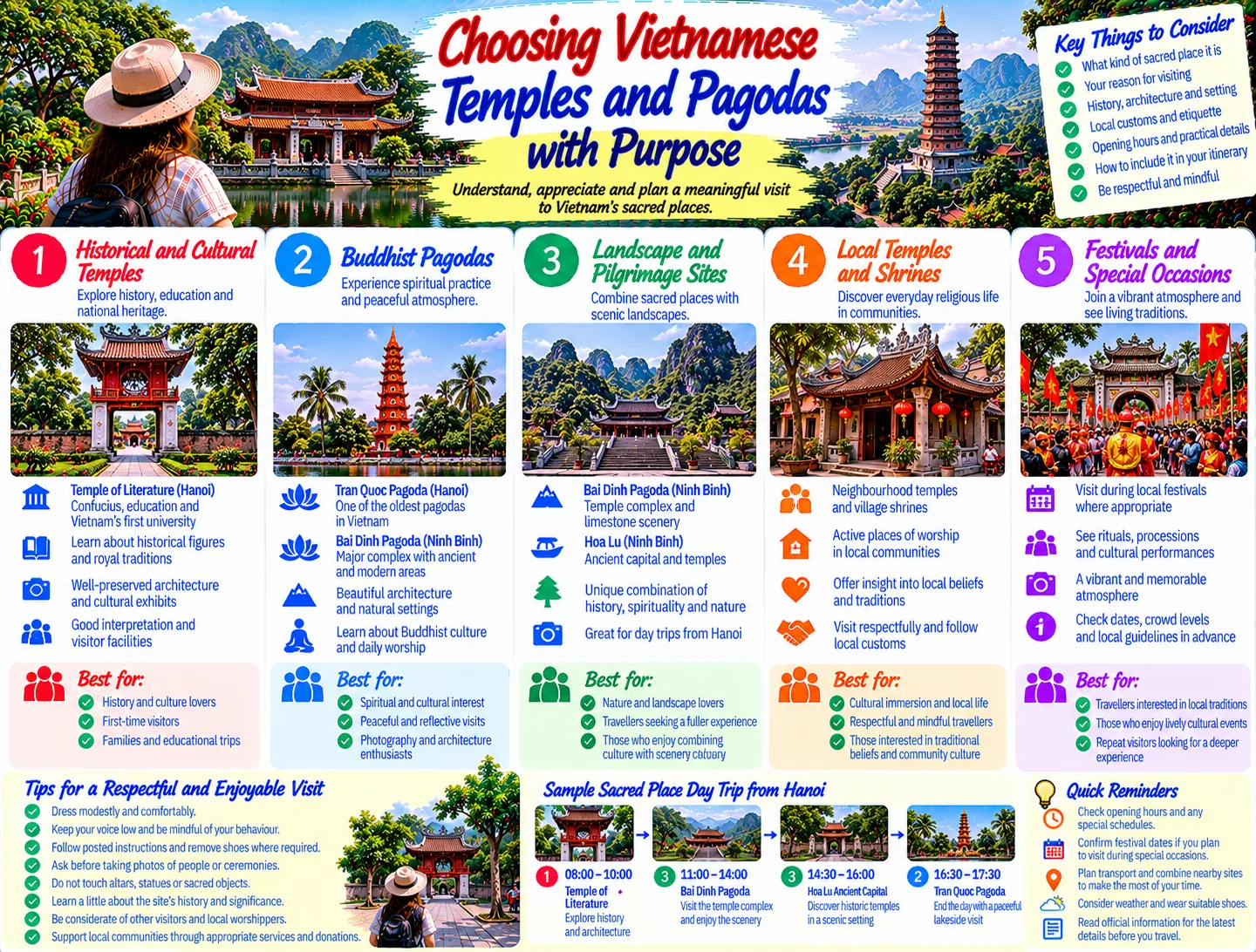
Vietnamese sacred places reward a slower kind of sightseeing. A pagoda may sit beside a busy street, a temple may preserve a royal story, and a shrine may be woven into an ordinary neighborhood. The most useful way to plan is not to collect the biggest names, but to understand what each place is for and how your visit can fit that purpose. This guide explains how to choose Vietnamese temples and pagodas, what to notice once you arrive, and how to plan a respectful route without turning spiritual sites into a checklist.
Start by knowing what kind of sacred place you are visiting
Travelers often use “temple” as a convenient umbrella term, but Vietnam’s sacred landscape is more varied. A pagoda is commonly associated with Buddhist practice, while a temple may honor a historical figure, a local guardian, a royal ancestor, or a religious tradition. Smaller shrines can be deeply meaningful to a community even when they are absent from guidebooks. The distinction is not always tidy, and names translated into English may flatten local meanings.
This matters because the atmosphere and visitor expectations can differ. A large tourist destination may have formal entrances, interpretation, and a steady flow of visitors. A neighborhood shrine may be an active place of worship first and a sightseeing stop second. Before you go, read the site’s own description where one is available, and treat the word “temple” as a starting point rather than a complete explanation.
For broader cultural context, pair this guide with Visiting Temples and Sacred Places Respectfully and the Temples & Spiritual Culture category. Those resources are useful when you want etiquette guidance; this article focuses more narrowly on choosing and reading a temple visit.
Match the destination to your reason for going
Before choosing a sacred place, name the experience you want. Are you interested in architecture, local history, Buddhist practice, quiet observation, photography, or a festival atmosphere? One destination rarely does all of these equally well. A famous complex may be excellent for understanding layers of history but less suitable for solitude. A smaller place may offer a stronger sense of everyday worship but little English-language interpretation.
For history and education
Choose a site with a clear institutional history, preserved buildings, or an interpretation area. Hanoi’s Temple of Literature is a useful example of a place that sits at the meeting point of heritage, education, and visitor experience. Its official site presents the complex as a special national relic and explains its zones, architecture, doctoral steles, exhibitions, and heritage-education activities. That makes it a good choice for travelers who want more than a quick photograph.
For landscape and pilgrimage atmosphere
Look beyond the building itself. In Ninh Binh, the official Vietnam Tourism destination page describes Bai Dinh as a major Buddhist temple complex combining older cave temples with a newer area, while the surrounding province is known for limestone mountains, waterways, and Hoa Lu’s history as an ancient capital. The setting changes how the visit feels: the sacred experience is connected to landscape, movement, and the memory of place.
For everyday community life
Choose a local shrine or modest pagoda only when you can behave as a guest rather than an observer collecting evidence. Ask your accommodation host which places welcome visitors, avoid interrupting ceremonies, and accept that a small site may have no formal visitor service. If your main goal is a polished heritage explanation, a major institution will probably serve you better.
Read the site in layers instead of rushing through it
A meaningful temple visit usually has several layers. Begin with the approach: is the entrance aligned with a street, a river, a hill, or a village path? Notice whether the site feels separated from daily life or folded into it. Then look at the threshold, courtyards, gates, trees, roofs, courtyards, and altars before trying to identify every figure or object.
Next, ask what kind of memory the place carries. A temple may preserve a story about a ruler, a scholar, a village founder, a national hero, or a local spirit. A pagoda may organize space around Buddhist images and ceremonies. A heritage complex may combine religious buildings with museums, gardens, steles, or performance areas. The official Temple of Literature website, for example, separates information about architecture, notable figures, doctoral steles, exhibitions, and visitor experiences. That structure suggests a practical reading method: connect the building to the people, ideas, and activities it has been designed to remember.
Finally, observe how people use the site now. Visitors may light incense, bow, sit quietly, make offerings, attend a ceremony, or simply pass through. You do not need to imitate a ritual to show respect. Quiet attention and physical awareness are often more appropriate than trying to perform an action whose meaning you do not understand.
Plan a respectful visit without overcomplicating it
Good temple etiquette is mostly a matter of reading the room. Wear clothing that is comfortable but not deliberately revealing, especially if you plan to enter worship spaces. Keep your voice low, silence unnecessary notifications, and follow posted instructions. If shoes must be removed, do so without making the threshold a photo opportunity. Do not climb onto altars, lean on statues, or touch objects simply because they look old.
Pause at the entrance and watch what worshippers and staff do.
Ask before photographing people, ceremonies, monks, or close-up devotional objects.
Keep food, drinks, and casual conversations outside areas where they are not appropriate.
Do not block a doorway, incense burner, offering table, or processional route.
Use a donation box or official ticket channel when you wish to contribute, rather than handing money to someone without understanding the arrangement.
Etiquette is not about pretending to be local. It is about reducing the burden your visit places on people who use the site for reasons other than tourism. For a broader approach to cultural behavior, see Everyday Vietnamese Customs Visitors Can Meet with Care.
Build an itinerary around time, energy, and atmosphere
Temple travel is often more enjoyable when you schedule fewer stops. A large complex can require more walking than its map suggests, especially when it includes gardens, steps, multiple courtyards, or a hill route. A visit planned around the site’s rhythm also leaves room for reading and quiet observation.
A half-day heritage route
Choose one substantial complex, arrive with enough time to read its visitor information, and leave a buffer for nearby streets or a museum. This works well for travelers who care about history and architecture. At the Temple of Literature, check the institution’s own visitor information before setting out because opening arrangements, ticketing, and special programs can change. Its current website publishes visitor information and describes both daytime access and selected evening programming; treat those details as time-sensitive rather than assuming they apply on every date.
A landscape-led day
In Ninh Binh, combine a sacred destination with the wider landscape instead of treating a temple as an isolated photo stop. The official tourism page frames the province through karst scenery, waterways, Hoa Lu, and Bai Dinh. That supports a slower plan with one main cultural anchor and enough time for the terrain, rather than an ambitious list of distant sites.
A neighborhood discovery
For a smaller pagoda or shrine, keep the route flexible. Visit during daylight, avoid turning a quiet lane into a staging area, and be prepared to leave if a ceremony or private activity is underway. The absence of a queue does not mean the place is open for unrestricted exploration.
Use seasons and events thoughtfully
Religious sites can feel very different on an ordinary weekday, a weekend, or a festival day. A festival may offer music, processions, offerings, and a strong sense of communal identity, but it can also mean crowds, restricted movement, and limited access to inner spaces. If you want to witness an event, confirm the date and visitor expectations with an official organizer or local authority before traveling. Do not present a remembered festival calendar as current.
For a quieter visit, choose a time when you can move without competing with ceremonies or large tour groups. Early starts can help with heat and crowds, but opening times vary, so verify them with the destination’s official channel. Weather also affects outdoor complexes: heat, rain, slippery steps, and humidity can change how much of a hill or garden route is realistic.
Travelers who want to connect sacred places with wider heritage can also browse Historical Sites & Heritage and read How to Read Vietnam’s Historic Places Beyond the Plaque. The key is to let the site’s own history shape the day, rather than forcing every place into the same sightseeing template.
Choose what to notice, photograph, and remember
Photography is easiest when it follows attention instead of replacing it. Look for relationships: how a roof frames a tree, how a courtyard directs movement, how a modern visitor facility sits beside an older structure, or how worshippers use space differently from tourists. These observations are more durable than a collection of isolated facade shots.
Ask yourself three questions as you leave. What story does the site tell about the community or period that created it? What practices are continuing today? What did you not understand well enough to photograph or describe? The last question is valuable because it keeps curiosity open. A respectful visitor does not need to leave with a complete explanation.
A simple decision framework for your next temple visit
If you have one free morning, choose the site with the clearest official visitor information and the strongest fit for your interest. If you have a full day, pair one major heritage complex with a slower neighborhood or landscape experience, but avoid stacking several distant destinations. If you are traveling with children or older relatives, prioritize shade, seating, accessible paths, and realistic walking distances after checking current details. If you are visiting during a festival, make the event the purpose of the day and accept that ordinary sightseeing may be secondary.
Most importantly, select a place whose meaning you are willing to approach with patience. Vietnam’s temples, pagodas, and shrines are not interchangeable backdrops. They are living cultural spaces, historic records, and community places at the same time.
Conclusion: let the place set the pace
The best Vietnamese temple visits are not measured by how many gates you pass or how quickly you identify every statue. They come from choosing a destination that matches your curiosity, checking current visitor information, moving carefully through worship spaces, and allowing the site’s history and present-day use to remain visible together. Plan less, notice more, and leave room for the possibility that the most meaningful part of the visit will be something a guidebook could not have listed. That patience is part of the experience, not time lost from it, or a distraction from understanding.
JOIN THE CONVERSATION
Comments (0)
No comments yet. Be the first to share a thought.