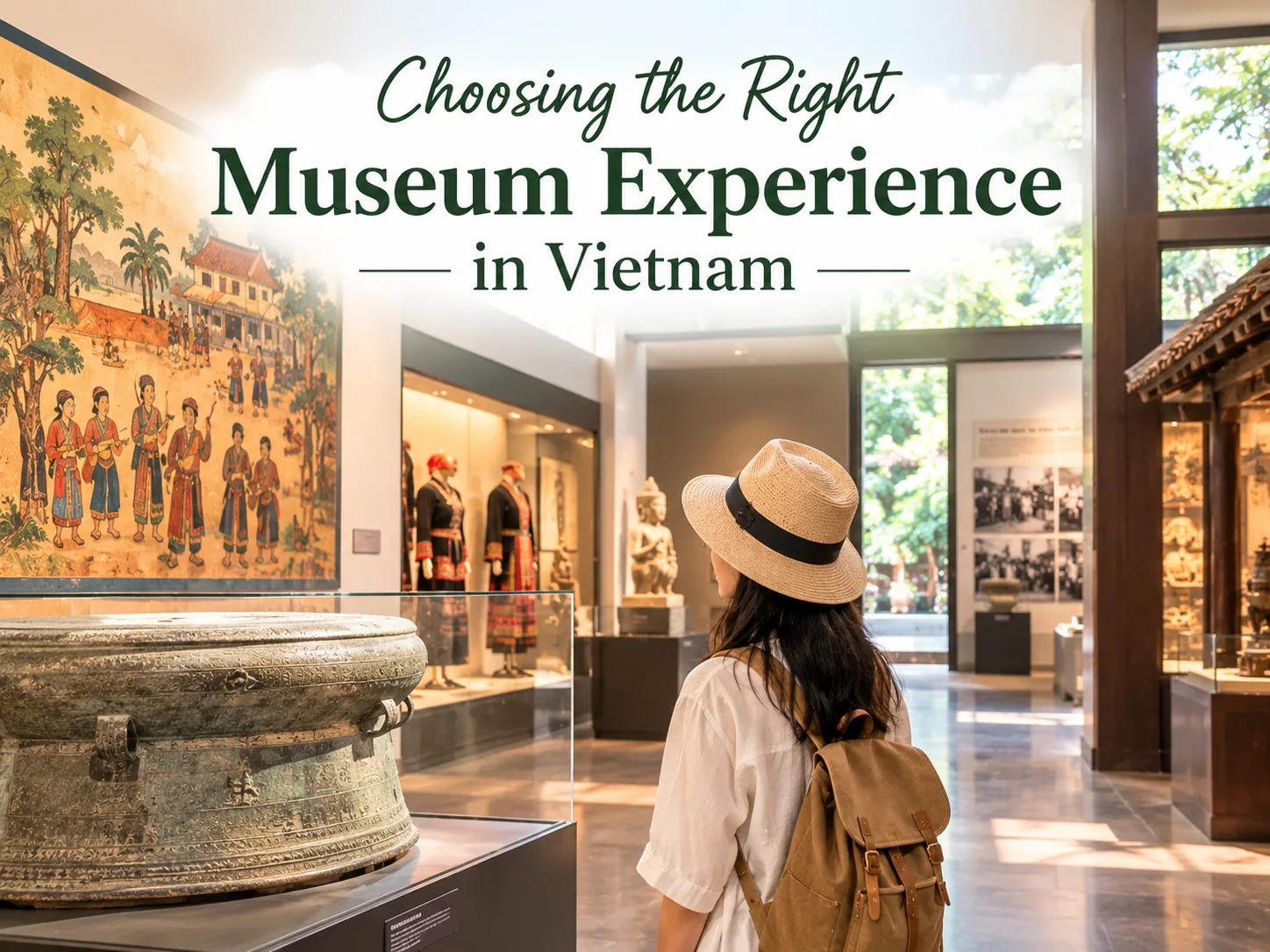
Vietnam museums are not all designed for the same kind of visit. Some are compact collections you can read closely in an hour; others combine indoor galleries, outdoor architecture, living demonstrations, or changing exhibitions. The best museum itinerary in Vietnam therefore starts with a question: what do you want to understand, and how much attention do you have for it? This guide helps you choose a museum experience by theme, pace, and travel style, while leaving room for respectful observation rather than rushing from one display to the next.
Start with the kind of story you want to follow
“Museum in Vietnam” is a broad search because the country’s collections range from archaeology and fine art to ethnology, wartime history, traditional craft, and contemporary culture. Before choosing a venue, decide whether you want a chronological story, a visual experience, or a closer look at everyday life.
For cultural diversity: look for ethnology museums that connect objects with communities, languages, houses, clothing, rituals, and foodways.
For art: choose a fine arts museum where painting, sculpture, ceramics, lacquer, silk, and folk art can be considered as visual traditions rather than isolated souvenirs.
For historical context: prioritize museums that organize primary objects, documents, and timelines around a period or national story.
For a family visit: check whether the venue offers educational rooms, demonstrations, outdoor space, or interactive activities rather than assuming every gallery will suit young children.
This approach makes your visit more focused. It also complements the site’s guide to making a more curious visit to Vietnam’s museums, which is useful when you want to slow down and ask better questions of a collection.
Match the museum to your travel pace
If you have one free hour
Choose one clearly bounded theme and resist the urge to cover an entire institution. Read the introductory panel, select a small group of objects, and compare how they use material, scale, color, or craftsmanship. A short visit can still be meaningful if you leave with one connection you can explain in your own words.
If you have half a day
Pair a main exhibition with one complementary section. For example, a visitor interested in Vietnamese art might compare a historical gallery with a display of applied art or ceramics. A visitor interested in communities might combine indoor interpretation with an outdoor architectural area, where the relationship between object and environment becomes easier to see.
If museums are the purpose of the day
Plan a sequence with contrast rather than three similar collections. An art museum in the morning, a cultural history museum after lunch, and a smaller specialist venue later can work better than trying to absorb several dense chronological displays back to back. Leave time for food, walking, and conversation; attention is part of the itinerary.
For a wider framework, browse the Cultural Travel Experiences category and consider how a museum day fits with the rest of your cultural travel rather than treating it as a checklist.
What to expect at a Vietnamese ethnology museum
The Vietnam Museum of Ethnology in Hanoi is a useful example of a museum that links objects to the lives and histories of Vietnam’s many communities. Its official visitor information lists hours of operation as 8:30–17:30 every day except Mondays and the New Year holiday, and gives its address on Nguyen Van Huyen Street in Nghia Do, Hanoi. The same page describes permanent, temporary, and virtual exhibitions, as well as educational activities and outdoor-oriented learning possibilities. Because hours, fees, and programs can change, check the museum’s own visitor page close to your visit rather than relying on an old guide.
When you visit an ethnology museum, avoid reducing communities to colorful objects. Ask what an item was used for, who made it, what materials were available, and whether the display explains a local name or social setting. Houses, textiles, tools, musical instruments, and ritual objects become more intelligible when you look for relationships between them. A good visit may leave you with questions about language, migration, family structure, or adaptation to landscape.
The site’s guide to ethnic diversity in Northern Vietnam can help you arrive with a broader cultural vocabulary, while the Ethnic Minority Cultures category offers a natural next step after the museum.
How to approach a fine arts museum
A fine arts museum rewards looking slowly. The Vietnam National Fine Arts Museum’s official website currently lists visiting hours as 8:30–17:00, Tuesday through Sunday, and gives its address as 66 Nguyen Thai Hoc in Hanoi. Its public displays include Vietnamese art from prehistory and early history through later periods and the present day, along with traditional applied art, folk art, ceramics, and named collections such as lacquer, oil, silk, paper, and folk paintings. The museum also states that its displays include approximately 2,000 special objects and artworks, while its wider collections hold around 20,000 objects and artworks.
Use those categories as a viewing method, not as a demand to see everything. Compare how lacquer creates depth differently from silk or paper; notice whether a work emphasizes narrative, symbolism, portraiture, landscape, or abstraction; and look at the relationship between technique and the period in which the work was made. If labels are brief, write down the artist, date, medium, and one visual detail. That small habit gives you a way to continue learning after you leave.
Check the official site for current exhibitions before going. A temporary exhibition may change your route through the building, and a three-dimensional tour or online exhibition can help you preview the institution when your travel schedule is tight.
Choose museums by the questions they help answer
Search results often emphasize famous names, but a better museum decision comes from the question behind your trip. Consider these starting points:
How has Vietnam represented itself? Look for national collections, historical displays, and exhibitions that make chronology visible.
How do materials carry memory? Fine arts, ceramics, lacquer, textiles, and craft collections can reveal technique as well as aesthetics.
How does place shape culture? Ethnology museums and local cultural centers can connect houses, tools, clothing, agriculture, and belief to geography.
How are difficult histories presented? Read captions carefully, notice whose voices are quoted, and allow time for a serious subject rather than treating the museum as a quick stop.
What is changing now? Contemporary galleries, temporary exhibitions, talks, and education programs may show how tradition is interpreted in the present.
This question-led approach is especially helpful for visitors who do not want a generic “top museums” list. It also makes it easier to choose one institution in Hanoi, Ho Chi Minh City, Hue, or another destination without assuming that the most famous venue is automatically the best fit for your interests.
Plan a respectful and practical museum visit
Before you go
Open the institution’s official website and confirm the current opening pattern, address, ticket information, exhibition notices, and any photography or bag guidance. Do not assume that a museum is open every day, that a past exhibition is still running, or that a price seen in an old article remains current. If the website is unclear, contact the venue directly or ask your accommodation to help verify the detail.
While you are inside
Follow posted instructions, keep your voice low in galleries, and ask before photographing people, performances, demonstrations, or culturally sensitive objects. Do not touch works unless the museum explicitly invites interaction. When an exhibition presents a community or living tradition, avoid turning people into background scenery; observe first and photograph only when the context and permission are clear.
For families and mixed-interest groups
Give each person a small task: find a repeated motif, choose one object made from an unfamiliar material, or sketch a shape without copying the whole display. Older children can compare two labels and ask what information is missing. Adults can take turns explaining one object without reading every panel aloud. These simple activities make a museum feel participatory without requiring a special worksheet or a hurried race through the galleries.
If your group wants to continue learning through making, the Cultural Workshops category can help connect museum observation with hands-on cultural experiences. For performances or demonstrations, the Traditional Arts & Performances category offers another route into living traditions.
Build a museum day that leaves room for reflection
A strong museum itinerary has a beginning, middle, and pause. Start with a venue that gives you the context you need. Take a break before a second collection, especially if the first visit dealt with war, loss, displacement, or other demanding subjects. End with a less dense activity: a walk, a quiet coffee, a craft neighborhood, or a conversation about the object everyone remembered.
Keep notes that are useful rather than exhaustive. Record three things: one object, one idea, and one question. Later, those notes can guide a visit to a historic site, temple, workshop, or festival. The goal is not to prove that you saw enough museums; it is to let a collection change how you notice the country around you.
Conclusion: choose attention over quantity
The best museum in Vietnam is the one whose story matches your curiosity and whose scale matches your available attention. Use official visitor information for current logistics, choose a clear theme, and give yourself permission to see fewer objects more carefully. Whether you spend an hour with Vietnamese art, half a day exploring cultural diversity, or a full day comparing collections, a thoughtful museum visit can become one of the most memorable ways to understand Vietnam.
Make the visit useful after you leave
A museum becomes more valuable when it changes the way you read the rest of a trip. After seeing a collection of textiles, notice material and pattern in a market or workshop. After studying lacquer or ceramics, look at how surfaces catch light in a temple, home, or shop. After learning about regional communities, listen for the names of places and products that appear in later conversations. This is not about turning every encounter into a lesson; it is about allowing museum knowledge to remain connected to daily life.
You can also revisit the museum’s own resources. Official sites may provide virtual exhibitions, collection pages, educational material, event announcements, or downloadable brochures. Use these resources to check a detail you missed rather than trying to photograph every label. If a display raises a question about ritual, family life, or traditional arts, continue with a relevant local guide and keep the distinction clear between what the museum states and what you are still investigating.
For travelers building a longer culture-focused itinerary, the site’s cultural trip planning guide offers a useful reminder to leave space for listening. A museum visit is not separate from that principle: it asks you to notice carefully, accept that one visit cannot explain everything, and return to the wider city with more curiosity than certainty.
JOIN THE CONVERSATION
Comments (0)
No comments yet. Be the first to share a thought.