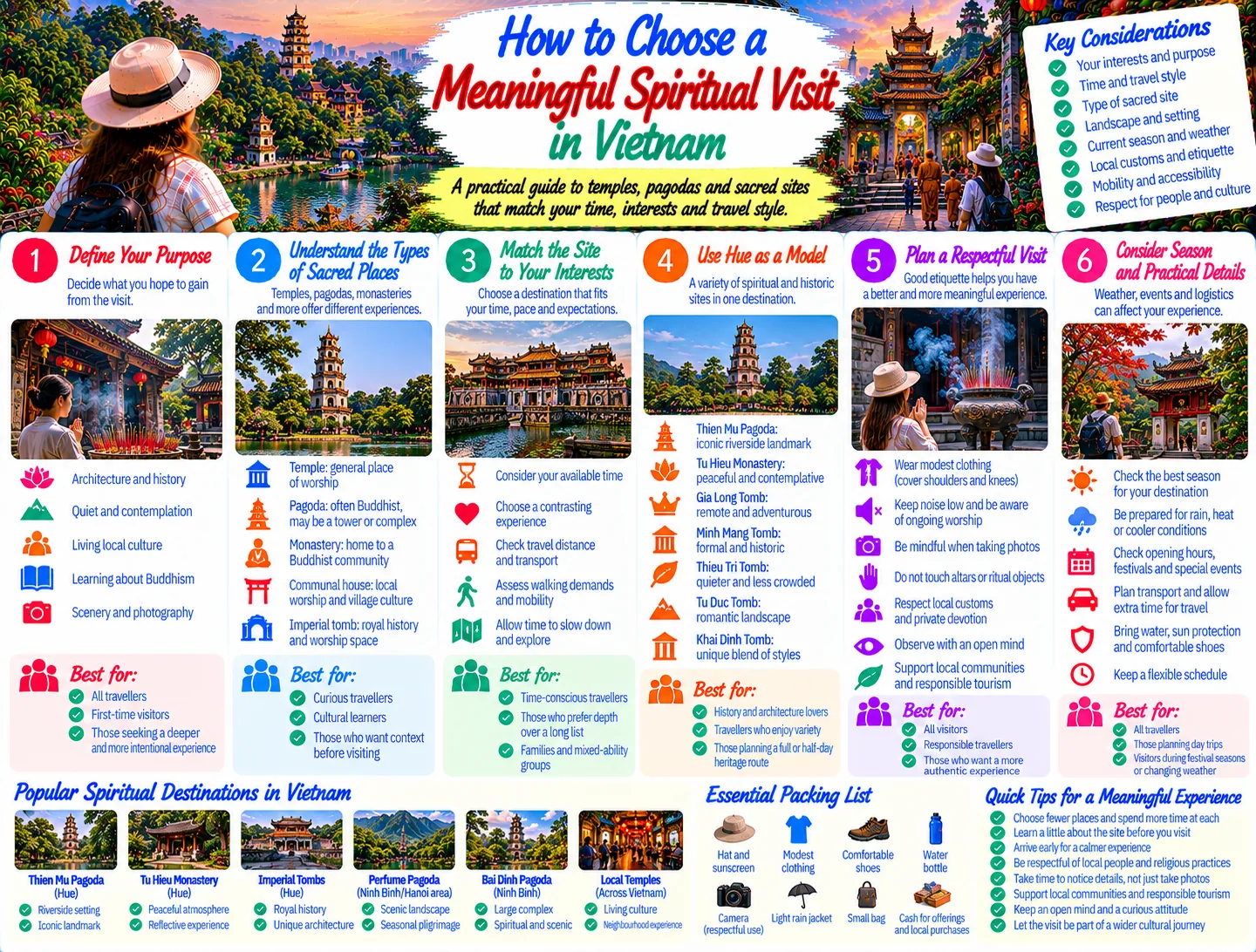
Vietnam’s temples and pagodas are not one interchangeable category of sightseeing. A riverside pagoda, a hilltop monastery, a neighborhood communal house, and an imperial tomb can each offer a different way into the country’s spiritual culture. The best visit is therefore less about collecting famous names and more about matching a place to your time, interests, mobility, and willingness to observe quietly.
This guide explains how to plan a Vietnam temple visit with more intention. It covers the difference between types of sacred places, how to choose a destination, what to notice once you arrive, and how to behave respectfully. For a wider approach to cultural travel, begin with planning a cultural trip that leaves room to listen, then use the ideas below to shape a spiritual day rather than a rushed photo stop.
Start by choosing the kind of spiritual experience you want
Before searching for the “best temple in Vietnam,” decide what you hope the visit will give you. Sacred places may be connected with Buddhist practice, local village life, royal history, ancestor remembrance, or a landscape that encourages stillness. Those purposes overlap, but they do not feel the same on the ground.
For architecture and layered history
Choose a temple or pagoda that sits within a historic city or heritage landscape. Hue is especially useful for this kind of visit because its spiritual places sit alongside imperial structures, old streets, gardens, and the Perfume River. The official Vietnam Tourism guide describes Hue as a city of mossy pagodas and monasteries, and specifically points visitors toward Thien Mu Pagoda and Tu Hieu Monastery. In this setting, the religious site is part of a larger historical story rather than an isolated attraction.
For quiet and landscape
Look for a monastery, mountain pagoda, or rural sanctuary where the setting does some of the teaching. A longer approach can be worthwhile when you want time to slow down. The important question is not whether the place has the most elaborate gate, but whether your schedule allows you to arrive without immediately needing to leave.
For living local culture
Consider a neighborhood temple or communal religious site, but arrive with extra humility. These places may serve residents first and visitors second. You may see offerings, family prayers, or ceremonies that are meaningful to people who live nearby. Observation is appropriate; treating private devotion as a performance is not.
Understand the words: temple, pagoda, monastery, and sacred site
Travel writing often uses “temple” and “pagoda” loosely, but the distinctions can help you read a place more carefully. In everyday English, a temple may refer broadly to a place of worship. A pagoda is commonly associated with a Buddhist site and may describe a tower, a complex, or the institution around it. A monastery suggests a community of monastics, while an imperial tomb may combine a worship space with a royal burial landscape.
You do not need to master every religious term before visiting. Instead, notice what the site is asking you to do. Is it primarily a place for worship, remembrance, learning, pilgrimage, or contemplation? The answer can guide your pace and your behavior. At a monastery, quiet observation may be more fitting than constant conversation. At an active neighborhood shrine, staying out of the way of worshippers may matter more than finding the perfect photograph.
For background on reading historic places rather than simply photographing them, see how to read Vietnam’s historic places beyond the plaque. The same habit works well at sacred sites: look for relationships between buildings, landscape, ritual objects, and the people using the space.
Use Hue as a model for matching sites to your interests
Hue shows why a thoughtful spiritual itinerary should be selective. Vietnam Tourism identifies Thien Mu Pagoda as one of the city’s defining Buddhist landmarks and also highlights Tu Hieu Monastery, associated with Thich Nhat Hanh’s early life as a novice monk. These are not interchangeable stops. One is a highly recognizable pagoda connected to the city’s river landscape; the other invites a more contemplative reading of monastic life and place.
The same matching principle applies to Hue’s royal tombs. The official guide to the tombs presents them as distinct experiences: Gia Long for a more remote, adventurous setting; Minh Mang for formal history and order; Thieu Tri for a quieter, less-visited atmosphere; Tu Duc for a romantic landscape; and Khai Dinh for a striking blend of Eastern and Western influences. Although tombs are not simply temples, many include worship spaces and help explain how imperial memory, ritual, architecture, and nature intersect.
Choose by time, not by fame
If you have only half a day, choose one compact area or two nearby sites with contrasting character. If you have a full day, leave room for pauses, meals, and the possibility that one place deserves more attention than expected. The official tomb guide notes that seeing all of Hue’s tombs can require two full days, while a shorter visit is better handled by selecting the sites that fit your interests.
This is a useful rule for Vietnam temple travel more generally: fewer places, visited with attention, usually produce better cultural understanding than a long list of hurried stops.
Plan a respectful visit before you arrive
Good temple etiquette begins before the entrance. Check the location, the likely walking demands, and whether the place is an active religious community rather than a museum. Do not assume that a site photographed frequently is always prepared for crowds. If you are using a guide or driver, ask whether there are ceremonies, restricted areas, or local preferences that visitors should know about.
Wear clothing that is comfortable but not deliberately revealing, especially when entering worship spaces.
Bring a light layer or scarf so you can adjust respectfully without making the visit complicated.
Keep your voice low and silence your phone before entering a prayer hall or monastery area.
Ask before photographing people, monks, altars, ceremonies, or close-up devotional objects.
Stay on public paths and follow posted instructions rather than stepping behind barriers for a better view.
Do not touch statues, offerings, bells, tablets, or ritual objects unless a caretaker clearly invites you to do so.
Respect is not a costume that begins at the gate. It is a way of giving the site priority over your itinerary. If the space feels busy or a ritual is underway, wait at the edge, observe quietly, or return another time.
Read the setting: five details worth noticing
1. The approach
Notice how the site meets the surrounding world. Does the path move through a city, rice fields, forest, riverbank, or hillside? The approach often explains why the place was founded where it was. A quiet walk can be part of the experience, not merely transport to the “main” building.
2. The sequence of spaces
Many sacred complexes unfold gradually. Gates, courtyards, gardens, halls, towers, and rear spaces may create a rhythm from public to more private. Pause before moving through each threshold. You will often understand the site better by noticing this sequence than by memorizing dates.
3. The relationship between nature and buildings
Water, old trees, hills, lotus ponds, and shaded courtyards are not always decorative extras. In Hue, Vietnam Tourism describes the city’s pagodas and monasteries as part of a serene atmosphere shaped by the Perfume River and leafy surroundings. Ask how the architecture frames the landscape, and how the landscape softens or emphasizes the architecture.
4. Signs of living practice
Look for incense, flowers, lamps, prayer mats, food offerings, donation boxes, and the quiet movement of worshippers. These details show that the site is being used, not simply preserved. Avoid turning every devotional object into a prop for a photograph.
5. Layers of change
Restoration, weathering, newer paint, repaired roofs, and mixed architectural influences can all tell a story. A building does not become less meaningful because it has changed. In the Hue tombs, for example, the official guide points out different royal personalities and periods of cultural contact through the design of each complex.
Build a temple day around pace and practical comfort
A spiritual itinerary works best when it has breathing room. Start with one anchor site, then add only what you can reach without turning the day into a race. If the destination is outside the city, confirm the route and return plan in advance. Rural and hillside sites can involve uneven surfaces, heat, rain, or longer walking than photographs suggest.
Plan your most reflective visit for the part of the day when you can be calm. Early morning or late afternoon may feel more comfortable in warm weather, but conditions and access vary by site, so verify current details locally rather than relying on a universal rule. Carry water, protect yourself from the sun, and keep your belongings compact enough that you can move quietly through narrow spaces.
For travelers combining spiritual places with other cultural interests, the site’s wider context matters. You might pair a pagoda with a museum, craft tradition, or historic neighborhood rather than adding three more temples. The category guide to Temples & Spiritual Culture is a useful place to keep exploring related ideas, while Historical Sites & Heritage can help you connect religious buildings with broader stories of place and memory.
Choose an ethical way to photograph and share
Photography can support attention when it makes you look longer, but it can also reduce a sacred place to a backdrop. Compose around architecture, light, pathways, and landscape before turning the camera toward people. If a monk, worshipper, or family is engaged in prayer, give them space. Ask permission for portraits, and accept a refusal without making it awkward.
Be cautious with captions. Avoid presenting a rumor as fact, describing a ritual you do not understand with certainty, or labeling every statue with a generic explanation. If you are unsure, use neutral language and learn from a guide, caretaker, museum label, or reliable official source. Sharing less but more accurately is part of responsible cultural travel.
Know when a temple visit is not the right plan
Sometimes the respectful choice is to postpone. If you are exhausted, dressed unsuitably, carrying noisy equipment, or arriving during a private ceremony, you may not be ready to enter. A sacred place should not be treated as an obligation simply because it appears on an itinerary.
You can still learn from the surrounding area, return after preparing, or choose a cultural setting that better matches your energy. Travelers interested in living traditions may also enjoy the site’s guidance on everyday Vietnamese customs visitors can meet with care. That wider perspective helps keep temple etiquette connected to everyday courtesy rather than reducing it to a list of rules.
Conclusion: let the place set the pace
The most meaningful Vietnam temple visit is rarely the one with the most stops. Choose a place whose setting and history genuinely interest you, understand whether it is an active religious space, and leave enough time to notice how people use it. Hue offers a clear example: pagodas, monasteries, imperial tombs, river landscapes, and historic streets can be approached as different chapters in one cultural story. Wherever you go, arrive prepared, move gently, and let the character of the place—not the checklist—shape your day.
JOIN THE CONVERSATION
Comments (0)
No comments yet. Be the first to share a thought.